



Christopher Hailstone, a seasoned authority in energy management and utility reliability, provides a deep dive into the Philippines’ ambitious roadmap for bioethanol self-sufficiency. As the nation grapples with high production costs and an increasing reliance on imported fuels, the government is pivoting toward innovative feedstock solutions like corn and palm oil to boost local output. This discussion explores the strategic integration of idle distillery capacity, the move toward a 15% ethanol blend, and the delicate economic balance required to support both the energy sector and the local agricultural community.
Given that domestic bioethanol currently costs twice as much as imported supplies, what strategic shifts are being implemented to bridge this price gap without undermining the local economy?
The economic hurdle is significant, especially since our data shows that every small fluctuation in feedstock costs can lead to an immediate one-peso increase in ethanol prices. To address this, the Department of Agriculture and Department of Energy are collaborating to identify more affordable raw materials like corn to complement our existing sugarcane and molasses production. Secretary Francisco P. Tiu Laurel Jr. has emphasized that while we have the raw availability, the real challenge lies in ensuring a price point that makes domestic production commercially viable. By optimizing the supply chain and reducing our reliance on expensive imports, we are aiming to lower gasoline prices at the pump for every Filipino.
What role does corn play in maximizing the efficiency of current distilleries, and how do you see this changing the production timeline for renewable fuels?
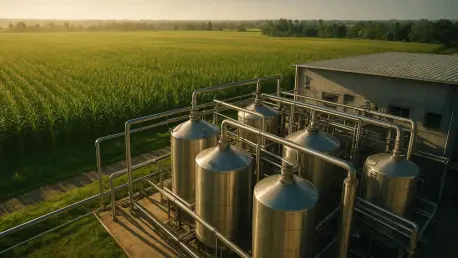
We currently have a massive gap in our infrastructure where existing distilleries have a combined capacity of over 500 million liters, yet we are only producing between 325 million and 385 million liters annually from sugarcane-derived feedstock. This idle capacity represents a lost opportunity that we are now targeting by introducing locally produced corn as a secondary feedstock, specifically for those unused facilities. Corn offers a strategic advantage because of its rapid 90 to 110-day growth cycle, allowing for much quicker turnover and more flexible responses to market demand than traditional crops. The government is backing this shift with investments in improved seeds and mechanization to ensure farmers can meet these new industrial requirements efficiently.
How are officials navigating the potential conflict between using corn for fuel and its essential role as a primary feed for the livestock industry?
This is a delicate balancing act because if the demand from ethanol producers drives corn prices too high, our livestock raisers will feel the pressure immediately. To mitigate this risk, the Department of Agriculture is looking at contract farming arrangements that provide stability for both the farmers and the bioethanol producers. Furthermore, a major benefit of using corn is the production of Distillers Dried Grains with Solubles, or DDGS, which is a high-protein by-product that can be returned to the feed industry. This circular approach helps offset the reduction in raw corn availability for animals while supporting the broader goal of diversifying our raw material base.
Beyond the current focus on corn and sugar, what long-term feedstock options are being evaluated to sustain the transition toward higher blending rates?
Looking ahead, palm oil is emerging as a strong candidate for both biodiesel and potentially sustainable aviation fuel as we move from 2026 to 2029. While palm plantations require a lead time of roughly three years to reach maturity, starting that process now is essential for a truly diversified energy portfolio. We are also in the final stages of establishing a Philippine National Standard for bioethanol, which will provide the regulatory certainty needed for these long-term investments. By broadening our scope to include diverse oils and grains, we reduce the risk of being dependent on any single agricultural commodity, ensuring a more resilient energy sector.
What is your forecast for the Philippine bioethanol industry?
I believe we are standing on the cusp of a total transformation where the Philippines moves from being a price-taker in the global ethanol market to a self-sufficient producer. Within the next few years, as we successfully transition to a 15% ethanol blend, we will likely see our domestic production finally reach that 500-million-liter capacity threshold through the integration of corn and improved sugarcane yields. This shift won’t just be about fuel; it will revitalize rural economies by creating high-value markets for farmers and reducing our vulnerability to volatile international fossil fuel prices. The synergy between the energy and agricultural sectors is the strongest it has ever been, and that collaboration is the key to our national energy security.







