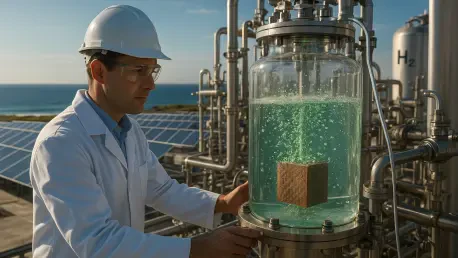

Christopher Hailstone joins us to discuss a breakthrough in green hydrogen production. With his background in utility management and grid security, he provides a unique perspective on using copper catalysts to split seawater. We explore how these dynamic materials are changing the landscape of renewable energy by replacing expensive precious metals. Our conversation covers the structural evolution of catalysts under sunlight, the impact of seawater impurities, and the logistical hurdles of scaling these systems for coastal applications.
How did you identify copper and titanium dioxide as the ideal components for this catalyst, and what specific structural changes occur at these sites when exposed to sunlight to improve charge movement?
Sunlight triggers a shift in the oxidation states of both copper and titanium sites. This is not a static arrangement; the sites alter their chemical nature as photons hit the surface. This dynamic evolution helps the catalyst become more active, facilitating the electron flow needed for splitting water. These structural shifts are the primary reason for the increased productivity we observe in the laboratory.
Could you explain the process by which copper introduces defects into the titanium dioxide framework and how these defects allow the material to utilize solar energy more effectively for hydrogen production?
Copper atoms integrate into the titanium dioxide lattice to create deliberate structural defects. These defects act as specialized pathways that move electrical charges more efficiently than a perfect crystal. By modifying the internal framework, the material absorbs solar energy more effectively across the spectrum. This transforms the TiO2 into a high-performance engine for hydrogen generation without needing platinum or other rare metals.
Given that environmental factors like sunlight intensity and reaction promoters affect long-term performance, what specific metrics are you using to measure stability, and how do you ensure consistent output under fluctuating conditions?
We monitor hydrogen evolution rates relative to sunlight intensity and various reaction promoters. Because these catalysts evolve continuously, we track how these transformations hold up under fluctuating weather. Consistency is achieved by treating the material as a system that responds to its environment rather than a static piece of hardware. Our metrics focus on the sustained efficiency of oxidation state changes throughout the entire reaction process.
How do dissolved minerals and ions in natural seawater specifically alter the interactions on the catalyst surface, and what adjustments were necessary to maintain efficiency despite these impurities?
Dissolved minerals and ions in seawater interact directly with the catalyst surface, influencing hydrogen generation. These components can significantly impact efficiency by changing the local chemical dynamics of the reaction. We found that these ions are active participants in the process rather than simple impurities. We adjusted the design to ensure the surface remains robust in complex salt environments typical of coastal regions.
Since these catalysts evolve continuously during the reaction rather than remaining static, how does this shift the way researchers should design future materials, and what are the primary challenges in controlling these structural transformations?
We are moving toward “evolutionary chemistry” where material structures are expected to change during use. The primary challenge is ensuring these transformations remain beneficial rather than leading to material degradation. If we can control how these defects shift, we can create catalysts that actually improve as they work. This requires a fundamental rethink of how we engineer long-term stability for utility-scale hydrogen systems.
What are the key technical hurdles in scaling this technology from a laboratory setting to solar photoreactor systems for coastal applications, and what is the estimated cost-benefit of replacing precious metals with copper?
The biggest hurdle is maintaining structural integrity across large-scale solar photoreactors in open environments. Replacing precious metals with copper provides a massive economic benefit by significantly lowering production costs for green fuel. This shift makes green hydrogen more feasible for large-scale utility applications in coastal regions. By eliminating expensive materials, we can finally scale this technology to meet the rising global energy demands.
What is your forecast for seawater-to-hydrogen technology?
I expect coastal energy hubs to become the primary producers of the world’s clean hydrogen fuel. Utilizing oceans and solar power allows us to move toward a decentralized, carbon-free energy model. Refined catalysts will soon provide the steady and reliable energy supply needed for industrial use. This technology is the vital bridge to making green hydrogen a globally accessible and economically feasible reality for everyone.