
A single hydraulic failure on a mountain road can instantly transform a 30-ton piece of advanced engineering into a dangerous mass of crushed fiberglass and metal. This scenario recently became a stark reality in Germany’s Black Forest, where a massive wind turbine blade destined for a mountain ridge project collapsed onto its transport convoy. The transition toward a carbon-neutral grid is frequently framed as a series of policy adjustments and digital infrastructure upgrades, yet the physical reality involves navigating gargantuan components through landscapes never designed for such loads. The incident on the L 131 mountain road near Schweighof serves as a critical case study in the intersection of high-stakes logistics and specialized heavy machinery. As onshore wind energy scales up to capture stronger winds at higher altitudes, the sheer dimensions of these blades push the boundaries of terrestrial transportation, necessitating a reliance on complex hydraulic systems that introduce unique points of failure.
The Mechanical Failure and Its Financial Impact
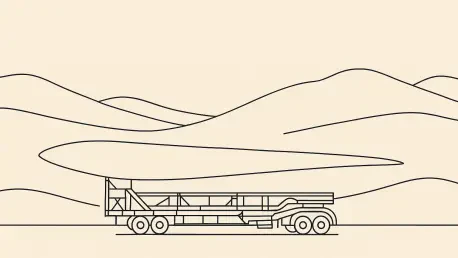
The August incident occurred when a technical defect within a specialized transporter’s hydraulic system caused a 279-foot fiberglass blade to tip over while navigating an S-curve. This 30-ton component was being moved using a specialized blade lifter, a device that allows operators to tilt the structure up to 60 degrees to avoid obstacles like trees and buildings. When the hydraulics failed, the massive weight of the blade shifted uncontrollably, crushing both the transport vehicle and the support tractor positioned ahead of it. Fortunately, despite the catastrophic nature of the collapse and the close proximity of the ground crew, no injuries were reported by the Freiburg police. However, the financial repercussions were severe, with estimated damages ranging from 700,000 to 1,000,000 euros. This figure accounts for the destruction of the high-value blade itself and the specialized machinery, which often remains out of service for extended periods while investigations proceed and repairs are made.
Clearing the wreckage proved to be an equally daunting task, requiring recovery crews to spend four days on the mountain road. Because a 279-foot blade cannot be towed or moved in one piece once it has been structurally compromised, the team had to use industrial cutting equipment to divide the fiberglass into manageable sections. This specific accident has also highlighted a significant lack of industrial oversight regarding specialized transport maneuvers. While the manufacturer and local authorities conducted a thorough review, it was revealed that no comprehensive national statistics are kept specifically for wind turbine blade transport accidents. Without a centralized database to track these failures, regulatory bodies and energy firms struggle to quantify the risks associated with modern heavy-lift technologies. This gap in data collection makes it difficult to refine safety standards or predict the likelihood of similar failures as wind farm projects move into even more rugged and inaccessible terrains.
Engineering Ambition at the Sirnitz Wind Farm
The blades lost in the Black Forest accident were intended for the Sirnitz/Dreispitz wind farm, a project that exemplifies the current trend toward massive onshore turbines. Located on a ridge at elevations reaching 3,600 feet, this facility will utilize E-175 machines, which stand among the tallest onshore structures in the world. At a total height of 819 feet, these turbines are significantly taller than the Gateway Arch in St. Louis, representing a monumental leap in mechanical engineering. The larger rotor diameter allows for increased energy capture, with the five planned turbines expected to generate a combined 35 megawatts of power. This capacity is sufficient to supply electricity to approximately 50,000 residents, illustrating why utility companies are willing to undertake such high-risk logistics. The ambition behind the Sirnitz project reflects a broader industry push to maximize efficiency per site, even if it means moving components that dwarf the very roads they must travel on.
Successfully delivering these components requires a multi-modal logistics chain that begins far from the mountain slopes. The blades typically travel via barge up the Rhine River before being unloaded at a staging yard for the final, grueling leg of the journey. Each of the five turbines requires three separate blades, meaning a total of 15 successful mountain ascents are mandatory for the project to reach completion. The logistical coordination involves local police escorts, road closures, and a constant monitoring of weather conditions to ensure that wind speeds do not interfere with the upright blades during transport. Following the collapse, the entire project was placed in a state of limbo for over a month as investigators analyzed the structural integrity of the remaining fleet. This delay not only impacted the immediate construction timeline but also highlighted how a single mechanical failure can ripple through the entire energy development schedule, postponing the date when the grid can benefit.
Regulatory Hurdles and Economic Costs
Navigating the bureaucratic landscape is often as complex as navigating the physical one, especially within the European Union’s strict regulatory framework. Any load that exceeds standard road dimensions is classified as an abnormal load, requiring specific permits and adherence to the German road traffic regulations. These permits are not merely paperwork; they involve extensive route surveys to ensure bridges can handle the weight and curves are wide enough for the transporter’s pivot points. The cost of a single blade of this size ranges from 280,000 to 450,000 euros, depending on whether it is constructed from standard fiberglass or more expensive hybrid-fiber composites. When insurance premiums and the costs of specialized transport crews are added, the financial stakes of a single trip become immense. This economic reality forces energy companies to balance the need for larger, more efficient turbines against the escalating costs and risks associated with their delivery in remote areas.
Furthermore, the long-term lifecycle of these massive components introduces additional environmental and industrial challenges that persist long after the transport phase is over. While modern blades are designed for a service life of 20 to 25 years, they remain vulnerable to environmental stresses such as rain erosion, lightning strikes, and material fatigue. When these blades eventually reach the end of their operational life or are destroyed in accidents, disposal becomes a significant problem because thermoset composites do not melt. Current recycling methods are often energy-intensive, involving mechanical grinding or pyrolysis, and many blades still end up in landfills or are processed in cement kilns as a low-grade fuel source. As the industry continues to scale up, the sheer volume of decommissioned fiberglass will require more sustainable end-of-life solutions. The push for larger turbines must be matched by a corresponding investment in material science to ensure the green transition does not leave behind unrecyclable waste.
Resuming Operations in the Black Forest
Approximately one month after the Schweighof accident, the transport of the remaining blades resumed under heightened scrutiny and revised safety protocols. The manufacturers and their logistics partners conducted exhaustive testing on the hydraulic systems of the blade lifters to ensure that the technical defect responsible for the previous failure would not recur. The resumption of activities was a calculated move, as the project aimed to maintain its momentum toward reaching operational status. During these subsequent runs, the transport teams implemented more frequent system checks and monitored hydraulic pressure with greater precision throughout the climb. The sight of the 279-foot blades pointing toward the sky once again served as a visible reminder of the inherent risks involved in modern energy projects. While the re-evaluation of the machinery provided some peace of mind, the industry acknowledged that the physical limits of mountain transport continue to pose a persistent challenge that demands constant vigilance and a commitment to engineering excellence.
To enhance future safety, industry stakeholders prioritized the development of redundant hydraulic systems and real-time monitoring sensors that could alert operators to pressure drops before a catastrophic failure occurred. Regulators suggested that implementing a centralized reporting system for transport incidents would allow for better risk assessment across the entire wind energy sector. Companies recognized that fostering a culture of transparency regarding mechanical failures was essential for improving long-term logistics reliability. Furthermore, logistics firms began exploring alternative transport routes and modular blade designs that could potentially reduce the reliance on extreme lifting angles. By investing in these technological and procedural safeguards, the industry took proactive steps to mitigate the dangers of moving massive infrastructure. Ultimately, the lessons learned from the Black Forest incident provided a framework for balancing the ambitious goals of the renewable energy transition with the fundamental necessity of public safety during every phase of the construction process.