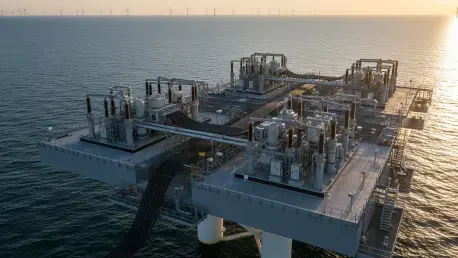

The vast expanse of the Yellow Sea now hosts one of the most ambitious engineering projects in the history of renewable energy, signaling a departure from traditional near-shore wind farming. While the world focuses on the sheer size of wind turbines, the real breakthrough lies in the submerged and floating infrastructure that bridges the gap between turbulent oceanic conditions and the stable power requirements of a modern city. The Rudong offshore converter station, a massive structure often described as an artificial electric island, functions as the central nervous system for a multi-gigawatt power network. Instead of merely generating electricity, this facility serves as a sophisticated logistics hub that collects, stabilizes, and transmits power over vast distances. By managing 1.1 gigawatts of clean electricity, the station addresses the critical bottlenecks of transmission loss and grid instability that have long plagued the offshore energy sector. It represents a paradigm shift where the focus moves from local generation to large-scale maritime energy management.
Technical Superiority: The Role of HVDC Systems
Deep-sea energy production faces a persistent physical hurdle in the form of electrical resistance, which typically drains energy as it travels through traditional alternating current lines. To overcome this, the Rudong station employs Voltage Source Converter-High Voltage Direct Current (VSC-HVDC) technology, a sophisticated method that converts energy into a more stable form for long-distance travel. By operating at a staggering ±400 kilovolts, the system ensures that electricity can traverse approximately 62 miles of undersea cable without the significant dissipation seen in standard AC systems. This technological choice is not merely an incremental improvement but a fundamental requirement for making deep-water wind farms economically and technically feasible. The conversion process at the station allows for a precise control of power flow, which is essential when integrating variable wind energy into a national grid that requires constant and predictable voltage levels to prevent outages.
The implementation of VSC-HVDC technology at the Rudong facility demonstrates a mature understanding of power electronics in harsh environments. This system allows for the independent control of active and reactive power, providing a level of flexibility that traditional transformer stations cannot match. By acting as a buffer between the fluctuating output of wind turbines and the rigid demands of the mainland grid, the converter station ensures that the energy transition does not compromise reliability. This setup effectively turns a cluster of disparate wind farms into a singular, high-capacity power plant located far beyond the horizon. The success of this project proves that distance is no longer a limiting factor for renewable energy, as the station can maintain high efficiency even when situated in deep-sea locations where wind speeds are higher and more consistent than those found closer to the coastline. This capability confirms that HVDC is the standard for the industry’s expansion into the 2026 to 2030 period.
Engineering Mastery: Building the Electric Island
Building a facility of such immense proportions required engineers to rethink the basic principles of maritime construction and installation. The Rudong converter station weighs approximately 24,250 U.S. tons, a mass that far exceeds the lifting capacity of even the largest specialized crane vessels available today. To solve this problem, engineers utilized a sophisticated floating tow method that relied on the natural physics of the ocean. This innovative approach eliminated the need for risky high-altitude lifts at sea and demonstrated that even the heaviest energy infrastructure could be safely deployed. These benchmarks are already being exceeded by newer projects, such as the Sea Wind Heart converter station, which is currently commencing operations in 2026 with a massive 2,000-megawatt capacity. This trend toward scaling up both physical size and electrical voltage shows that the Rudong project was a successful proof-of-concept for the industry’s rapid expansion into deeper waters and higher energy densities.
The durability of the station is as impressive as its installation, featuring materials and designs specifically engineered to withstand the corrosive effects of saltwater and the mechanical stress of typhoons. The structure must operate autonomously for long periods, requiring high-reliability components that can function without frequent manual intervention. Every aspect of the electric island, from its internal cooling systems to the exterior protective coatings, reflects a design philosophy focused on longevity and resilience. This technical evolution marks the transition of offshore wind from a niche pursuit into a robust industrial sector capable of operating under extreme conditions. The lessons learned during the construction and early operation phases are already informing the design of next-generation platforms. By mastering the assembly of such a complex facility in the open sea, the project has pushed the boundaries of what is possible in maritime engineering, turning the deep ocean into a viable site for heavy industrial infrastructure.
Strategic Directions: Lessons for Future Energy Grids
The successful operational history of the Rudong station demonstrated that integrated offshore grids were the most efficient way to manage remote renewable resources. In the past, the industry often relied on fragmented connections that were both costly to maintain and prone to energy loss. The shift toward centralized hubs allowed for a more streamlined approach to maritime energy, where multiple wind farms fed into a single, high-capacity transmission point. This model significantly reduced the number of undersea cables required, thereby minimizing the impact on marine ecosystems and lowering overall project costs. Engineering teams across the globe studied the Rudong project to understand how to manage large-scale power conversion in high-salinity environments. The station’s ability to maintain grid synchronization while handling fluctuating inputs from various wind farms provided a wealth of data that improved the design of subsequent projects in both the Yellow Sea and international waters alike.
To ensure the continued success of deep-sea energy, future efforts were directed toward the standardization of HVDC components and the development of more resilient undersea cable networks. Governments and private energy companies focused on creating interconnected maritime grids that allowed power to be diverted between different regions based on demand. The lessons from Rudong showed that the hardware of the transmission system was just as critical as the turbines for achieving a green grid. Expanding the use of autonomous monitoring systems and artificial intelligence optimized the performance of these remote islands, reducing the need for human presence in hazardous conditions. As the energy landscape continued to evolve, the focus shifted toward building international offshore power links, turning the ocean into a shared resource for global energy security. The path forward involved refining these massive converter stations to serve as the backbone of a truly global, carbon-neutral electricity supply.