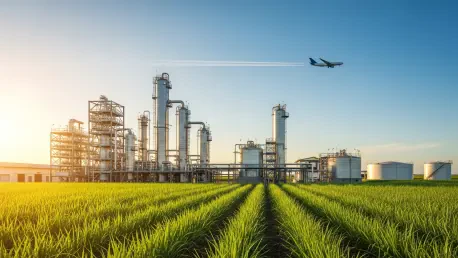

Christopher Hailstone joins us today, bringing his deep-seated knowledge of energy management and grid security to a pressing global challenge: the decarbonization of the skies. With the aviation industry racing toward a net-zero future, the focus has shifted from experimental flight to the massive industrial scale-up of fuel production. We are exploring how Brazil, leveraging its agricultural heritage and world-renowned sugarcane ethanol industry, stands to become the central nervous system of the global sustainable aviation fuel market. Throughout our discussion, we examine the staggering production targets required by mid-century, the technological pathways converting biomass into jet fuel, and the regulatory frameworks necessary to turn this potential into a transformative economic reality.
As the global aviation sector sets its sights on reaching 500 million tonnes of sustainable fuel annually by 2050, how does Brazil’s existing agricultural framework allow it to meet such a staggering demand?
Brazil is not just a participant in this transition; it is a frontrunner because it has already mastered the art of large-scale bioenergy over several decades. By mid-century, the nation is expected to tap into nearly 180 million tonnes of biomass feedstock, which could translate into a massive 60 million tonnes of sustainable aviation fuel (SAF). Walking through the vast, sun-drenched sugarcane fields, you can almost sense the potential energy that will eventually power long-haul flights across the Atlantic. This isn’t just about farming; it’s about a sophisticated agricultural machine that provides a unique combination of abundant resources and a clean energy system, giving Brazil an unmatched head start in the race to net-zero.
Looking at the more immediate horizon, specifically the year 2030, what role do you see sugarcane ethanol and other feedstocks playing in the transition away from traditional jet fuels?
By 2030, we are looking at a critical pivot point where sustainably produced sugarcane ethanol, along with vegetable and used cooking oils, will generate roughly 18 million tonnes of feedstock. This volume is projected to produce nearly 12 million tonnes of SAF, a figure that is a staggering five times larger than the total global production we anticipate seeing as early as 2026. This represents a seismic shift in how we think about energy security for airlines, moving from a reliance on volatile fossil markets to a more stable, soil-driven supply chain. The sheer scale of these numbers highlights that Brazil isn’t just filling a niche; it is building the foundation for a whole new global commodity market that could redefine international trade.
With approximately 15 major sustainable aviation fuel projects currently under development in Brazil, how will this burgeoning infrastructure reshape the country’s industrial landscape?
Those 15 projects are the physical manifestation of a massive economic transition, aiming to add approximately 2 million tonnes of annual SAF production capacity once they are fully operational. We are seeing a sophisticated blend of existing refining infrastructure and new, cutting-edge technologies that can convert ethanol directly into high-grade aviation fuel. It is a multi-layered approach where Brazil’s clean energy grid provides the backbone for a logistics network that could serve both a hungry domestic market and high-demand international hubs. The feeling on the ground is one of intense industrial renewal, where traditional sugarcane processing is being upgraded into a high-tech export engine that can compete with any energy producer on the world stage.
Beyond the physical production, what are the most critical policy shifts and economic investments needed to ensure that Brazil’s bioenergy potential translates into long-term global leadership?
To truly unlock this potential, we need to see a rigorous alignment with international standards like CORSIA and the implementation of robust SAF certificate trading systems. It is absolutely vital that we build out sufficient production capacity before we start introducing mandatory blending requirements, ensuring the market is stable enough to handle the transition without price shocks. Investors need to see a clear, supportive regulatory environment that rewards sustainability and provides the complex financing necessary for these multi-billion-dollar facilities. Without this policy “glue” to hold the sectors together, even the best feedstock resources will remain stranded, so the focus must remain on creating a transparent, globally-recognized framework for international trade.
What is your forecast for the role of Brazilian bioenergy in the global aviation sector over the next two decades?
My forecast is that Brazil will evolve from an agricultural giant into the dominant global “refining hub” for the skies, likely providing a double-digit percentage of the world’s total SAF requirements. As the industry scales, we will see the 12 million tonnes of SAF projected for 2030 become the baseline for an even more aggressive expansion as ethanol-to-jet technologies mature and attract more global capital. The emotional weight of this transition cannot be overstated; we are witnessing the birth of a cleaner era for travel where the fuel in our planes starts in the rich soil of the tropics rather than the depths of a drill site. Ultimately, Brazil’s ability to marry its clean energy grid with its massive biomass reserves will make it the indispensable partner for every major airline striving for a carbon-neutral future.