
Deep in the heart of Bahia’s Recôncavo region, the vibrant green of the macaúba palm forests is becoming a symbol of a deep-seated struggle between international climate ambitions and the ancestral rights of local communities. As global industries scramble to meet aggressive decarbonization targets, Acelen—a major energy player backed by significant capital from the United Arab Emirates—is transforming this landscape into a massive industrial hub for sustainable aviation fuel and renewable diesel. While the initiative is championed as a cornerstone of the global green energy transition, the reality on the ground reflects a more complex and troubling narrative involving eighteen Quilombola communities and numerous traditional fishing villages. These groups allege that the rapid expansion of biofuel monocultures has led to restricted land access, severe environmental degradation, and a startling lack of transparency from both the company and the state. What was originally presented as a solution for a cleaner future has instead become a high-stakes human rights flashpoint, exposing the friction between corporate efficiency and the preservation of traditional ways of life in rural Brazil.
Financial Architecture and Industrial Strategy
The Capital Powering the Biofuel Shift: Global Financial Backing
The financial architecture supporting Acelen’s biofuel ambitions is as vast as the plantations themselves, anchored by a BRL 7 billion investment strategy that has mobilized some of the world’s most influential lending institutions. This massive influx of capital, provided by a consortium including HSBC, the International Finance Corporation, and Brazil’s national development bank BNDES, has allowed the company to accelerate its pivot from traditional petroleum refining toward a sustainable energy model. By securing these funds, the project has solidified its position as a primary supplier for international markets, particularly in Europe and North America, where approximately 90% of the future production of sustainable aviation fuel has already been locked in through long-term pre-sale agreements.
This strategic prioritization of global exports ensures that the economic viability of the project remains high, even as local tensions rise. The involvement of multilateral organizations like the IFC was intended to provide a veneer of social and environmental responsibility, yet critics argue that the speed of the investment has outpaced the implementation of necessary safeguards. For the financial backers, the project represents a lucrative entry into the carbon credit market and the burgeoning green diesel sector. However, for the residents of Bahia, this capital represents a powerful force that is rapidly reconfiguring their territory to meet the energy demands of distant nations, often at the expense of local socio-economic stability and territorial sovereignty.
Diversification and the Macaúba Model: Industrial Scale Monoculture
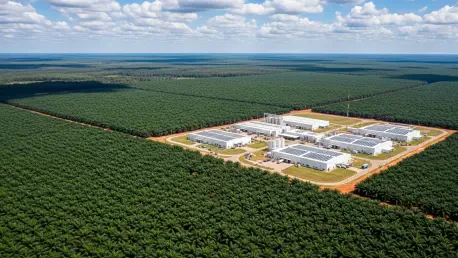
Acelen’s strategy represents a significant shift from its origins as the operator of the Mataripe Refinery, moving away from fossil fuels toward a business model centered on the industrial-scale cultivation of the macaúba palm. This native Brazilian species was selected for its extraordinary energy density, with the capacity to yield significantly more oil per hectare than traditional biofuel crops like soybeans. The company’s vision involves creating a seamless supply chain that integrates high-tech agricultural production with advanced refining capabilities. This transition is not merely a technical upgrade but a fundamental change in land use, as vast swaths of the Recôncavo region are being converted into monoculture plantations designed to maximize oil extraction for the 2026 to 2029 production cycle.
The introduction of industrial agriculture into a landscape traditionally managed by Afro-Brazilian descendants has created immediate friction. While macaúba is a native plant, its cultivation at this scale requires intensive management and infrastructure that often conflicts with the subsistence farming and gathering practices of the Quilombola people. Corporate efficiency dictates a level of control over the land that leaves little room for the fluid, communal land use patterns that have defined the region for generations. This clash of models highlights a broader debate about the nature of the “green” transition, questioning whether replacing one form of industrial extraction with another can truly be considered sustainable if it displaces the very populations that have historically protected these ecosystems.
Territorial Disruption and Infrastructure Impact
Encroachment on Quilombola Traditions: Barriers to Ancestral Lands
For the Quilombola residents in the municipality of Cachoeira, the expansion of the macaúba project has manifested as a physical and symbolic partitioning of their ancestral territory. Families who have lived on these lands for generations now report the sudden appearance of wire fences and warning signs that prohibit trespassing on what the company claims as its operational zones. These barriers have cut off traditional paths used for gathering wild fruits, medicinal herbs, and raw materials essential for local handicrafts. The restriction of movement does more than just hinder economic activity; it severes the spiritual and cultural connection that these communities maintain with the forest, which is central to their identity and collective survival.
Community leaders have voiced deep concerns that the enclosure of these lands is the first step toward a more permanent displacement. The psychological impact of being treated as intruders on their own soil has fostered a climate of fear and resentment. Furthermore, the lack of clear communication regarding the exact boundaries of the company’s holdings has led to confusion and accidental confrontations between residents and private security teams. This territorial encroachment represents a significant disruption to the social fabric of the Quilombola communities, as the collective management of natural resources is replaced by rigid, exclusionary property rights that favor industrial expansion over the basic human right to traditional land use.
The Degradation of Public Infrastructure: Industrial Toll on Local Routes
The physical impact of the biofuel project extends well beyond the boundaries of the plantations, placing an unprecedented strain on the local transportation network that serves rural Bahia. Heavy industrial traffic, including constant convoys of company trucks and machinery, has led to the rapid deterioration of essential routes such as the BA-880. Residents have documented a surge in potholes, structural cracks, and general road erosion that makes daily travel hazardous for small passenger vehicles and school buses. This damage to public infrastructure has created a significant barrier for locals trying to access healthcare facilities in nearby cities or transport their own small-scale agricultural goods to regional markets.
While the project promises modernization, the current reality for many villagers is a decline in their quality of life due to this crumbling infrastructure. The heavy dust kicked up by the industrial convoys also presents a growing public health concern, particularly for children and the elderly living in houses adjacent to the main transport corridors. Despite numerous complaints filed with local authorities, the pace of road repairs has failed to keep up with the rate of destruction caused by the project’s logistics. This situation illustrates a common theme in large-scale industrial developments where the public bears the cost of infrastructure wear and tear while the private entity reaps the benefits of the operational efficiency provided by those very roads.
Legal Accountability and Consultation Failures
Breaches of International Human Rights Protocols: Consultation Lapses
A central legal grievance against the Acelen project involves the alleged failure to adhere to the International Labour Organization’s Convention 169, which provides a framework for the protection of indigenous and traditional peoples. This international treaty, to which Brazil is a signatory, mandates that communities must be granted “Free, Prior, and Informed Consultation” before any project that could affect their lands or livelihoods is approved. Academic experts and community advocates have compiled evidence suggesting that the dialogue sessions organized by the company were often superficial or conducted in locations that were inaccessible to the most vulnerable members of the affected populations. This lack of genuine engagement has left many residents feeling that their voices were ignored in favor of a predetermined industrial timeline.
The failure to conduct a proper consultation process is not merely a procedural oversight but a significant breach of international human rights standards. Many Quilombola residents reported that they only learned about the full scale of the project after construction and planting had already begun, precluding any opportunity to negotiate safeguards or alternative arrangements. By bypassing the spirit of Convention 169, the project has undermined its own social license to operate. The absence of a transparent and inclusive decision-making process has reinforced the power imbalance between a multi-billion dollar corporation and marginalized rural communities, leading to a legal and ethical crisis that threatens the long-term stability of the green energy initiative.
Investigations by the Federal Public Prosecutor: Seeking Judicial Oversight
In response to the growing outcry from civil society and community leaders, the Brazilian Federal Public Prosecutor’s Office has launched formal inquiries into the procedural lapses and social impacts of the Acelen venture. Prosecutors are specifically focusing on the vulnerability of traditional populations who lack formal land titles, a common issue in rural Brazil that makes these groups easy targets for displacement as land values rise. The investigation aims to determine if the state regulatory bodies were negligent in their oversight duties and if the company knowingly exploited the legal ambiguities surrounding Quilombola territories. These legal proceedings represent a critical attempt to bring accountability to a project that has moved forward with minimal public scrutiny.
The judicial intervention is also looking into the long-term social consequences of the project, including the risk of permanent displacement and the loss of cultural heritage. Federal prosecutors have emphasized that the pursuit of environmental goals cannot serve as a justification for the violation of constitutional rights. As the investigation progresses through 2026 and 2027, it may lead to court-ordered pauses in production or the requirement for significant compensation and land restoration. This legal scrutiny serves as a vital check on corporate power, ensuring that the “green” label is not used to mask the marginalization of Brazil’s traditional peoples and that the rule of law is applied equally, regardless of the economic interests at stake.
Environmental Oversight and Speculative Risks
Risks of Simplified Licensing: Oversight and Self-Declaration
Environmental advocates have raised red flags regarding the “Special Licensing Procedure” granted to Acelen, a streamlined regulatory pathway that relies heavily on corporate self-declarations rather than rigorous independent assessments. This simplified process was designed to expedite the transition to renewable energy, but critics argue that it lacks the necessary checks to prevent significant ecological harm. Investigative teams on the ground have already observed evidence of unauthorized vegetation clearing near project sites, which contradicts the company’s claims of adhering to strict non-deforestation policies. The reliance on the company’s own data for environmental compliance creates a clear conflict of interest and leaves the local ecosystem vulnerable to unmonitored degradation.
The lack of robust, third-party oversight is particularly concerning given the scale of the macaúba plantations and their proximity to sensitive water sources. Without comprehensive environmental impact studies that account for the unique biodiversity of the Recôncavo region, there is a high risk of long-term damage to soil quality and local aquifers. The streamlined licensing approach also sets a worrying precedent for future industrial projects, suggesting that environmental protection can be compromised for the sake of speed and economic growth. For the communities that depend on the health of the land for their survival, this regulatory leniency is seen as a direct threat to their future and a betrayal of the state’s responsibility to protect the natural environment.
Indirect Speculation and Biodiversity Loss: The Ripple Effect
The Chico Mendes Institute for Biodiversity Conservation has identified a troubling trend of “indirect land speculation” triggered by the massive industrial footprint of the Acelen project. As the demand for macaúba cultivation sites grows, third-party landowners in the surrounding areas are increasingly clearing native Atlantic Forest vegetation to make their plots more attractive for future leasing agreements with the company. While Acelen may not be directly performing these clearings, its presence creates a powerful economic incentive for environmental destruction in the broader region. This ripple effect suggests that the total environmental cost of the project is much higher than what is documented in official reports, as it drives a cycle of land grabbing and habitat loss.
This phenomenon of indirect deforestation poses a severe threat to the remaining fragments of the Atlantic Forest, one of the most biodiverse and endangered biomes on the planet. The speculative clearing of land not only destroys vital habitats for endemic species but also disrupts local climate patterns and water cycles. Environmentalists argue that the company must take responsibility for the entire ecological impact of its supply chain, including the speculative actions of potential partners. The current lack of accountability for these indirect impacts highlights a major flaw in the green fuel model, where the carbon benefits of the fuel may be offset by the carbon emissions and biodiversity loss caused by the land-use changes it inspires throughout the region.
Coastal Ecosystems and the Labor Mismatch
Threats to Traditional Fisheries: Protecting the Bay’s Resources
The construction of the biorefinery in São Francisco do Conde has placed the fragile ecosystems of Todos os Santos Bay at significant risk, threatening the livelihoods of nine fishing and shellfish-harvesting communities. These populations depend entirely on the health of the coastal waters and the remaining patches of Atlantic Forest that buffer the shoreline. The clearing of land for the industrial facility has already led to concerns about increased sedimentation and pollution entering the bay, which could decimate the local fish and mollusk populations. Having survived previous oil spills and industrial accidents from the nearby legacy refinery, the fishers harbor a deep-seated and well-founded distrust of new large-scale operations in their backyard.
For the residents of these coastal villages, the environmental stakes are an existential matter, as their entire culture and economy are built around the sea. They fear that the “green” refinery will replicate the toxic legacy of the petroleum industry, further marginalizing those who have lived in harmony with the bay for centuries. The lack of adequate environmental safeguards for the marine environment is a major point of contention, with local leaders calling for more stringent monitoring and the establishment of exclusion zones to protect traditional fishing grounds. The tension in the bay illustrates the direct conflict between the industrialization of the coast and the preservation of traditional maritime livelihoods that are inherently more sustainable than the high-tech fuel production slated to replace them.
The Paradox of Productive Inclusion: Skills and Employment Gaps
Acelen’s promises of “productive inclusion” and the creation of thousands of local jobs have been met with profound skepticism due to a glaring mismatch between the technical requirements of the project and the skills of the local workforce. The company primarily recruits for specialized roles such as chemical engineers, industrial technicians, and specialized agronomists, positions for which the majority of the local population—largely composed of fishers and manual laborers—is not qualified. This disconnect means that the high-paying jobs and economic benefits of the green transition are likely to go to outsiders, while the local residents are left with the lowest-level manual labor or, worse, no employment at all.
This paradox of productive inclusion reveals that the social benefits of the green economy are not automatically distributed to the most affected communities. Instead of a pathway to prosperity, the project has created a scenario where locals bear the environmental and social costs while the economic rewards flow elsewhere. To address this, there would need to be a massive investment in local education and vocational training years before the project began, an effort that has been largely absent from the company’s social responsibility initiatives. Without a genuine strategy to integrate the local population into the high-value parts of the biofuel economy, the project risks entrenching existing inequalities and leaving the people of Bahia behind in the global race toward sustainability.
The resolution of the conflict in Bahia necessitated a fundamental shift in how green energy projects were evaluated and implemented. It became clear that achieving decarbonization could not come at the cost of erasing the territorial rights of traditional populations or degrading the very ecosystems these projects sought to save. Moving forward, the industry adopted more rigorous, independent auditing processes that replaced the flawed self-declaration models of the past. These new standards ensured that any future expansion into biofuel monocultures was preceded by years of meaningful, transparent engagement with local communities, moving beyond simple consultation to a model of co-ownership and shared benefit. By integrating traditional knowledge into the management of macaúba plantations, companies were able to create a more resilient and socially just energy model. This transition ultimately proved that true sustainability was only possible when international capital respected local sovereignty and focused on long-term ecological health rather than immediate industrial output.