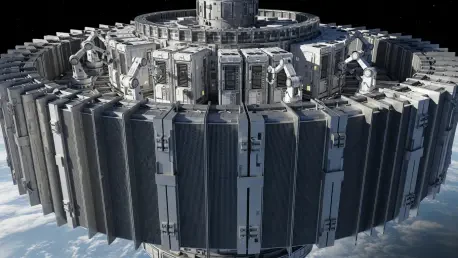

The global technology sector has officially reached a tipping point where the availability of stable electrical power, rather than the supply of advanced semiconductor chips, serves as the primary bottleneck for artificial intelligence development. As of mid-2026, the industrial focus has transitioned from securing high-end Blackwell-class processors to ensuring a consistent multi-gigawatt power supply for massive server farms that now consume more energy than some mid-sized European nations. Terrestrial grids are straining under the weight of this unprecedented demand, leading to a scenario where the scarcity of electricity is effectively throttling the evolution of large language models and neural networks. This sudden energy wall has forced engineers and executives to consider radical alternatives that were previously relegated to the realm of science fiction. The most prominent of these proposals involves relocating the most power-hungry training clusters into Earth’s orbit to tap into the constant, unfiltered energy of the sun, bypassing the constraints of a planet that is running out of plug space.
Resource Competition: The Breaking Point of Terrestrial Infrastructure
Residents in states like Florida and Utah are increasingly vocal about the strain data centers place on their regional infrastructure, leading to a significant shift in public perception. These facilities are frequently labeled as resource hogs because they require millions of gallons of water for cooling and place immense pressure on local power grids that were never designed for such intensity. In many counties, the arrival of a new server farm has led to skyrocketing utility rates for homeowners, sparking a wave of legislative pushback and organized protests. Activists have successfully lobbied for stricter zoning laws that require tech firms to prove they will not compromise the reliability of the local electricity supply before breaking ground. This social friction creates a significant barrier to entry, as the time required to secure permits and community approval now extends several years into the future. Consequently, the traditional model of building massive, centralized campuses near urban centers is becoming politically and socially untenable for companies aiming to scale.
The physical constraints of the existing terrestrial power grid represent an even more daunting challenge than local political opposition or environmental regulations. Much of the electrical infrastructure in developed nations was designed for a different era, and it simply lacks the capacity to transport the massive loads required by modern high-density compute clusters. Upgrading high-voltage transmission lines and building new substations is an agonizingly slow process, often hampered by regulatory red tape and jurisdictional disputes between state and federal agencies. This delay has created a massive backlog where ready-to-build data centers are waiting for years just to be plugged into the grid. In this environment, the search for “stranded power”—excess energy located in remote areas—has intensified, but these sources are often too far from existing data hubs to be useful. This systemic bottleneck has turned the conversation toward orbital solutions, where the power generation is localized to the hardware and entirely independent of the aging and congested terrestrial grid.
Solar Supremacy: Harnessing the Potential of Orbital Platforms
Moving data centers into orbit offers a unique solution by tapping into an environment that provides uninterrupted solar energy without the interference of weather or atmosphere. In space, solar panels can operate with nearly one hundred percent efficiency, receiving constant sunlight that is significantly more intense than what reaches the Earth’s surface. This provides a virtually limitless fuel source for high-performance computing, allowing platforms to run at maximum capacity without fluctuating energy costs or the risk of blackouts. By building specialized outposts in Low Earth Orbit, companies can effectively decouple their carbon footprint from the terrestrial environment while gaining access to power levels that would be impossible to permit on the ground. The ability to generate gigawatts of clean energy in a vacuum creates a new paradigm for AI training, where the primary cost shifts from electricity consumption to the initial deployment of the hardware. This shift allows for the development of even larger models that were previously deemed too expensive to train.
Industry leaders remain divided on the feasibility of this transition, weighing the benefits of cheap energy against the immense engineering hurdles of maintaining hardware in a vacuum. While visionaries suggest that solar-powered satellites will eventually offer the lowest-cost method for high-intensity computing, others point to the extreme difficulty of heat management in space. Unlike Earth-based centers that use water or ambient air to cool processors, orbital hardware must rely on complex radiator systems to dissipate heat through radiation alone. This requires massive surface areas and advanced thermal materials to prevent the sensitive electronics from melting under the load of heavy AI processing. Despite these challenges, the prospect of bypassing terrestrial zoning laws and grid limitations remains a powerful motivator. Proponents argue that the speed of deployment for a standardized orbital cluster could eventually outpace the decade-long timelines required for new ground-based nuclear plants or grid expansions, making space the path of least resistance for rapid growth.
Technical Barriers: Thermal Management and Radiation Shielding
The physics of cooling remains one of the most significant technical obstacles for any company attempting to operate a high-density compute cluster outside of Earth’s atmosphere. In the absence of an atmosphere, traditional convection cooling is impossible, forcing engineers to design massive radiator wings that can shed heat into the cold void of space. These systems must be incredibly efficient, as even a small failure in the thermal loop could lead to the immediate destruction of billions of dollars in hardware. Furthermore, the weight and complexity of these radiators add significant cost to every launch, potentially offsetting the savings gained from free solar power. Advanced liquid-metal coolants and carbon-nanotube heat pipes are currently being tested to increase the thermal conductivity of these systems, but they remain unproven at the scale required for a full-scale AI data center. Solving the heat equation is not just a matter of engineering; it is a fundamental requirement for the survival of orbital computing as a viable commercial industry.
Beyond the thermal challenges, orbital servers must be built to withstand the constant bombardment of cosmic radiation and extreme temperature swings. Terrestrial data centers are protected by the Earth’s magnetic field and atmosphere, but space-based hardware is vulnerable to high-energy particles that can cause bit-flips and permanent physical damage to silicon wafers. Protecting these systems requires heavy shielding or the development of radiation-hardened processors, both of which increase the cost and decrease the performance-per-watt of the hardware. Additionally, the lack of human technicians in orbit means that every repair and upgrade must be performed by autonomous robotics, which adds another layer of complexity to the operational model. Companies are currently investing in modular designs that allow robotic arms to swap out damaged blades or upgrade memory modules without human intervention. This reliance on automation is a double-edged sword, as it reduces long-term labor costs but creates a high risk of mission failure if the maintenance robots themselves experience a malfunction.
Economic Sustainability: Fiscal Risks and Strategic Implementation
The massive capital required to build this orbital infrastructure has raised significant concerns about a potential economic bubble within the artificial intelligence sector. Trillions of dollars are being funneled into power and cooling projects, yet there remains a notable lag between these massive investments and the actual profits generated by AI services. If the costs of securing energy continue to rise, the business case for widespread AI integration could become strained, leading to a possible market correction as investors look for more immediate returns. Launching and maintaining hardware in space remains a major financial barrier, even with the advent of reusable heavy-lift rockets that have significantly lowered the cost per kilogram to orbit. To justify these expenditures, the industry must demonstrate that orbital computing can provide a clear competitive advantage in terms of processing speed and energy reliability. Without a path to profitability, the dream of space-based data centers could collapse under the weight of its own ambition.
To address these looming challenges, industry leaders prioritized the development of standardized modular orbital chassis that allowed for hot-swapping components via autonomous robotic systems. They focused on refining laser-based data transmission protocols to ensure that high-bandwidth communication between orbital nodes and ground stations remained reliable despite atmospheric interference. Governments and private corporations also collaborated on international frameworks for space-based energy management to prevent geopolitical friction over prime orbital real estate. These steps were crucial in shifting the focus from simple terrestrial expansion to a sustainable, off-world computational model. By investing in resilient, radiation-hardened hardware, the sector mitigated the risks of long-term orbital degradation. Ultimately, the transition required a fundamental rethinking of how data centers functioned, moving away from resource-heavy ground facilities toward a streamlined, solar-reliant ecosystem that preserved Earth’s resources while enabling the next phase of technological growth.