
The stability of a regional power grid often hinges on its ability to balance instantaneous demand with fluctuating supply, especially when aging transmission lines are pushed to their absolute limits during extreme weather events. In British Columbia, where rugged terrain and vast distances complicate electrical distribution, the introduction of the first grid-scale battery system represents a pivotal shift in utility management. Rather than relying solely on traditional hydroelectric dams and lengthy wires, this new infrastructure provides a localized reservoir of energy that can be deployed within milliseconds. This technological milestone is a functional necessity designed to protect remote communities from the threat of outages caused by falling trees or heavy snow. By integrating lithium-ion batteries into the circuit, the utility aims to bridge the gap between old-world reliability and the requirements of a modern society that demands constant connectivity and power for its people.
Integrating Advanced Storage
Security in Remote Geography
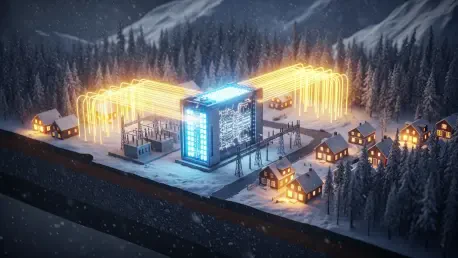
The primary impetus for installing grid-scale storage in locations like Field, British Columbia, stems from the extreme vulnerability of long, radial transmission lines that traverse mountain passes. For years, these communities faced the reality of multi-day blackouts whenever a single point of failure occurred along the hundreds of kilometers of wires snaking through the wilderness. The newly commissioned battery system functions as a massive uninterruptible power supply, capable of sustaining the entire town’s electrical load for several hours while repair crews locate and fix the source of a disruption. This decentralized approach fundamentally changes the risk profile for remote residential and commercial customers who previously had to invest in expensive, noisy, and carbon-intensive diesel generators. By providing a clean alternative that integrates with the existing grid, the project demonstrates how localized storage effectively mitigates geographic disadvantages and ensures safety.
Technical Foundations: Performance Metrics
Beyond simple backup capabilities, the technical architecture of this battery installation utilizes high-density lithium-ion cells coupled with sophisticated power conversion systems to manage voltage stability. This setup allows for instantaneous frequency regulation, which is essential for maintaining the health of the broader provincial grid as it transitions toward more variable power sources. When the demand for electricity spikes unexpectedly or a generator elsewhere in the system trips, the battery can inject power into the lines at a speed that traditional spinning reserves—like massive turbines in hydroelectric dams—simply cannot match. This rapid response time helps to prevent the cascading failures that typically lead to wide-scale blackouts across entire regions. Furthermore, the software monitors cell health and temperature in real-time, ensuring that the system remains operational under the diverse environmental conditions found in the Rocky Mountains and the various surrounding areas.
Sustainability and Economic Growth
Optimizing Renewable Energy: Future Integration
The success of this initial battery deployment provides a scalable blueprint for integrating intermittent renewable energy sources like wind and solar into the provincial energy mix. Currently, British Columbia relies heavily on its vast hydroelectric resources, but as the province seeks to diversify its portfolio, the need for flexible storage becomes increasingly urgent to handle the periods when the sun is not shining or the wind is not blowing. Grid-scale batteries act as a temporal bridge, storing excess energy during times of high production and low demand, then releasing it when the requirements of the population reach their peak. This leveling effect reduces the need for peaker plants or the expensive purchasing of electricity from neighboring jurisdictions during shortages. Consequently, the localized storage unit serves as a critical proof of concept for a future where every major substation might include a storage component to maximize the efficiency of clean energy production.
Building Future Resilience: Strategic Outcomes
The successful integration of the first grid-scale battery in British Columbia established a definitive framework for future energy resilience strategies. It became clear that utility providers had to prioritize the installation of distributed storage at critical nodes to ensure the long-term viability of the clean energy transition. Moving forward, the focus shifted toward diversifying battery chemistries, such as exploring long-duration flow batteries that offered even greater capacity for seasonal storage. Stakeholders recognized that waiting for a total grid overhaul was no longer a viable strategy in the face of increasing climatic volatility. Instead, the implementation of localized, high-capacity systems provided the immediate protection necessary for vulnerable populations. This project proved that the key to preventing blackouts laid in the marriage of traditional generation with agile, modern storage solutions, which then empowered local communities to manage their security very effectively.