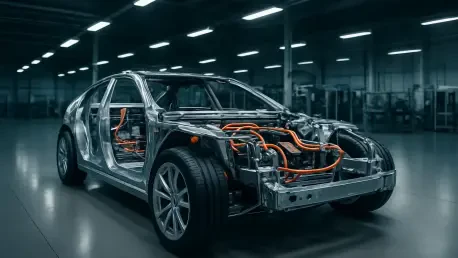

Power Management Integrated Circuits now orchestrate complex system states by managing communication via LIN or CAN-FD networks during low-power modes. This shift marks a pivotal moment in automotive history where the electrical architecture is no longer just a supporting infrastructure but the central nervous system of the vehicle. As internal combustion engines yield to high-voltage electric drivetrains, the sheer volume of data and current flowing through a modern chassis has reached unprecedented levels. Modern luxury EVs and performance-oriented platforms require a level of granular control that traditional relay-based systems simply cannot provide. Engineers are now tasked with balancing the extreme power demands of autonomous driving sensors, high-definition infotainment screens, and thermal management systems for massive battery packs. This environment demands a transition toward software-defined power, where every watt is accounted for and every fault is predicted before it can lead to a critical failure. The current landscape involves a total reimagining of how energy is distributed from the source to the endpoint, moving away from simple fuses toward intelligent, networked nodes that can pivot their behavior based on the driving mode, environmental temperature, or emergency protocols.
Drivers of Technological Integration
System Complexity: Transitioning to Zonal Architectures
The architectural blueprint of the modern automobile has undergone a radical transformation, moving away from a decentralized model where dozens of independent Electronic Control Units were scattered throughout the frame. In the previous decade, adding a new feature often meant adding a new dedicated controller and a corresponding set of wires, leading to a “spaghetti” effect that hindered efficiency and scalability. Today, the industry is converging on zonal architectures, where high-performance computers act as regional hubs, or “zones,” to manage all functions within a specific physical area of the vehicle. This consolidation allows for a more streamlined flow of information and electricity, as a single zonal controller can manage everything from the door locks and window motors to the sophisticated lidar sensors located in the front bumper. By grouping these functionalities geographically rather than functionally, manufacturers can utilize much shorter cable runs, which simplifies the assembly process and reduces the risk of electromagnetic interference across the network.
While some manufacturers have moved aggressively toward a pure zonal model, a significant portion of the market currently utilizes hybrid solutions that bridge the gap between legacy and modern designs. These transitional architectures allow car makers to maintain some proven domain-based controllers while integrating new zonal power distribution modules to handle high-current loads. This approach balances the immense cost of platform redevelopment with the immediate need for better power management. The complexity of these systems is managed through sophisticated software layers that abstract the physical hardware, allowing for over-the-air updates that can reconfigure power priorities on the fly. For instance, if a vehicle detects a low-battery state, the central brain can instruct zonal controllers to deactivate non-essential comfort features like seat heaters or ambient lighting, ensuring that every remaining joule is reserved for the drivetrain and critical safety sensors. This level of dynamic resource allocation was unthinkable in the era of passive electrical components.
Software Synergy: Managing Power-Hungry Safety Stacks
The rise of Level 2 and Level 3 autonomous driving features has introduced a new class of power consumers that demand absolute reliability and high current. Modern sensor suites, which include high-resolution cameras, radar units, and energy-intensive lidar systems, require a stable and “clean” power supply to function correctly in varied environmental conditions. These components are often part of a safety-critical path, meaning that any interruption in power could result in the immediate loss of advanced driver assistance systems. To mitigate this risk, power distribution networks now feature redundant pathways and intelligent load-shedding capabilities that prioritize safety-critical compute clusters over infotainment and cabin amenities. The synergy between software and power hardware ensures that the vehicle can maintain its situational awareness even during a partial electrical failure, providing a safety margin that is essential for gaining public trust in autonomous technologies.
Furthermore, the integration of advanced software stacks requires the power network to manage aggressive standby and wake-up cycles to preserve the health of the 12V or 48V auxiliary batteries. Modern vehicles are never truly “off”; they exist in various states of low-power readiness, waiting for a signal from a key fob, a mobile app, or a scheduled software update. Managing these states requires highly specialized Power Management Integrated Circuits that can monitor the network for “wake” signals while drawing only micro-amps of current. When the system is activated, these circuits must coordinate a sequenced power-on procedure to prevent massive current inrushes that could damage sensitive silicon components. This intelligent sequencing is vital as vehicles move toward 2026-2028 standards, where the total computational power onboard is expected to rival that of high-end data centers. By treating power as a programmable asset, engineers can ensure that the vehicle remains responsive and efficient throughout its entire lifecycle, regardless of how many software features are added after it leaves the factory floor.
Physical and Electrical Optimization
Weight Reduction: Streamlining the Wiring Harness
One of the most significant challenges in modern vehicle design is the physical weight of the electrical system, which has historically been the third heaviest component in a car, trailing only the engine and the chassis itself. In an era where every kilogram of weight directly subtracts from the range of an electric vehicle, the wiring harness has become a prime target for optimization. The traditional approach of using thick copper cables to carry high current over long distances is being replaced by localized power distribution. By placing input and output aggregators in close proximity to the actual loads, such as the electric motors or seat actuators, engineers can significantly reduce the length and thickness of the copper required. This shift not only saves weight but also reduces the physical volume occupied by the harness, allowing for more spacious cabin designs or larger battery compartments.
Beyond the raw weight of the copper, the shift toward modular electronic boards has revolutionized how these harnesses are manufactured and installed. Integrated power distribution modules now combine switching elements, protection circuitry, and networking interfaces into a single compact unit. This consolidation reduces the number of physical connectors and splices within the harness, which are historically the most common points of failure in an automotive electrical system. By minimizing the mechanical complexity of the distribution network, manufacturers are achieving higher levels of long-term reliability and lower warranty costs. The resulting “lean” harness is easier to route through the vehicle’s frame during assembly, often using automated robotic systems that were previously hindered by the bulk and inflexibility of traditional wiring bundles. This evolution in physical design is a direct response to the need for greater efficiency in the competitive 2026-2028 automotive market.
High-Voltage Standards: The Rise of 48V and 800V Systems
The transition from the century-old 12V standard to higher voltage architectures represents one of the most impactful changes in automotive electrical engineering. The adoption of 48V board nets is a strategic middle ground that allows for the delivery of four times the power over the same gauge of wire, or the same power over wires that are significantly thinner and lighter. This voltage jump is particularly beneficial for high-load components like electric power steering, active suspension systems, and electric turbochargers, which would require impractically thick cables under a traditional 12V system. However, the transition is not as simple as swapping batteries; it requires a sophisticated ecosystem of DC/DC converters to support legacy 12V components that are still cost-effective and reliable. These converters must operate with extremely high efficiency to ensure that the transition to 48V does not introduce unwanted thermal overhead or energy waste.
In the high-performance and long-range electric vehicle segments, the industry is moving even further toward 800V architectures. This leap is primarily driven by the need for ultra-fast charging and the demand for higher efficiency in the traction inverter and motor. At 800V, the current required to deliver a specific amount of power is halved compared to 400V systems, which dramatically reduces heat generation and allows for more compact power electronics. To manage these extreme voltages, engineers are increasingly turning to Wide Bandgap materials like Gallium Nitride and Silicon Carbide. These advanced semiconductors can switch at much higher frequencies than traditional silicon-based parts, enabling the use of smaller inductors and capacitors. The result is a power distribution module that is not only more powerful but also significantly more compact and thermally efficient. As we progress through 2026 and look toward 2028, these high-voltage standards will become the baseline for any manufacturer aiming to provide competitive charging speeds and driving ranges.
Intelligent Semiconductor Solutions
Silicon Protection: Replacing Fuses with eFuses
The replacement of traditional thermal melting fuses with intelligent silicon-based eFuses is a cornerstone of the “smart” power distribution revolution. Traditional fuses were essentially “dumb” components that could only respond to overcurrent by physically breaking a circuit, a process that was slow, imprecise, and required manual replacement by a technician or the vehicle owner. In contrast, eFuses utilize advanced MOSFET technology to monitor current flow in real-time and can disconnect a circuit in as little as 100 microseconds. This rapid response is critical for protecting the sensitive microprocessors and sensors that populate modern vehicles. Because these devices are controlled by silicon, they offer programmable trip thresholds, allowing the same hardware to be used for different applications simply by changing the software parameters. This flexibility drastically reduces the number of unique parts a manufacturer must stock, simplifying the supply chain.
Moreover, the “self-healing” capability of eFuses represents a major leap forward in vehicle uptime and diagnostics. Unlike a traditional fuse that is destroyed upon failure, an eFuse can be reset electronically. When a fault is detected, the system can attempt to “retry” the circuit after a brief cooling period or once the short-circuit condition is cleared. If the fault was merely a transient glitch caused by a momentary surge or environmental factor, the vehicle can continue to operate without requiring a trip to the service center. If the fault persists, the eFuse provides detailed diagnostic data to the central computer, identifying the exact nature of the problem and the specific branch of the circuit where it occurred. This data-driven approach to circuit protection allows for predictive maintenance, where the vehicle can alert the driver to a degrading component before it leads to a complete system shutdown.
Strategic Evolution: Sustaining Next-Generation Performance
The implementation of smart power distribution systems reached a level of maturity that fundamentally altered the relationship between hardware and software. Engineers realized that by integrating analog-to-digital converters directly into the high-side drivers and power stages, they could capture a high-fidelity “heartbeat” of the vehicle’s electrical health. This data was then utilized to refine energy consumption models and improve the accuracy of range estimations, which were critical for the widespread adoption of electric vehicles. The transition from reactive to proactive power management was supported by the development of standardized communication protocols that allowed different modules to share power-state information with minimal latency. This ecosystem of interconnected power nodes ensured that even the most complex autonomous platforms could maintain a stable electrical environment regardless of external fluctuations or sudden changes in computational load.
As the industry moved forward, the lessons learned from the deployment of these intelligent systems provided a clear roadmap for future developments. The focus shifted toward even greater levels of integration, where power distribution and data processing were combined into singular, multi-functional chips. This reduction in component count further enhanced reliability and decreased the overall carbon footprint of the manufacturing process. Manufacturers successfully demonstrated that by prioritizing “software-defined power,” they could extend the lifespan of a vehicle through continuous optimization and functional enhancements delivered via the cloud. These strategic advancements ensured that the automotive power network was no longer a limiting factor but an enabling technology that paved the way for the next era of mobility, characterized by zero-emission operation and high-level autonomy. The shift proved that the intelligent management of energy was just as important as the energy source itself in defining the performance and safety of a modern vehicle.