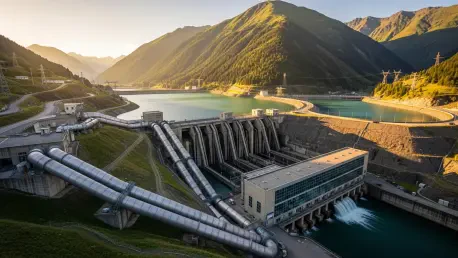

The rugged mountains of the Indian subcontinent are quietly transforming into colossal reservoirs of potential power that will soon stabilize the entire national electrical grid. This evolution centers on strategic pumped storage projects that act as massive water batteries, storing surplus energy to be released when demand peaks. By leveraging gravity and hydraulic pressure, the nation is building a resilient defense against the intermittency of clean energy.
The Massive Surge in India’s Hydraulic Energy Storage
India currently accelerates its energy transition by constructing 11 major pumped storage projects across diverse terrains. These facilities represent a combined capacity of 15,870 MW, marking a significant departure from traditional energy management strategies that relied heavily on fossil fuels for baseload stability.
By utilizing natural geography to store energy, the nation bypasses many of the logistical and material limitations associated with chemical battery arrays. This shift ensures the world’s most populous country maintains a steady power supply while pursuing carbon neutrality through a diversified and scalable storage portfolio.
Why Long-Duration Storage Is the Backbone of India’s Green Transition
Long-duration storage serves as the essential pillar of a modern renewable grid. As solar and wind sources increase their share of total generation, the inherent variability of weather requires a robust mechanism to bridge the gap between production and peak usage.
While solar output peaks at midday, electricity demand frequently surges after sunset when solar panels go dark. Pumped storage projects mitigate this imbalance, ensuring clean energy is preserved rather than discarded, which provides the reliability needed to replace traditional thermal plants.
Mapping the Infrastructure: From Construction Pipelines to Grid Stability
The infrastructure expansion remains aggressive, with six additional projects totaling 8,140 MW already cleared by the Central Electricity Authority. These sites are strategically located to optimize water resources and topographical advantages, creating a network of synchronized power hubs.
These facilities provide vital ancillary services like frequency regulation and voltage support. By pumping water to higher elevations during surplus periods, they offer a flexible response to grid fluctuations, ensuring overall stability during sudden spikes in national consumption.
De-Risking Development Through Regulatory and Environmental Reform
Bureaucratic reforms played a decisive role in accelerating these massive engineering feats. The timeline for the concurrence of Detailed Project Reports was reduced from 90 days to just 50 days, drastically shortening the pre-construction phase for major developers.
The removal of interstate clearance requirements further eliminated significant administrative hurdles. Collaborative efforts introduced simplified appraisal procedures and flexible rules for forest surveys, allowing developments to proceed without compromising environmental integrity or local ecosystems.
Financial Frameworks for Private Sector Participation
A sophisticated financial framework now incentivizes significant private sector participation across the energy landscape. A 100% waiver of Inter-State Transmission System charges for projects commissioned by June 2028 has lowered the entry barrier for global and domestic investors.
The adoption of a tariff-based competitive bidding process ensures a transparent procurement environment for all stakeholders. Additionally, the state provided direct funding for peripheral infrastructure, such as roads and bridges, to support the logistical demands of reaching remote mountain sites.
The government effectively synchronized industrial policy with environmental goals to create a resilient energy architecture. Stakeholders explored the potential for hybrid systems to maximize land use efficiency. Future initiatives focused on scaling solutions to smaller municipalities and refining ecological monitoring toward a sustainable grid.