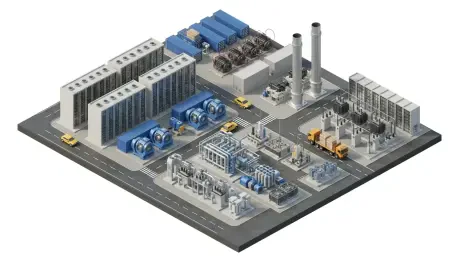

The energy math behind the AI surge has become impossible to ignore as proposed U.S. data center capacity on paper now rivals the nation’s entire peak load, yet the wires, plants, equipment, and crews needed to deliver that vision remain stubbornly finite and slow to scale. That mismatch between digital ambition and physical execution defines the next few years: leasing teams and chip roadmaps promise exponential compute, while generation additions, transmission builds, and interconnection milestones move through timelines measured in years, not quarters. The result is a market where demand signals look overwhelming, but the real constraint is buildability, from gas turbines and transformers to cooling skids and EPC bandwidth. Financial engineering cannot shortcut permitting. Software cannot replace steel. And queue reform, while necessary, will narrow the funnel before it widens it.
Demand vs. Reality
The Scale of Announced Load
Publicly announced U.S. data center projects now tally close to 780 GW of potential load—an astonishing figure that eclipses current U.S. peak demand, estimated around 759 GW, and reframes the conversation from “Is demand real?” to “What can actually be delivered by 2030?” This headline number captures a broad swath of intentions: hyperscale campuses chasing low-cost power, AI clusters seeking capacity at dense metros, and colocation expansions tied to enterprise cloud growth. Yet translating announcements into grid-tied facilities entails siting generation that can run when needed, securing interconnection that does not collapse under congestion, and procuring specialized equipment that manufacturers cannot conjure overnight. Even if a modest slice of the pipeline materializes, the absolute additions would be consequential. The question is not whether tens of gigawatts will connect, but where they will land, how reliably they will run, and at what price to customers sharing the same networks and fuel supply chains.
Why Top-Down Forecasts Overshoot
Forecasts that start with aspirations and queue filings tend to overstate near-term reality because they lean on administrative pipelines, not physical progress. Grid Strategies raised its five-year peak demand growth outlook from 38 GW in a prior estimate to 166 GW, with roughly 90 GW tied to data centers, while cautioning that utility and RTO projections often front-run actual construction. BloombergNEF’s latest view—106 GW of data center demand by 2035, up 36%—adds useful context but still includes projects with thin execution plans and unproven siting. The core analytical challenge is that demand can scale quickly with capital and chips, whereas transmission corridors, substations, and firm capacity cannot. As a result, linear extrapolations from lease signings or land options miss the gating steps: transformer lead times, network upgrade costs, thermal plant air permits, and proven labor pools. Robust planning now discounts speculative filings and weights milestones like signed interconnection agreements, locked-in equipment orders, and verifiable construction schedules.
Binding Constraints
Generation Build Rates and Siting Hurdles
Reaching the loftiest 2030 scenarios would require capacity additions at levels the U.S. has never sustained, all while compressing siting and permitting to timelines rarely seen outside emergency builds. Renewable additions have accelerated, but their variability and siting patterns do not always align with data center clustering, especially where grid headroom is thin. Developers exploring dedicated or behind-the-meter gas as a “fast” bridge face a new reality: OEM production slots for large-frame turbines are oversubscribed, balance-of-plant packages and high-voltage yards compete with utility procurements, and pipeline interconnects and water approvals trigger local scrutiny. Moreover, hedging heat-rate and fuel-basis risk over a decade in volatile gas markets is not trivial, particularly when off-take must guarantee high availability for AI workloads. The net effect is that “quick gas” often turns into “faster than transmission, but slower than the slide deck,” with budgets drifting and CODs slipping as equipment queues lengthen.
Transmission Limits and Price Fallout
Transmission remains the most visible and consequential bottleneck, because it determines whether added megawatts can move to where load shows up at the hours that matter. Interregional lines face a stacked deck of federal, state, and local reviews, alongside land acquisition challenges and contested cost allocation. Even within regions, upgrading congested 345 kV backbones or expanding substations to accommodate multi-gigawatt clusters takes longer than typical data center leasing cycles. The stakes are not academic. In a modeled ERCOT case that injected 10 GW of data center load without parallel transmission expansion, congestion costs rose fivefold and average power prices climbed 34%, a warning that circuits already running hot cannot absorb step-changes in load without raising delivered costs. Grid-enhancing technologies—topology optimization, dynamic line ratings, advanced power flow controllers—can relieve pinch points, but they do not add the bulk transfer needed to unlock remote wind or solar at the scale AI nodes demand.
Interconnection Reform and Cost Shifts
Queue reform efforts are trimming speculation and prioritizing readiness, but they are also forcing developers to internalize more risk up front. Requirements for site control, detailed modeling, and financial security reduce churn and speed studies for credible projects; they also push out those without firm capital or engineering depth. Meanwhile, large-load tariffs and revised cost-allocation rules are steering more network upgrade costs to big new users, particularly where local reinforcements or transformer banks must be upsized to serve clustered campuses. This shift aligns incentives but reshapes project math: moving from “interconnect and hope for regional upgrades” to “interconnect and self-fund portions of the solution.” For AI-heavy facilities that need predictable power quality and redundancy, sequencing becomes critical. Missing a study window by a quarter can add a year. Failing a readiness checkpoint can reset interconnection milestones entirely, stranding equipment orders and vendor slots that cannot be easily rebooked.
Equipment, Cooling, and Supply Chains
Long-lead equipment has emerged as a first-order throttle on delivery. U.S. utilities and industrials are competing for the same grid-scale transformers, high-voltage breakers, and switchgear that large campuses require, and factory expansions take time to translate into shipments. On the generation side, industrial gas turbines and reciprocating engines face similar crunches, with major OEMs allocating slots years out and aftermarket upgrade capacity constrained by service backlogs. The much-cited “quick gas” pathway runs into this metal reality, eroding its speed and cost edge. Cooling has become a standout bottleneck as AI racks push power densities beyond the comfort zone of legacy air systems. Liquid-cooled cold plates, rear-door heat exchangers, and immersive solutions rely on specialized pumps, manifolds, and controls, while facility plumbing and water treatment must be rethought. Integration risk rises as thermal and electrical designs intersect, and commissioning windows stretch when vendors cannot deliver synchronized kits.
EPC Capacity and Skilled Labor Scarcity
EPC firms report full pipelines, and their bid lists increasingly favor counterparties with signed interconnection agreements, locked-in OEM slots, and realistic commissioning timelines. This triage disadvantages newcomers and speculative schedules, consolidating activity among developers with track records and committed financing. Skilled labor is the companion constraint. Electricians certified for high-voltage work, welders for pressure-rated systems, and controls technicians versed in mission-critical environments are in short supply, particularly in regions juggling semiconductor fabs, battery plants, and transmission upgrades. What once took six months from concept to groundbreaking can now stretch to 18 months as teams align permits, union dispatch, and subcontractor scopes. Wage escalation and per diem competition add cost layers that are hard to squeeze out later. The practical takeaway is simple: execution risk is being priced earlier and higher, and projects without credible labor plans are stalled before they pour a yard of concrete.
Case in Point: Project Matador
Fermi America’s proposed 6 GW “Project Matador” in Amarillo, designed around approximately 90 Siemens industrial turbines on a single campus, illustrated execution risk at the extreme end of the scale. Even before leadership turnover, the effort struggled to sign an anchor tenant while attempting to assemble a procurement schedule that secured dozens of turbines, balance-of-plant packages, and grid interconnection milestones in parallel. The math was unforgiving: competing claims on turbine manufacturing slots, local labor pools already stretched by other Texas energy and industrial builds, and cooling systems for AI-dense halls that required integration beyond typical peaker configurations. The vision promised speed via dedicated generation; the supply chain delivered friction via sequential bottlenecks. The episode underlined that megawatts on a deck are not equivalent to energization dates, and that AI-grade thermal management and auxiliary systems can derail even well-capitalized plans if kit availability and commissioning choreography are not locked early.
Market Pathways to 2030
Adaptation Strategies and Planning Priorities
In response to rising load, utilities have been revising forecasts upward and rolling out specialized service classes for large, quickly connecting customers, often with differentiated pricing for firmness and redundancy. Developers, meanwhile, are experimenting with hybrid strategies that combine on-site or adjacent generation with firmed renewables and storage, using tolling or heat-rate-indexed contracts to balance fuel risks. In PJM and MISO, some projects are co-locating near existing 345 kV or 500 kV infrastructure to minimize upgrade scope, while in ERCOT, private-wire solutions and conditional firm service are being explored to bridge timelines. Regional planners have nudged toward more methodical transmission programs, prioritizing corridors that unlock multiple value streams—renewable integration, reliability, and large-load accommodation—over single-purpose fixes. A more grounded planning approach now bakes in equipment lead times, EPC capacity, and workforce constraints, aiming to right-size expectations and steer capital to sites with demonstrable execution paths rather than aspirational maps.
Likely Outcomes and Regional Distribution
By 2030, actual data center load additions were set to be a notable fraction of the 780 GW pipeline but far below the headline total, with delivery concentrating in regions that combined available transmission headroom, flexible siting, and credible fuel or renewable firming. Areas with surplus capacity at strong-voltage nodes, like portions of the Southeast or interties around major 500 kV backbones in the Mid-Atlantic, were expected to capture outsized projects, while congested metros would face longer queues and higher upgrade tolls. Price volatility had been poised to intensify at constrained nodes as congestion rents rose without timely network expansions, placing a premium on projects with mature interconnection status, firm OEM orders, and binding EPC and labor commitments. The most practical next steps were clear: lock transmission-friendly sites early; secure transformer and switchgear slots before shell construction; pair load with firm capacity backed by real fuel logistics; and expand the skilled workforce through apprenticeships and targeted immigration. Done well, these moves would have turned deliverability from a throttle into a differentiator rather than a brick wall.