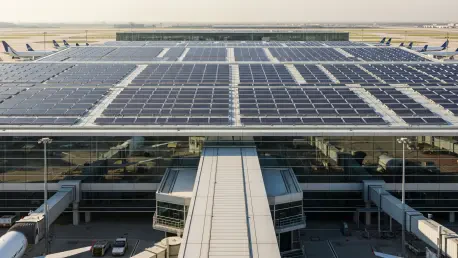

Sky-high emissions targets are forcing the aviation sector to look beyond the flight deck and toward the vast, untapped potential of the ground-based infrastructure that supports every journey. Airports have long been energy-intensive hubs, yet they possess immense rooftop and parking acreage perfectly suited for large-scale solar integration. This shift represents a fundamental change in how transportation centers operate, moving from passive consumers to active energy producers. Recent successful installations demonstrate that harvesting sunlight can effectively decouple growth from carbon footprints while stabilizing operational costs for the long term.
The Global Surge of Solar Adoption in Aviation Hubs
Analyzing Market Growth and Net-Zero Trajectories
International aviation hubs are rapidly scaling their renewable capacities to align with aggressive decarbonization trajectories and national energy mandates. This surge is driven by a need for energy independence in an era of volatile utility prices and stringent environmental regulations. By deploying megawatt-peak (MWp) systems, operators are significantly slashing their carbon dioxide equivalent emissions. Strategic frameworks like the National Energy Transition Roadmap provide the necessary incentives for infrastructure managers to pivot toward cleaner power sources, turning logistical centers into cornerstones of a regional green economy.
Pioneering Infrastructure: The Gentari and KLIA2 Case Study
The commissioning of a 3.1 MWp solar photovoltaic system at Kuala Lumpur International Airport 2 marks a pivotal moment for regional aviation sustainability. Developed by Gentari for the gateway@klia2 complex—a joint venture involving Segi Astana, WCT Holdings, and Malaysia Airports Holdings Berhad—the project features over 5,000 panels. Spread across 10,500 square meters, the system generates roughly 4,277 megawatt-hours of clean energy annually, reducing emissions by 3,310 metric tons. This technical feat was achieved without interrupting the complex flow of a high-security airport environment, providing shaded parking and stable power.
Industry Perspectives on Technical Integration and Operational Safety
Integrating solar technology within active commercial zones requires extreme logistical precision and a deep understanding of aviation safety standards. Experts emphasize that on-site generation does more than just lower utility bills; it builds operational resilience against external grid fluctuations. Moreover, the synergy between renewable generation and lifestyle infrastructure maximizes land value, proving that sustainability and profitability can coexist. These systems turn mundane surfaces into high-performing assets that contribute to the facility’s long-term viability and enhance the overall passenger experience through modern amenities.
Future Outlook: Synergizing Renewable Energy with Travel Logistics
The next evolution of travel logistics involves creating holistic green mobility hubs where solar power feeds directly into electric vehicle charging networks. While scaling these systems presents hurdles like glare management and strict airspace regulations, the technological advancements in smart building management are making integration more seamless. As storage solutions improve, airports will likely transition into self-sustaining microgrids that can support neighboring communities. This evolution sets a new global standard for urban infrastructure, where every transit point acts as a catalyst for environmental stewardship and technological innovation.
Conclusion: Paving the Way for Resilient Aviation Infrastructure
The transition toward solar-powered aviation infrastructure proved that traditional energy dependence was no longer a necessity for large-scale transportation hubs. Stakeholders who prioritized renewable integration early found themselves better equipped to handle the demands of a modern, eco-conscious traveling public. This shift established a clear blueprint for future developments, where sustainable energy served as a vital pillar of operational longevity. Moving forward, the industry was encouraged to view these clean energy investments as essential components of a resilient, decarbonized global network that balances mobility with ecological responsibility.