
The global transition toward carbon-neutral energy infrastructures has placed an unprecedented strain on the existing supply chains of nuclear fuel, forcing exploration companies to accelerate their search for high-grade deposits in stable jurisdictions. Against this backdrop of heightened urgency, Cauldron Energy recently announced a massive expansion of the mineralized footprint at its flagship Yanrey Project, effectively quadrupling the strike length of known uranium mineralization within a critical target zone. This discovery represents a pivotal moment for the project, suggesting that the underlying geological structures are far more extensive than initial models predicted. By systematically testing the southern extensions of the Bennet Well deposit, the technical team identified high-grade intercepts that suggest a continuous and robust mineralized system. Such findings provide a strong foundation for scaling the project as the global market looks for reliable and sustainable sources of fuel for the next generation of reactors.
Expanding the Mineralization Footprint
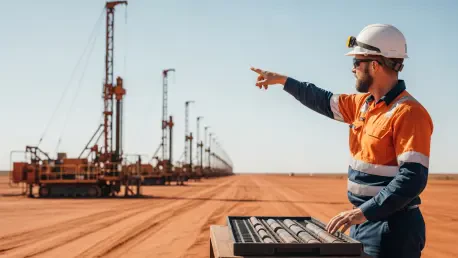
Recent exploration activities at the Yanrey Project focused on a series of aggressive step-out drilling programs designed to test the limits of the paleochannel system that hosts the uranium. The results revealed that the strike length has been extended from a few hundred meters to several kilometers, showcasing the scalability of the asset in a region that is increasingly recognized for its untapped potential. These results were not merely about geographic spread but also about the consistency of the mineralization encountered during the campaign. Multiple drill holes returned grade-thickness values that exceed the economic thresholds typically required for successful in-situ recovery operations. This consistency suggests that the depositional environment was highly favorable for long-term uranium accumulation, which simplifies the modeling of the ore body for future extraction. As the data is integrated into the broader geological map, the company is seeing a much clearer picture of a large-scale uranium province.
Moreover, the geological interpretation of the Yanrey basin has been significantly refined through the application of advanced geophysical techniques and real-time drilling data analysis. By mapping the deep paleochannels that serve as the primary conduits for mineral-bearing fluids, the exploration team was able to predict where uranium would likely precipitate against chemical traps. This predictive model was validated by the latest drilling success, proving that the northern and southern limbs of the deposit are part of a much larger integrated system. Furthermore, the presence of specific clay and sand sequences within these channels provides the ideal permeability required for mining methods that do not involve massive open pits or shafts. The success of this campaign underscores the importance of utilizing modern sensing technology to unlock value in mature mining jurisdictions. Every new hole provides critical data that reduces risk and increases the confidence levels of the estimations.
Strategic Advancement: Technical and Economic Feasibility
Building on this foundation, one of the most significant advantages of the Yanrey Project is its suitability for in-situ recovery, a method that involves circulating a specialized solution through the ore body to dissolve the minerals without moving the earth. This approach is highly favored in the modern mining landscape because it minimizes surface disturbance and reduces the overall carbon footprint of the extraction process. For Cauldron Energy, the confirmation of favorable hydrological conditions across the newly expanded strike length is a major milestone in the path toward commercialization. The ability to utilize this technology allows for a much lower capital expenditure compared to traditional mining, making the project more resilient to price fluctuations. Detailed testing indicated that the porosity of the host sands is conducive to high recovery rates. This technological alignment ensures that the project remains competitive during the cycle from 2026 to 2028.
In light of these findings, the successful completion of the latest drilling phase at the Yanrey Project established a new benchmark for uranium exploration and validated the long-term strategic vision of the development team. Stakeholders observed a significant transformation of the project’s potential as the quadruple expansion of the strike length moved from a theoretical possibility to a confirmed geological reality. Subsequently, the technical focus shifted toward finalizing a comprehensive mineral resource update that reflected the increased scale of the extensions. Management prioritized the engagement of specialized hydrological consultants to conduct pump tests that further solidified the project’s viability for in-situ recovery operations. These actions ensured that the project remained on an accelerated path toward the permitting phase. Future operations were planned to integrate these insights into a modular production strategy that could scale in response to global demand.