
The New England power grid is currently navigating a pivotal transformation, steering away from decades of predictable demand patterns toward a far more complex operational reality. Recent data from the regional capacity and transmission forecast signals a definitive end to the era of declining energy use, marking a shift that impacts every stakeholder from utility providers to residential consumers. As the region pivots toward aggressive electrification to meet climate goals, the grid is projected to see a 9% increase in total consumption over the next decade. This analysis explores whether the existing infrastructure and current policy frameworks are sufficient to support a “dual-peaking” system, where winter demand rivals traditional summer spikes.
From Decades of Decline to a Reversal in Consumption Trends
To understand the significance of the current forecast, one must look back at the unique trajectory of the regional energy landscape. Since the early 2000s, the area successfully decoupled economic growth from electricity consumption through a combination of nation-leading energy efficiency programs and the rapid proliferation of behind-the-meter solar installations. For nearly two decades, these factors led to a steady decline in net energy use from the regional bulk power system. However, this period of contraction has officially ended as state-level mandates for carbon reduction now drive a massive shift toward electric heating and transportation.
Navigating the Mechanics of a Dual-Peaking System
Policy Volatility: The Downward Revision of Demand Projections
While the overall trend points toward growth, recent reports highlight how sensitive the energy transition is to political and economic shifts. Interestingly, the current projected growth of 9% is a significant downward revision from previous expectations, which once estimated a much sharper surge in demand. Regional operators attribute this cooling of expectations to changes in federal policy, particularly the expiration or removal of certain tax credits. These adjustments have tempered the immediate adoption rates of electric vehicles and residential heat pumps, illustrating that while the long-term destination of electrification is clear, the speed of the journey remains highly dependent on a fluctuating regulatory environment.
Winter Peak Loads: The Ascent of Thermal Electrification
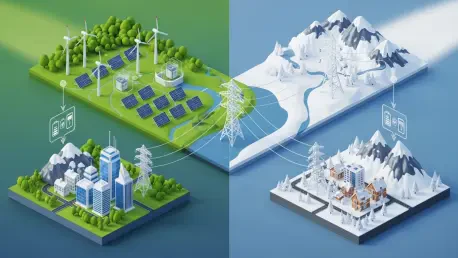
The most striking revelation in the current forecast is the emergence of a dual-peaking system. Historically, the region’s highest demand occurred during summer heatwaves when air conditioning use skyrocketed; however, by 2035, winter peak demand is expected to hit approximately 26.5 GW. The primary engine of this change is the electrification of building heat, with residential and commercial heat pumps expected to add over 5,500 MW to the winter peak load. When combined with the anticipated demand from transportation, the grid faces a future where cold snaps pose as much of a reliability risk as summer heatwaves.
Distributed Energy: The Role of Resources in Balancing Strain
As the region grapples with these rising peaks, distributed energy resources—specifically behind-the-meter solar—offer a vital but limited buffer. Current projections suggest that solar will reduce the winter peak load by only about 316 MW, highlighting a fundamental seasonal limitation. Solar generation is at its lowest during the short, overcast days of winter when heating demand is at its highest. This discrepancy necessitated a more diverse portfolio of energy resources and advanced grid management techniques to ensure the lights stay on when the sun goes down and temperatures drop.
Anticipating the Evolution of Grid Infrastructure and Regulatory Landscapes
Looking ahead, the evolution of the New England grid will likely be defined by smart integration and increased flexibility. Technological innovations in grid-scale battery storage and long-duration energy storage will be essential to bridge the gap between intermittent renewable generation and the new winter peaks. Furthermore, the market can expect a shift toward more dynamic regulatory frameworks that reward consumers for “load shifting”—using electricity during off-peak hours to alleviate strain. Industry players may also move toward more localized microgrids that can operate independently during extreme weather events.
Strategies for Enhancing Resilience in a Transitioning Power Market
For businesses and policymakers, the transition to a dual-peaking grid required proactive planning rather than reactive adjustment. Energy-intensive industries had to consider investing in on-site storage or backup generation to mitigate the risks of peak-hour pricing and potential instability. For residential consumers, the adoption of smart heat pumps and managed charging systems provided significant cost savings while helping to flatten the demand curve. Utilities prioritized infrastructure hardening, such as upgrading transmission lines to handle higher loads in extreme cold, ensuring that every electric vehicle and heat pump became a potential asset for grid stability.
Securing the Energy Future Amidst Transformation
The transition to a dual-peaking power grid was no longer a distant possibility; it became the definitive reality for the region. While the 9% growth forecast suggested a more manageable pace of change than previously feared, the underlying shift remained profound and required a massive overhaul of generation and distribution. The success of this transition depended on the ability to align political will with technical reality. Ultimately, the region focused on building a resilient, decarbonized grid that stood ready to withstand the demands of all four seasons while powering a modern, electrified economy.