
Christopher Hailstone has spent decades at the intersection of energy management and grid reliability, navigating the complex transition from centralized power plants to a decentralized, resilient future. As a utilities expert, he has seen firsthand how the pulse of the electric grid shifts under the pressure of peak summer demand and the rising threat of climate-driven infrastructure stress. His expertise in renewable energy delivery offers a unique vantage point on how California can balance the scales between massive capital expenditures and the nimble deployment of local resources. Today, we delve into the technical potential of front-of-the-meter solar and storage, exploring a roadmap that could redefine the state’s energy landscape over the coming decade.
The discussion centers on the massive potential for distribution-connected energy systems to stabilize the grid without necessitating a total overhaul of the high-voltage transmission system. We explore the specific technical capacities of California’s three largest investor-owned utilities, the economic advantages of avoiding billion-dollar infrastructure costs, and the regulatory shifts needed to fully value distributed resources. From the operational nuances of substation configurations to the strategic implementation of virtual power plants, the conversation provides a deep dive into how community-scale assets can serve as a cornerstone for a more reliable and affordable power system.
How would you describe the untapped potential currently sitting within California’s distribution substations, and what does this mean for the state’s peak load management?
The technical potential waiting to be unlocked at the distribution level is nothing short of transformative for our energy security. Recent analysis indicates that front-of-the-meter solar and storage could serve approximately 17.5 GW of summer peak load across the substations owned by our three primary utilities. When you consider the sweltering heat between 4 p.m. and 9 p.m. from June through September, these assets have the capacity to offset about 32% of the load when the grid is most strained. We are looking at the possibility of supporting 3,112 individual 5-MW solar-and-storage installations, which alone would account for 15,560 MW of local load. This isn’t just a theoretical exercise; it represents a tangible path to improving reliability by placing power generation exactly where it is consumed, reducing the heavy lifting required from the bulk transmission system during those critical sunset hours.
Looking at the major investor-owned utilities, how do their unique infrastructures change the way we approach local solar and storage deployment?
Each utility presents a different puzzle, and the impact varies significantly based on the scale and existing configuration of their systems. For Southern California Edison, we see the greatest numeric impact, where 1,657 5-MW installations could meet 9,188 MW of non-coincident summer peak load, covering about 37% of their expected demand by 2032. San Diego Gas & Electric, while having a smaller system, shows the most impressive proportional impact, with 326 of these 5-MW units capable of meeting 39% of their projected peak load. Meanwhile, PG&E, the largest of the trio, has room for 1,129 of these installations to cover 26% of their 2032 demand projection, which is about 6,560 MW. These figures highlight that while the physical footprint of the grid differs from the coastal breeze of San Diego to the vast territories of the north, the opportunity to leverage customer-owned resources and flexible demand is universal across the state.
Beyond just meeting demand, what are the broader economic and security implications for ratepayers and the transmission grid when we shift toward front-of-the-meter resources?
The financial stakes here are staggering, as the current trajectory for grid hardening and clean energy integration requires more than $110 billion in capital spending over the next five years. By utilizing front-of-the-meter solar and storage, we can significantly reduce the need for these massive, incremental upgrades to the transmission system, which often end up as costs passed directly to the ratepayer. Studies have shown that deploying 5.4 GW of community-scale resources could slash power system costs by $6.5 billion over 20 years, representing a 0.6% reduction in total costs. This shift also offers a crucial buffer against wildfire risks; as utilities face potential credit downgrades due to liability concerns, decentralized power helps maintain stability without the same level of exposure as long-distance, high-voltage lines. It’s a strategy that prioritizes affordability while ensuring that the “strained” transmission grid isn’t the single point of failure during a crisis.
From a technical standpoint, how do we ensure these distributed assets operate seamlessly without overwhelming the existing high-voltage transmission lines?
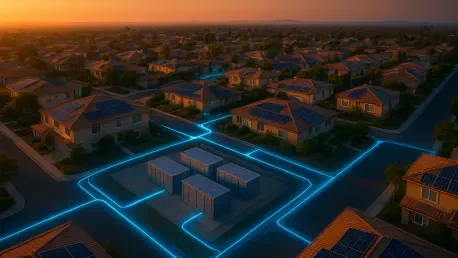
The key to a successful rollout lies in the configuration of the host substations and the intelligent dispatch of the stored energy. For these systems to be effective, they must be designed to redirect any potential backflow to other feeders rather than pushing energy back onto higher-voltage transmission lines. We assume these front-of-the-meter batteries will charge from a combination of colocated solar and the grid during off-peak periods, ensuring they are fully “fueled” before the evening peak arrives. By boosting the availability of dispatchable distributed energy resources, we effectively reduce the amount of generation needed from the bulk grid and decrease our reliance on expensive gas-fired peaker plants. This requires a shift toward grid-responsive architectures, where substations act as localized hubs that manage the flow of electrons with much higher precision than the old “one-way” street model.
What role do state regulators and legislative programs play in bridging the gap between the current grid value and the potential benefits of community-scale energy?
Policy is the bridge that turns technical potential into a functioning market, and right now, there is a clear gap between the value these resources provide and how they are compensated. We need the California Public Utilities Commission and the California Energy Commission to work in lockstep to identify the exact attributes that maximize grid value and update procurement programs accordingly. We are already seeing progress with initiatives like PG&E’s SAVE virtual power plant and the new SHARE VPP, which show that utilities are beginning to recognize the role of customer-owned resources. Furthermore, the legislative move to develop community solar-and-storage programs that compensate assets based on the avoided cost of generation is a vital step forward. Without these frameworks, we risk leaving gigawatts of clean, local power on the table simply because the market rules haven’t caught up to the reality of the 2026 energy landscape.
What is your forecast for the evolution of California’s distributed energy landscape over the next several years?
I forecast a decisive shift away from the traditional, centralized model toward a “web” of localized power hubs that are far more resilient to the stresses of electrification. As demand from data centers, advanced manufacturing, and electric transportation continues to surge, the state will be forced to accelerate the integration of front-of-the-meter solar and storage to avoid crippling costs. We will likely see community-scale arrays become as common as traditional substations, acting as the primary defense against peak load spikes and reducing our dependence on electricity imports. Over the next six years, this transition will not only stabilize our energy prices by saving billions in avoided transmission projects but will also create a grid that feels much more invisible and reliable to the average citizen, regardless of how high the temperature climbs. The era of the passive consumer is ending, replaced by a dynamic system where local generation is the heartbeat of the community.