
The transition from internal combustion engines to zero-emission heavy-duty logistics hinges largely on the industry’s ability to replicate the operational efficiency of traditional diesel systems. While battery-electric trucks excel in short-haul scenarios, long-haul freight requires a fuel source that offers high energy density and rapid replenishment times without sacrificing payload capacity. Hydrogen fuel cells have emerged as the primary contender for these demanding routes, yet the efficacy of this technology is deeply intertwined with the pressure at which the gas is stored. Traditionally, 350-bar systems were the standard, but the shift toward 700-bar technology promises to double the energy density within the same physical footprint. This advancement is more than a technical upgrade; it represents a fundamental shift in how fleet operators approach transcontinental shipping. By moving toward higher pressures, the industry seeks to eliminate the range anxiety that has hindered adoption.
The Engineering Logic: High-Pressure Refueling Refined
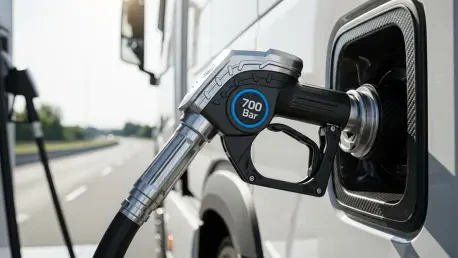
Engineering a 700-bar refueling station involves sophisticated thermodynamic management to ensure that the hydrogen gas remains at a stable temperature during the high-speed transfer process. When hydrogen is compressed and dispensed at such high pressures, it generates significant heat. This could potentially damage the storage tanks of the vehicle if not properly regulated. To counteract this effect, modern 700-bar stations utilize advanced pre-cooling units that chill the hydrogen to temperatures as low as minus 40 degrees Celsius before it ever reaches the nozzle. Pre-cooling allows for a much faster mass flow rate. It enables a heavy-duty truck to refill its massive tanks in roughly ten to fifteen minutes, a timeframe that directly mirrors the diesel experience. Such precision engineering ensures that the structural integrity of the carbon-fiber-reinforced tanks is maintained while maximizing the fuel delivered. This level of efficiency is vital for maintaining strict logistics schedules.
Beyond the speed of refueling, the adoption of 700-bar technology significantly alters the weight-to-range ratio that has long plagued electric and lower-pressure hydrogen vehicles. In the world of freight, every pound counts. Every pound of battery or fuel storage is a pound of cargo that cannot be carried, making energy density a critical economic factor. By storing hydrogen at 700 bar, trucks can carry enough fuel to cover distances exceeding 500 miles on a single fill. The storage system remains relatively compact. This enables manufacturers to design chassis that do not deviate from existing aerodynamic profiles, which reduces drag and enhances powertrain efficiency. Furthermore, the increased pressure allows for smaller, lighter tanks compared to 350-bar systems. These lighter components help operators stay within legal axle weight limits. Consequently, 700-bar stations are becoming the preferred infrastructure choice for the most critical long-haul routes.
Overcoming Barriers: Economic and Infrastructure Realities
Establishing a comprehensive network of 700-bar stations requires substantial capital investment and a synchronized effort between energy providers and government entities. The cost of building a high-pressure station is considerably higher than its low-pressure counterparts. This is due to the necessity of high-grade compressors, specialized seals, and robust safety monitoring systems. These stations must also be capable of producing or receiving high-purity green hydrogen to ensure that the carbon-neutral promise of the technology is actually fulfilled. In many regions, the current strategy involves clustering these stations along primary freight arteries. These major interstate highways now host hydrogen corridors that support early adopters of the technology. Incentives provided through recent energy legislation have begun to bridge the funding gap, which encourages private firms to invest in hardware. However, the scalability of these networks depends on consistent demand from the fleet operators.
The deployment of 700-bar refueling infrastructure successfully demonstrated that high-density energy storage could effectively meet the rigorous demands of the global logistics industry. Decision-makers recognized that the path toward decarbonization required more than just incremental changes. It demanded a robust technological foundation that did not compromise on productivity. As these stations became more prevalent, the industry observed a noticeable stabilization in the supply chain for high-pressure components. This shift subsequently drove down maintenance and operational costs. Engineers focused on refining the modularity of these stations, allowing for rapid expansion as fleet sizes grew. The integration of smart grid technology further optimized the electrolysis process. This ensured that refueling remained affordable even during peak energy demand periods. This transition solidified hydrogen’s role as the primary fuel for transport and provided a roadmap for marine sectors.