
Christopher Hailstone joins us today, bringing extensive expertise in utility security and energy management during a period of intense geopolitical friction. As an expert in grid reliability, his insights into the current Middle Eastern diplomatic surge and the subsequent impact on global supply chains are invaluable for navigating today’s volatile markets. We will explore the delicate negotiations in Tehran, the rising threat to physical infrastructure from militant strikes, and the structural risks facing global refining capacity. Hailstone provides a deep dive into the uncertainty premium and what the lowest strategic reserves in decades mean for the future of energy stability.
Saudi Arabia is engaging in high-level talks with Iranian, Pakistani, and Turkish officials to ease simmering regional tensions; how do these diplomatic maneuvers influence the immediate pricing and volatility of crude oil?
When Saudi Defense Minister Prince Khalid bin Salman meets with Iranian President Masoud Pezeshkian in Tehran, the market immediately reacts to the hope of de-escalation. We saw Brent crude futures lose 91 cents to close at $115.81 a barrel after it had briefly topped the $117 mark, while WTI fell $1.51 to settle at $101.76. These talks are critical because they include Pakistan and Turkey, who are part of a defense pact with the Saudis, creating a multi-layered diplomatic shield. Despite this slight dip, we have to recognize that prices have still gained about 12% this month alone. Traders are essentially balancing the hope of these high-level meetings against the reality of a very hot conflict zone.
With Houthi militants reportedly targeting international airports and oil pumping stations, how vulnerable is the current Saudi energy infrastructure to a disruption that could fundamentally shift global supply?
The vulnerability is a major concern for investors because any significant strike on the East-West pipeline or refining infrastructure could send prices into a vertical climb. Houthi militants claimed they fired missiles at Riyadh’s international airport and targeted pumping stations with drones, which directly threatens the heart of Saudi export capabilities. While the Saudis haven’t confirmed all these strikes, the mere threat adds a risk premium of roughly $20 a barrel to the current price of oil. We are in a theme where uncertainty is off the charts, and the prospect of another major disruption to refining or export facilities is a constant shadow over the market. If prices jump above $120, we aren’t just looking at expensive gas; we are looking at total demand destruction.
Considering that global inventory levels have fallen sharply and the U.S. Strategic Petroleum Reserve is at its lowest level since 1982, what tools are left for governments to manage a sudden supply shock?
The options are becoming increasingly limited because we have depleted our most important safety nets over the last eight months of conflict. The U.S. Strategic Petroleum Reserve is currently sitting at its lowest level since 1982, which significantly reduces the government’s ability to dampen price shocks. On Friday, the Energy Department authorized the release of up to 400,000 barrels, but that was a specific response to a disruption at a Louisiana refinery rather than a global solution. Without a substantial reserve to draw from, the market remains hyper-sensitive to every geopolitical tremor in the Middle East. This lack of a buffer is exactly why the risk premium remains so high and why any further disruption would be felt immediately at the pump.
Looking toward the future of global energy flows, specifically the plans to store crude in Singapore by late 2027, how critical is refining capacity compared to raw crude production in maintaining market stability?
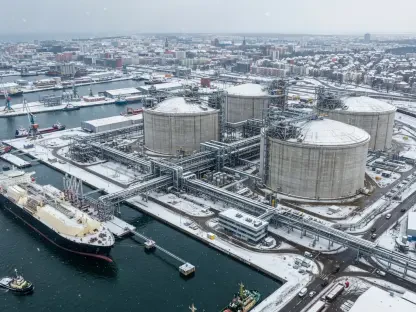
Refining capacity is actually the more persistent and dangerous challenge facing the global energy market right now. While Saudi Arabia plans to store crude in Singapore starting in the second half of 2027 to bolster its Asian supply chain, this doesn’t address the immediate structural problem of limited refining facilities. Damage to existing refineries could create a long-term bottleneck that extends well beyond the current year and into the late 2020s. If we lose significant refining capacity, it won’t matter how much raw crude is available because the system won’t be able to process it into usable products. This is a structural issue that could keep energy markets tight for years to come, regardless of short-term production increases.
Why are U.S. domestic producers remaining so cautious about increasing capital expenditure despite the high price environment and geopolitical uncertainty?
U.S. producers are navigating a minefield of volatile prices and geopolitical risks that make major new investments feel incredibly dangerous. While we are seeing some companies add a few drilling rigs, there is a distinct lack of major capital expenditure additions to bring significant new production online. The caution stems from the fact that while prices are high now, the “uncertainty premium” could vanish if diplomacy succeeds, potentially leaving expensive new projects underwater. Companies are choosing to remain disciplined rather than committing to massive capex in an environment where the global landscape changes by the hour. They would rather maintain stability than chase a price spike that might be driven by temporary geopolitical fear.
What is your forecast for oil prices?
I expect oil prices to remain highly volatile, likely staying within the $100 to $120 range as long as the conflict in the Middle East remains unresolved. The $20 risk premium currently baked into the price is unlikely to disappear until we see a definitive end to the Houthi attacks on energy infrastructure. If we see a successful implementation of the Singapore storage plans and a cooling of tensions by late 2027, we might see a return to more fundamental-based pricing. However, for the immediate future, the combination of depleted reserves and refining bottlenecks means that any minor supply disruption will have a disproportionately large impact on global costs. Consumers should prepare for a sustained period of elevated prices until the structural refining issues are addressed.