
The transition from experimental laboratory physics to a commercially viable energy source has long been hindered by the inherent inefficiencies of traditional steam-driven power cycles that dominate the modern energy landscape. For nearly a century, nuclear research has prioritized the containment of extreme plasma temperatures, often overlooking the massive energy losses that occur during the final stage of electricity generation. Realta Fusion recently altered this trajectory by successfully demonstrating direct energy conversion at the Wisconsin HTS Axisymmetric Mirror facility, marking a pivot from thermal-based systems to direct kinetic harvesting. This milestone involved capturing electricity directly from the movement of charged plasma particles, effectively bypassing the bulky and complex mechanical turbines used in conventional reactors. By lighting a simple bulb through the use of plasma kinetic energy, the team provided proof that a private fusion firm could operate a device capable of turning ion movement into a steady current. This suggests a leaner architecture for power plants that avoids the infrastructure required for boiling water.
The Advantage of Magnetic Mirror Architecture
Turning Design Flaws into Energy Sources
The success of this recent demonstration is deeply rooted in the specific geometry of the magnetic mirror, a design that offers a stark departure from the more famous donut-shaped tokamak reactors. In a tokamak, the primary engineering objective is to trap plasma within a closed loop using immense magnetic pressure, which makes energy extraction a complex task that often disrupts the delicate stability of the confinement. However, magnetic mirrors are fundamentally open-ended systems where charged particles are naturally funneled toward the ends of the device through what is known as a loss cone. Historically, physicists viewed this constant leakage of particles as a design flaw because it made maintaining the reaction more energy-intensive. Realta Fusion has effectively reframed this perceived weakness by treating the loss cone as a natural exhaust pipe, allowing high-energy ions to be directed toward conversion hardware. This architectural shift transforms the escape of plasma into a predictable and useful stream of energy.
By integrating advanced high-temperature superconducting magnets into this open-ended architecture, the facility creates a powerful and precise magnetic field that guides escaping particles with accuracy. These magnets are essential because they allow the reactor to achieve the high plasma pressures necessary for fusion while maintaining the specific field shapes required to manage the ion exhaust. The ability to control the trajectory of high-speed particles as they leave the core means that the conversion system can be placed at the ideal location to intercept the maximum amount of kinetic energy. Unlike traditional reactors that must circulate vast amounts of coolant through high-pressure plumbing, this “open” approach allows for a continuous, unimpeded flow of charged matter. This simplification not only reduces the mechanical complexity of the reactor vessel but also minimizes the thermal stresses on the surrounding materials. The result is a more durable and streamlined system that turns energy loss into a primary electrical output.
Engineering a Steady Stream of Power
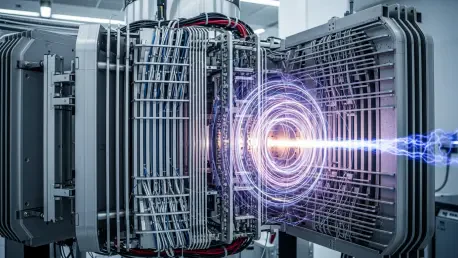
The technical proof of concept for this direct harvesting method relies on a specialized electrostatic converter designed to intercept ions as they emerge from the magnetic mirror. Using a series of meticulously engineered grids, the converter applies an electric field that slows down the high-speed ions, effectively braking them without physical contact. As these charged particles decelerate, their kinetic energy is transformed directly into a voltage potential, creating a steady electric current that can be fed into the power grid or used internally. During the experimental phase, the hardware demonstrated that it could handle the flux of a plasma exhaust and convert that motion into usable electricity with high fidelity. While the initial power output was relatively modest, the successful validation of the electrostatic components proves that the underlying physics is ready for industrial scaling. This method represents a significant leap over older concepts that struggled with grid transparency and particle scattering.
Eliminating the need for mechanical turbines and the associated steam cycle addresses one of the most persistent bottlenecks in nuclear engineering: the Carnot efficiency limit. Traditional thermal plants are constrained by the temperature differences between the reactor core and the cooling water, which typically caps their efficiency at around thirty to forty percent. In contrast, direct energy conversion bypasses these thermodynamic constraints by harvesting the work done by the particles themselves rather than relying on their thermal heat. This allows for an extraction process that could theoretically reach over ninety percent efficiency in a mature commercial system. By reducing the number of energy transformation steps—from kinetic to thermal, then to mechanical, and finally to electrical—the system significantly lowers the amount of waste heat that must be managed. This reduction in heat rejection means that the secondary cooling systems can be smaller, further contributing to the overall compact nature of the magnetic mirror power plant.
Maximizing Plant Efficiency and Economy
Improving Net Energy Balance with Hybrid Systems
In a commercial power plant configuration, direct energy conversion is not intended to function as a standalone solution but rather as a high-performance complement to traditional heat-capture methods. Developers envision a hybrid reactor design where a thermal blanket surrounds the central core to capture the heat generated by neutrons, while the system simultaneously harvests energy from the escaping charged particles. This dual-track approach functions much like a hybrid automotive engine, where two different power systems work in tandem to maximize the total output of the machine. By splitting the energy capture between these two modalities, the plant can achieve a far higher net energy balance than would be possible with a single-source extraction method. This integrated strategy ensures that every product of the fusion reaction, whether it is a high-speed neutron or a charged ion, is utilized to generate electricity. Such a comprehensive capture system is vital for making fusion a competitive player.
The economic implications of this efficiency boost are profound when considering the internal power requirements of a large-scale fusion facility. Reactors require a massive amount of house load electricity to maintain cryogenic cooling for the superconducting magnets and to power the high-energy heaters needed to sustain the plasma. If a plant can use its direct energy conversion system to satisfy these internal operational demands, the entire output of the primary steam turbines can be sold directly to the consumer grid. Industry analysts project that this arrangement could reduce the levelized cost of electricity by as much as twenty percent compared to traditional fusion designs. By improving the net energy balance of the facility, the system effectively lowers the financial threshold for fusion to become a viable alternative to existing renewable and fossil fuel sources. This shift from parasitic energy consumption to high-efficiency self-sustenance is the primary key for developers seeking profitability.
Scaling Technology and Expanding Fuel Horizons
Implementing direct energy conversion technology also facilitates the use of advanced fusion fuels that are traditionally considered too difficult for standard thermal reactors. Fuels such as deuterium and helium-3 are particularly attractive because they produce a high proportion of charged particles and very few neutrons compared to the standard deuterium-tritium mix. While these advanced reactions require much higher temperatures to initiate, they are perfectly suited for systems that thrive on the kinetic energy of charged ions. Moving toward these cleaner reactions would significantly reduce the neutron-induced damage to the internal reactor components, extending the operational life of the facility and lowering the long-term maintenance costs. Furthermore, the reduction in neutron production simplifies the regulatory and safety challenges associated with radioactive materials, making it easier to site these plants closer to urban population centers. This transition to low-neutron fuels is a strategic step for the industry.
The journey from lighting a single bulb to powering a metropolitan grid required a focused effort on scaling the underlying electrostatic architecture. Engineers identified that the next major hurdle involved the durability of the grid materials under the intense radiation and heat of a full-scale commercial environment. They prioritized the development of multi-stage converters capable of capturing a wider spectrum of particle energies, which increased the total system efficiency beyond initial laboratory results. These advancements moved fusion out of the realm of experimental science and into the world of practical, low-cost engineering. As organizations looked ahead, the integration of direct energy conversion was seen as a necessary evolution for reducing the capital expenditures of nuclear plants. By validating the hardware at a small scale, the industry laid the groundwork for a decentralized energy network. Future projects focused on refining the ion deceleration process to ensure fusion power became a reliable and affordable clean energy source.