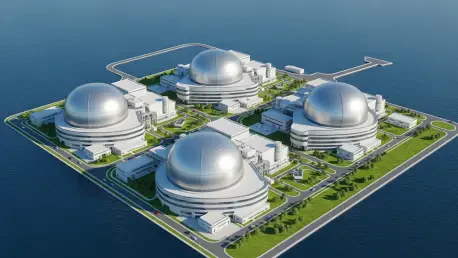

The rapid expansion of the Xudabao Nuclear Power Plant in Liaoning Province serves as a definitive case study in how large-scale infrastructure can redefine a nation’s energy security and carbon trajectory while maintaining industrial momentum. As one of the most ambitious energy projects in Northeast China, this facility represents a multi-billion dollar investment that bridges international cooperation with aggressive domestic technological advancement. The current construction roadmap extending from 2026 to 2029 aims to finalize the remaining units, ensuring that thousands of engineers are synchronizing the assembly of multiple reactors simultaneously. Beyond the mere generation of electricity, the project functions as a cornerstone for the regional economy, aiming to replace aging coal-fired plants that have long dominated the landscape. By integrating advanced Generation III+ reactor designs, China is setting a new benchmark for global nuclear safety and efficiency in the modern era.
Strategic Reactor Implementation: Integrating Foreign and Domestic Designs
Engineering Milestones: The VVER-1200 Technical Framework
The implementation of Units 3 and 4 at the site marks a significant phase in the technical evolution of the facility through the deployment of Russian-designed VVER-1200 reactors. These units are classified as Generation III+ pressurized water reactors, featuring enhanced safety systems designed to withstand extreme external impacts and internal stresses. The collaboration between the China National Nuclear Corporation and Rosatom has facilitated a seamless transfer of expertise.
This partnership highlights the importance of cross-border engineering alliances in accelerating the deployment of reliable baseload power. By utilizing standardized components and modular construction techniques, the project team has managed to keep the timeline on track despite the inherent complexities of assembling such massive primary circuit systems for the regional grid. The integration of these units represents a massive step toward regional energy independence and total grid stability.
Expansion Phases: Deploying Domestic CAP1000 Units
Parallel to the international cooperation seen in the later units, the development of Units 1 and 2 focuses on the integration of the CAP1000 reactor design, which is a localized version of the AP1000 technology. This strategic shift underscores the commitment to domesticating the nuclear supply chain and reducing reliance on imported components for critical infrastructure. The CAP1000 units employ passive safety features that rely on natural forces like gravity and convection.
Engineers have successfully optimized the layout of these units to maximize efficiency and shorten the refueling cycles, which is essential for maintaining a high capacity factor. This domestic focus not only bolsters the technological sovereignty of the energy sector but also creates a robust market for local manufacturing firms specializing in high-precision metallurgy and advanced controls. The successful localization of this technology serves as a blueprint for future energy projects.
Operational Safety: Digital Monitoring and Environmental Impact
To ensure the long-term reliability of the diverse reactor types at the site, the management has implemented a sophisticated digital twin system that creates a virtual replica of the plant. This technology allows operators to simulate various scenarios and monitor the structural integrity in real-time using sensors. By applying artificial intelligence to analyze the data, the system can predict maintenance needs before they become critical issues, thereby reducing the risk of downtime.
The completion of the construction phases successfully demonstrated the viability of integrating multiple reactor technologies into a single centralized hub. By displacing millions of tons of annual carbon emissions, the project transformed the regional air quality and provided a stable foundation for the industrial sector. Moving forward, the global industry should prioritize the standardization of safety protocols. The successful deployment proved that investment in modern nuclear technology remains a primary solution for sustainable development.