
The global refining industry is currently standing at the precipice of a radical transformation driven by a groundbreaking advancement in chemical engineering that introduces ultrathin polymer membranes. These innovative materials are designed to selectively separate complex hydrocarbon mixtures with a level of speed and precision that was previously considered impossible within the constraints of traditional industrial physics. By utilizing a sophisticated conceptual framework known as locked intrinsic microporosity, these membranes represent a shift away from energy-heavy thermal processes toward a much more efficient molecular filtration method. This technological leap aims to drastically reduce the massive amounts of energy required to produce the essential chemicals and fuels that currently power every aspect of modern society. Beyond mere efficiency, this innovation addresses the pressing need to mitigate the environmental footprint of one of the world’s most critical industrial sectors.
Industrial Legacy: Challenging a Century of Distillation
For over a hundred years, the process of crude oil refining has relied almost exclusively on the mechanical principles of thermal distillation to separate valuable chemicals. This traditional method operates by boiling complex petroleum mixtures to isolate various components based on their individual boiling points, a process that has remained largely unchanged since its inception. While distillation is undeniably effective for large-scale operations, it is notoriously inefficient from a thermodynamic perspective, currently consuming roughly one percent of the total energy used across the globe. Engineers and scientists have recognized for decades that a transition toward membrane-based technology could offer a far more sustainable path. By filtering molecules according to their size and chemical affinity rather than relying on high heat, industries could bypass the extreme energy demands of boiling, but the transition has faced significant technical hurdles throughout its long history.
The primary reason that membrane technology has struggled to gain a foothold in the refining sector involves the incredibly harsh nature of organic hydrocarbons themselves. Traditional polymer membranes often suffer from a phenomenon known as plasticization, where the aggressive chemical components of crude oil cause the polymer structure to swell and lose its integrity. When these materials swell, the precise pores required for molecular sieving expand, allowing unwanted particles to pass through and effectively rendering the entire filtration process useless for refining. Historical attempts to create more resilient polymers often resulted in membranes that were either too fragile for industrial pressures or too slow to handle the massive throughput required by modern refineries. This persistent technical barrier meant that while the idea of molecular sieving was elegant in theory, it remained impractical for the rigorous demands of the global energy supply chain and production.
Advanced Engineering: The Science of Locked Microporosity
To resolve the historical problem of membrane swelling under industrial conditions, researchers developed a new class of materials known as Polymers of Locked Intrinsic Microporosity. These specific polymers feature a rigid and highly contorted molecular structure that naturally forms a complex network of sub-nanometer pores specifically sized for molecular sieving. The breakthrough innovation that differentiates these materials is a specialized in-situ crosslinking technique, which essentially stabilizes the polymer at the nanoscale during the fabrication process. By locking these tiny pores into a permanent and optimal configuration, the membranes can maintain their high selectivity without expanding when exposed to solvents. This allows liquid hydrocarbons to pass through the structure at high speeds while blocking larger molecules, finally achieving the performance balance between durability and throughput that has eluded membrane scientists for many decades of intensive laboratory research.
Validation of this locking mechanism required the use of advanced molecular probing techniques at a high-level pulsed neutron facility located within the United Kingdom. Scientists employed quasi-elastic neutron scattering to observe the internal dynamics of the polymer chains with a degree of precision that conventional laboratory equipment simply cannot provide. This rigorous scientific analysis confirmed that the in-situ crosslinking effectively restricted the movement of the polymer chains at the atomic level, thereby preserving the rigid pores necessary for separation. Such a confirmation was essential for proving that the membranes would remain stable and functional even when subjected to the most aggressive organic solvents found in typical refinery streams. By providing a clear view of how these molecules behave under stress, the research team was able to verify that their structural design could withstand the harsh realities of large-scale industrial use and chemical exposure.
Practical Application: Achieving Performance and Scalability
The empirical performance of these new membranes has significantly outpaced existing state-of-the-art technologies in terms of both separation accuracy and processing speed. During rigorous testing phases involving real-world Arabian Extra Light crude oil, the membranes demonstrated an ability to remove approximately 99.8 percent of heavy hydrocarbons from the mixture. Additionally, the filtration process achieved a 93 percent reduction in sulfur content, a finding that holds immense value for the industry because sulfur must be removed early to prevent the corrosion of equipment. Perhaps most impressively, these membranes exhibited a ten-fold increase in the rate at which liquids pass through them compared to current high-end polymer alternatives. This high permeability suggests that the technology is capable of handling the massive volumes of fluid necessary for industrial processing, making it a viable candidate for replacing sections of traditional distillation towers today.
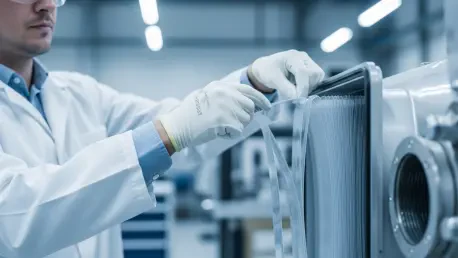
Bridging the gap between a successful laboratory prototype and a functional industrial application often presents the most significant challenge for any new material science discovery. To address this, the research team ensured that the new polymer membranes were fully compatible with established industrial manufacturing techniques such as roll-to-roll processing. This continuous fabrication method allowed for the production of large-scale membrane sheets that were subsequently integrated into standard spiral-wound modules used across various sectors. Because these modules are already the industry standard for large-scale water treatment and gas separation, the new technology can be incorporated into existing refinery frameworks without an overhaul. This compatibility significantly lowers the barrier to entry for refineries, as it allows for the modular upgrading of facilities using hardware that engineers and technicians are already trained to operate, install, and maintain for years.
Global Impact: Long-Term Sustainability and Partnerships
The broader implications of this membrane breakthrough extend well beyond the immediate needs of the petroleum industry into several other high-value manufacturing sectors. As the global economy continues its transition toward a lower-carbon future, there is an urgent demand for more efficient production methods in pharmaceuticals, specialty solvents, and bio-based feedstocks. By substituting traditional heat-driven separation processes with these pressure-driven membrane systems, industrial plants can drastically reduce their total energy consumption and greenhouse gas emissions. Furthermore, because membrane units are significantly smaller and more modular than massive distillation towers, they enable the construction of more flexible and localized processing facilities. This shift toward decentralized production allows companies to adapt more quickly to changing market conditions while minimizing the environmental footprint associated with centralized refining and distribution.
This significant breakthrough resulted from a massive collaborative effort that involved several international universities and deep-tech companies working in unison. Funding provided by organizations like the UK Research and Innovation Future Leadership Fellowship supported the strategic goal of creating high-selectivity membranes for sustainable chemical separations. The research team continued to explore the use of greener solvents during the manufacturing stage, proving that membrane-based molecular separation moved from a theoretical ideal into a commercially viable reality. This work marked a pivotal moment in the global quest to decarbonize heavy industry by offering a practical path toward a more sustainable industrial future. Scientists successfully demonstrated that the integration of advanced polymers could resolve long-standing energy inefficiencies. These findings offered a roadmap for future engineering applications across the sector, emphasizing the adoption of modular units.