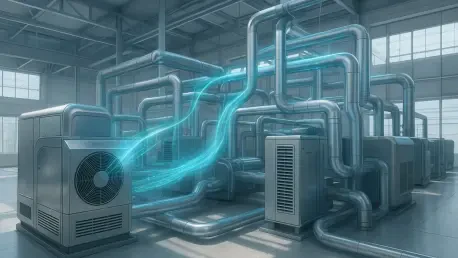

Strategic partnerships with major industrial groups are validating that energy-optimizing AI can meet the rigorous quality standards of international manufacturing markets. While the public imagination often fixates on bipedal robots performing manual labor, the most transformative shift in industrial operations is occurring within the invisible infrastructure of the factory floor. Physical AI has emerged as a sophisticated digital nervous system that resides within critical energy systems rather than existing as a separate mechanical entity. This technology does not simply process data; it completes a continuous closed loop of perception, decision-making, and execution in high-stakes environments. By integrating directly into air compressors, chillers, and water pumps, these intelligent systems are addressing the most energy-intensive components of modern production. These utilities often account for over half of a facility’s total electricity consumption, making them the primary target for decarbonization and cost-reduction efforts. As of 2026, the transition from passive monitoring to autonomous physical control has turned traditional mechanical assets into an interconnected, intelligent network that responds to fluctuating operational demands in real-time, ensuring that efficiency is no longer a goal but an inherent property of the system itself.
Redefining Intelligence Through Physical Control
The true value of intelligence in a heavy industrial setting is measured by its capacity to manage physical variables under volatile conditions. Traditional automation relied on static logic and manual setpoints that could not adapt to the subtle shifts in ambient temperature, humidity, or production load. In contrast, modern Physical AI systems act as dynamic controllers that understand the physics of the equipment they manage. This shift moves beyond the era of simple “if-then” commands and into an era where machines possess a high-fidelity understanding of their own operational boundaries. By focusing on the underlying thermodynamics and fluid dynamics of industrial utilities, Physical AI can predict the exact energy requirements of a process minutes before the demand peaks. This allows for a proactive rather than reactive management style, where the system anticipates the needs of the production line and adjusts the output of chillers and compressors accordingly. Such precision reduces wear and tear on expensive hardware while simultaneously cutting down on the wasted energy that typically occurs when systems are over-provisioned to handle potential spikes.
The Shift: Generative Models vs. Tangible Outcomes
Unlike generative models that are primarily judged on their ability to synthesize text or images, Physical AI is evaluated by its impact on the physical world. Its success is not found in a well-written report but in the maintenance of pressure stability within a pneumatic system or the precision of a cooling load for a chemical reactor. This functional difference requires a move from digital assistance to actual physical responsibility. When an AI system is given the keys to a multi-million-dollar HVAC system, it must operate with a level of reliability that exceeds human capability. The transition to this “driver’s seat” model means that the AI is no longer just providing suggestions to a human operator; it is actively manipulating valves, adjusting motor speeds, and balancing loads across multiple units. This level of autonomy is made possible by the integration of high-speed sensors and edge computing, which allows the AI to make decisions in milliseconds. The primary metric of success here is the reduction of the carbon footprint and the lowering of operational costs, which are tangible results that contribute directly to the bottom line of a manufacturing enterprise.
Implementation: Scenario-First Strategies in Heavy Industry
Successful deployment of Physical AI requires a scenario-first strategy that prioritizes the specific nuances of industrial environments over generalized digital models. For years, the industry struggled with one-size-fits-all solutions that failed to account for the unique protocols of different equipment manufacturers or the specific environmental conditions of diverse geographic locations. By immersing development teams in actual factory settings, engineers have been able to build models that understand the specific quirks of air compressors or the idiosyncratic behavior of aging water pumps. This approach involves gathering data from thousands of unique scenarios, ranging from extreme heat waves in tropical production hubs to the specific vibration patterns of machinery under heavy load. By accumulating this vast repository of industry-specific data, Physical AI can be trained to recognize patterns that are invisible to the human eye. This ensures that the theoretical models used in the lab translate into practical, high-utility tools that can be trusted by plant managers who are responsible for the uptime and safety of the facility.
Asset Management: Transforming Passive Utilities into Intelligent Nodes
The modernization of industrial energy systems involves transforming passive mechanical assets into active, intelligent nodes within a broader digital ecosystem. In the past, a chiller was a standalone piece of equipment that operated according to its own internal thermostat, often oblivious to the broader energy needs of the factory. Today, through the application of Physical AI, these assets are interconnected and capable of communicating with one another to optimize total system performance. For instance, a series of air compressors can now coordinate their output to ensure that the entire plant receives a steady stream of compressed air at the lowest possible energy cost. This intelligence extends to predictive maintenance, where the AI monitors the health of individual components and schedules repairs before a failure occurs. By treating energy utilities as a unified, intelligent network, manufacturers can achieve levels of efficiency that were previously impossible. This integration also allows for better participation in demand-response programs with local utilities, as the AI can automatically reduce power consumption during peak hours without disrupting the core manufacturing processes.
Overcoming Technical Thresholds in Industrial Environments
The path to fully autonomous industrial energy systems is fraught with technical challenges that distinguish it from other fields of artificial intelligence. One of the most significant hurdles is the acquisition of high-quality data that accurately reflects the complexity of the physical world. In the digital realm, data is abundant and often easy to label, but in a factory, the most valuable information is found in “state-action-result” sequences. This requires tracking exactly what a machine was doing, what specific adjustment the AI made, and what the resulting impact on energy consumption and equipment health was. These datasets are proprietary and difficult to obtain, as they require constant monitoring of live production environments over long periods. Furthermore, the variability of industrial hardware means that an AI model must be robust enough to handle data from machines that may be decades old alongside the latest high-tech sensors. Overcoming these thresholds is essential for building a system that is not only smart but also resilient enough to function in the gritty, unpredictable reality of a working factory floor.
Navigating Data: Scarcity and Execution Security
Security and data integrity are the cornerstones of any physical AI implementation, as the consequences of a digital error in the physical world can be catastrophic. Unlike a virtual assistant that might provide an incorrect answer to a question, an industrial AI that issues a faulty command to a high-pressure boiler could lead to significant equipment damage or even endanger the lives of workers. To mitigate these risks, enterprises are implementing rigorous rule-based safety boundaries that act as a “sanity check” for AI-generated strategies. These safety layers ensure that even if the AI identifies a theoretically more efficient path, it cannot execute any command that falls outside of the pre-defined mechanical tolerances of the equipment. This combination of neural network intelligence and deterministic safety protocols provides the necessary confidence for plant operators to relinquish manual control. Moreover, the focus on execution security extends to the protection of the data itself, ensuring that the proprietary operational patterns of a factory are shielded from external cyber threats while still allowing the AI to learn and adapt from the local environment.
Scaling: Generalization Across Industries and Platforms
For Physical AI to achieve widespread commercial viability, it must solve the problem of generalization across different industrial sectors and equipment configurations. No two factories are identical; they often feature different layouts, varying brands of machinery, and unique production schedules. A specialized AI model that only works for a single facility is too expensive to develop and maintain at scale. The solution lies in the adoption of a standardized cloud-edge-end architecture that allows a vertical AI model to adapt quickly to new environments. By using a modular approach, developers can create a core intelligence layer that understands the basic principles of energy optimization while allowing for local “edge” adjustments that account for site-specific variables. This architecture enables rapid cross-industry replication, allowing a system developed for an automotive plant to be adapted for a pharmaceutical facility with minimal redevelopment. This scalability is what is currently driving the rapid adoption of Physical AI across the global manufacturing landscape, as it lowers the barrier to entry for smaller enterprises and speeds up the return on investment for larger industrial groups.
Optimization: From Manual Monitoring to Autonomous Action
The most immediate benefit of deploying Physical AI is the dramatic reduction in the time required to respond to changing energy demands and environmental conditions. In a traditional setup, the task of optimizing energy supply often fell to veteran technicians who relied on years of experience and manual gauge readings to make adjustments. This process was inherently slow, often taking thirty minutes or more to realize and correct an inefficiency. In contrast, an AI-driven system can analyze hundreds of data points—including local weather forecasts, current production loads, and the real-time health of the machinery—to formulate and execute an optimal strategy in as little as thirty seconds. This speed allows for micro-adjustments that aggregate into significant energy savings over the course of a year. By removing the bottleneck of human intervention, factories can operate much closer to their theoretical maximum efficiency. This transition from manual monitoring to autonomous optimization represents a fundamental shift in how industrial energy is managed, moving away from a reliance on human intuition toward a data-driven, automated reality.
Strategic Advancements: Lessons from the Deployment Phase
Early adopters of Physical AI realized that waiting for a perfect, all-encompassing model was a strategic mistake that delayed significant efficiency gains. Instead, successful teams implemented a phased rollout that focused first on non-critical utilities before expanding the AI’s control to more complex areas of the production line. They recognized that the data collected during these initial trials provided the essential foundation for subsequent performance improvements. These organizations also learned the importance of fostering a collaborative relationship between AI developers and traditional plant engineers, ensuring that the software was built with a deep respect for the mechanical limits of the hardware. By analyzing the outcomes of these deployments, industrial leaders demonstrated that the most robust path forward involved a combination of high-speed autonomous precision and human-defined safety parameters. These steps established a clear roadmap for the rest of the industry, proving that the integration of intelligence into the physical lifeblood of manufacturing was both safe and highly profitable. The lessons learned during this period continue to guide the development of next-generation systems as they become even more integrated into the global supply chain.