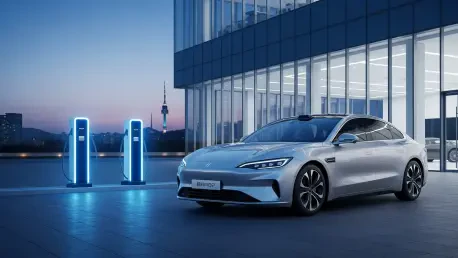

The roar of internal combustion engines that once defined the Seoul skyline is fading into a silent electric revolution led by unfamiliar neighbors. For two decades, Japanese sedans were a staple of the premium imported car market in South Korea, but that era has reached a definitive end. While Honda recently followed Nissan and Infiniti in a full-scale retreat from the peninsula, a new sound is filling the void: the high-pitched hum of Chinese electric motors. This shift is occurring so rapidly that in just one year, sales of Chinese-made electric vehicles (EVs) skyrocketed by 286 percent, signaling a total restructuring of one of the world’s most competitive automotive landscapes.
The Sudden Silence of Japan’s Engines in Seoul
The landscape of the Korean peninsula was once a stronghold for the reliability of Japanese engineering, yet the streets of Gangnam now tell a different story. The departure of major Japanese brands marks a psychological shift for local consumers who once viewed Tokyo’s automotive output as the gold standard of imported luxury and practicality. As dealerships close their doors, the vacuum is being filled by a diverse range of Chinese models that offer a glimpse into a future where legacy prestige no longer dictates purchasing decisions.
This transition is not merely a matter of changing tastes; it represents a fundamental displacement of market power. The exit of Honda has left Toyota and Lexus as the final holdouts in a market that is increasingly hostile toward traditional fuel systems. Meanwhile, the aggressive entry of Chinese manufacturers into the passenger vehicle segment has turned a once-steady market into a volatile arena of technological competition.
Why the Traditional Import Hierarchy is Collapsing
The departure of Japanese brands was not a byproduct of diplomatic tensions alone, but a failure to align with the aggressive pivot toward electrification in South Korea. For years, Japanese manufacturers relied on their reputation for reliable internal combustion engines and hybrid systems, but this “slow and steady” approach left them vulnerable. As domestic giants like Hyundai and Kia set an incredibly high bar for EV technology, Japanese brands found themselves with narrow product lineups that simply could not compete with the digital-first experience modern buyers demand.
This technological gap created a vacuum that Chinese manufacturers, unburdened by legacy combustion assets, were more than ready to fill. Unlike the incumbents, these new entrants treated the vehicle as a mobile software platform rather than a mechanical tool. By the time Japanese firms attempted to introduce dedicated electric models, the consumer perception had already shifted toward brands that could offer faster charging, better software integration, and superior battery range at a lower entry point.
The Mathematical Reality of the Chinese EV Influx
The scale of China’s market entry is best understood through the aggressive expansion of BYD and the success of Shanghai-built Teslas. In early 2025, BYD officially entered the passenger market and moved over 10,000 units in less than a year, largely driven by the Dolphin hatchback’s accessible $13,500 price tag. This aggressive pricing strategy forced a recalibration of the entire market, making electric mobility attainable for a demographic that previously viewed imported EVs as an expensive luxury.
By 2026, China’s share of the South Korean EV market surged to nearly 34 percent, a massive leap from the 4.7 percent share it held just four years prior. This growth came at the direct expense of domestic brands, whose market dominance slipped from 75 percent to 57.2 percent as consumers prioritized high-tech features and competitive pricing. The sheer volume of Chinese imports redefined the competitive baseline, proving that brand loyalty is secondary to value in the age of electrification.
Expert Insight into the Hybrid-to-Electric Transition
Despite the current surge, industry veterans suggest that the market shift is still in its early stages. Professor Kim Pil-soo of Daelim University points out that Chinese EVs are not yet a direct substitute for the Japanese cars they are replacing. Historically, Japanese brand loyalists favored hybrid technology, while the current wave of Chinese EV buyers consists primarily of tech-focused early adopters. However, this distinction is expected to blur as the infrastructure for charging becomes as ubiquitous as the gas station.
As premium Chinese subsidiaries like Geely’s Zeekr and Xpeng prepare to launch midsize SUVs and sedans, they are positioning themselves to capture the mainstream buyer who is finally ready to move beyond the hybrid era. These companies are not just competing on price anymore; they are competing on luxury and performance benchmarks that were once the exclusive domain of German and Japanese manufacturers. The transition is evolving from a budget-conscious trend into a wholesale transformation of the premium segment.
How to Evaluate the New Generation of Imported EVs
As the market moves from Japanese hybrids to Chinese electrics, consumers and analysts used a new framework to assess the changing landscape. They prioritized “price-to-tech” ratios, specifically looking at how models like the Zeekr 7X compared to established benchmarks like the Tesla Model Y or the Ioniq 5. Success in the Korean market depended heavily on localized charging networks and service centers, areas where Chinese firms began investing heavily to secure long-term viability.
The 2026 launch window for Xpeng’s P7 and G6 served as the litmus test for whether Chinese brands could move from being budget alternatives to becoming the new standard for premium mobility. Analysts monitored these developments to determine if the aggressive expansion could be sustained against a backdrop of increasing domestic protectionism. Ultimately, the shift established a blueprint for how agile, tech-centric manufacturers could dismantle decades of established brand equity through rapid innovation and strategic pricing.