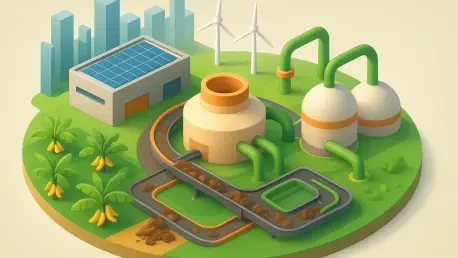

The global banana industry remains a powerhouse of the international agricultural sector, yet it carries a significant environmental footprint that often goes overlooked during the shipment of millions of tons of fruit. Co-digestion of urban food waste and banana residues creates a stable environment where city waste provides necessary moisture and agricultural waste adds structural carbon. This innovative approach addresses a dual crisis: the accumulation of urban organic waste in overflowing landfills and the massive quantities of agricultural leftovers, such as pseudostems and stalks, that typically rot in the fields of Colombia and Ecuador. While these agricultural materials were once viewed as mere debris, they actually represent a dense, untapped reservoir of chemical energy. However, the complex cellular structure of banana plants, primarily composed of lignocellulose, makes it incredibly difficult for standard biological processes to extract this energy efficiently. By integrating city-based food scraps with rural agricultural waste, researchers have developed a circular system that not only mitigates the release of uncontrolled greenhouse gases from decomposition but also generates a reliable stream of renewable biogas. This strategy represents a fundamental shift in how tropical nations view their biological assets, turning what was once a waste management nightmare into a cornerstone of regional energy security and environmental stewardship in the current landscape of 2026.
Optimizing the Bioenergy Conversion Process
Refining Treatment Parameters: Finding the Severity Window
The core challenge of utilizing banana residues lies in the recalcitrant nature of lignin, a natural polymer that reinforces plant cell walls and protects them from microbial attack. To bypass this biological shield, the steam explosion process subjects the biomass to high-pressure saturated steam at temperatures ranging from 160°C to 200°C. When the pressure is instantaneously released after a specific residence time, the water inside the plant fibers undergoes a violent phase change into steam, effectively tearing the structural matrix apart from the inside out. This physical disruption is coupled with chemical changes, where the heat catalyzes the hydrolysis of hemicellulose, making the remaining cellulose much more accessible to the enzymes produced by anaerobic bacteria. Without this critical step, the bacteria in a biogas digester would take weeks to penetrate the tough stalks, leading to low methane yields and inefficient operation. By precisely controlling the thermodynamics of the steam explosion, operators can ensure that the biomass is perfectly prepared for the microbes, maximizing the surface area available for fermentation and significantly accelerating the rate of gas production.
Achieving the perfect balance during steam explosion requires a deep understanding of the “severity factor,” which accounts for both the temperature and the duration of the treatment. If the treatment is too aggressive, the high heat can trigger secondary reactions that convert simple sugars into inhibitory compounds like furfural and hydroxymethylfurfural. These toxins are detrimental because they can kill or significantly slow down the methane-producing archaea in the anaerobic digester. Research conducted through 2026 has pinpointed an optimal treatment point at 180°C for approximately ten minutes. This specific configuration provides enough energy to deconstruct the lignocellulosic matrix without reaching the threshold where inhibitory byproducts become a problem. This “Goldilocks” zone ensures that the highest possible amount of fermentable sugar is preserved, leading to a much more productive downstream fermentation process. By standardizing these parameters, industrial-scale facilities can maintain a consistent output of biogas regardless of the varying quality of the raw agricultural inputs, creating a more predictable and stable renewable energy source for the regional power grid.
Synergistic Effects: The Power of Co-Digestion
While the steam explosion treatment makes banana residues more digestible, mixing them with urban food waste provides a secondary layer of process stability that is difficult to achieve with agricultural waste alone. Urban food waste is naturally rich in nitrogen and highly biodegradable, but when it is digested by itself, it tends to break down too quickly, causing the pH levels in the reactor to drop sharply. This acidification can stall the entire system, rendering the microbial community inactive. In contrast, pretreated banana residues provide a robust carbon source and a physical structure that helps buffer the chemical environment. By blending these two distinct waste streams, the resulting mixture maintains a more balanced carbon-to-nitrogen ratio, which is essential for the sustained growth of the bacteria involved in methane production. This synergy allows the anaerobic digestion system to operate at higher loading rates and with much greater resilience against fluctuations in the feedstock composition, ensuring a continuous and efficient energy conversion process throughout the operating year.
The quantitative benefits of this co-digestion strategy are evident in the increased biodegradability and methane yield observed in recent pilot studies. Researchers identified that a blend consisting of 70% urban food waste and 30% pretreated banana residues yields the most favorable results, showing a 25% increase in total methane production compared to the digestion of untreated agricultural waste. This mixture not only improves the chemical stability of the reactor but also optimizes the moisture content, reducing the need for additional water inputs. By utilizing the high water content of city food scraps to hydrate the drier, more fibrous banana stalks, the process becomes more resource-efficient. This integration demonstrates that waste management solutions are most effective when they bridge the gap between urban and rural environments. In 2026, this model serves as a template for municipal planners looking to divert organic waste from landfills while simultaneously supporting the agricultural sector’s transition toward sustainable energy production, creating a truly interconnected and efficient bioeconomy.
Broader Impacts of the Waste-to-Energy Model
Economic Advantages: Scaling for Regional Power
The transition to a waste-to-energy model offers profound economic benefits for regions that are currently dependent on imported fossil fuels for electricity generation. Detailed analysis shows that the optimized digestion of these waste streams can produce over 450 liters of methane for every kilogram of organic matter processed. On a larger scale, this translates to roughly 200 kilowatt-hours of clean electricity per ton of wet biomass, a figure that becomes staggering when considering the millions of tons of banana waste generated annually in South America and Southeast Asia. For a country like Colombia, the widespread adoption of this technology could potentially supply a significant portion of the rural population’s energy needs through decentralized power plants. These facilities can be situated near major plantations and urban centers, reducing the need for expensive long-distance transmission infrastructure. This localized approach to energy production creates new revenue streams for farmers and waste management companies, turning the costs associated with disposal into a profitable asset that strengthens the local economy.
Beyond the immediate generation of electricity, the waste-to-energy process produces a high-value byproduct known as digestate, which has major implications for the agricultural industry’s bottom line. Digestate is the nutrient-rich material left over after the anaerobic digestion process is complete, containing concentrated amounts of nitrogen, phosphorus, and potassium that were originally present in the organic waste. This material serves as an excellent organic fertilizer, allowing banana producers to return vital nutrients to the soil and reduce their reliance on expensive, synthetic chemical fertilizers. By closing the nutrient loop, plantations can improve soil health and long-term productivity while lowering their operational expenses. In the economic landscape of 2026, where the prices of petrochemical fertilizers remain volatile, the ability to produce a steady supply of high-quality organic soil amendments on-site is a major competitive advantage. This circularity ensures that the value of the original plant material is fully realized, providing benefits that extend from the energy grid back to the very fields where the fruit was first grown.
Strategic Implementation: Logistics and Infrastructure
Implementing a large-scale bioenergy system requires more than just biological expertise; it demands a sophisticated logistical framework that can handle the movement of bulky materials efficiently. Banana waste is heavy and contains significant amounts of water, making long-distance transportation economically unfeasible. Therefore, the most viable strategic model involves the construction of regional “biorefinery hubs” located at the intersection of major agricultural zones and urban centers. These hubs can collect food waste from cities and agricultural residues from nearby farms, minimizing the carbon footprint and cost associated with trucking. By centralizing the steam explosion and digestion equipment in these strategic locations, operators can benefit from economies of scale while still serving the needs of the local community. This infrastructure-led approach allows for the development of specialized transport routes and collection schedules that ensure a steady flow of fresh biomass, which is critical for maintaining the health of the microbial populations inside the digesters.
The integration of these biorefineries into the national energy grid also provides a necessary buffer for energy security, particularly in tropical regions that may be vulnerable to climate-related power disruptions. Biogas-to-electricity plants can provide “baseload” power, meaning they generate electricity consistently regardless of whether the sun is shining or the wind is blowing. This makes them an ideal complement to other renewable sources like solar and wind power, which are more intermittent. In 2026, government incentives and carbon credit programs are increasingly favoring projects that demonstrate such integrated waste management and renewable energy generation. By aligning municipal waste policies with agricultural subsidies, nations can create a supportive regulatory environment that encourages private investment in these facilities. This strategic alignment not only solves the immediate problem of waste accumulation but also builds a more resilient and self-sufficient energy infrastructure that can withstand the global shifts toward a carbon-neutral future.
Technical Foundations for Future Scaling
Streamlining the Pretreatment: Mechanical and Thermal Efficiency
A major breakthrough in the current research is the development of a streamlined pretreatment workflow that treats various parts of the banana plant as a single feedstock. In the past, the different physical properties of pseudostems and fruit stalks required separate processing lines, which increased both capital and operational costs. However, recent findings have demonstrated that a single severity window for steam explosion can effectively break down a combined mixture of these residues without sacrificing methane yield. This simplification is critical for industrial developers, as it reduces the complexity of the mechanical sorting systems needed at the front end of the plant. A more uniform process means fewer points of failure and a more straightforward path to scaling the technology from laboratory prototypes to full-scale commercial installations. This advancement makes the technology much more attractive to investors who are looking for reliable and low-maintenance solutions for organic waste processing in diverse agricultural settings.
Efforts to improve the thermal efficiency of the steam explosion process are also central to making the technology more sustainable on a larger scale. Modern biorefineries are being designed to capture and reuse the heat generated during the pressure release phase, redirecting it to pre-warm incoming biomass or to maintain the optimal temperature of the anaerobic digesters. This internal heat recovery significantly lowers the external energy requirement of the plant, ensuring that the net energy balance of the system remains highly positive. In 2026, the development of continuous-flow steam explosion reactors, rather than older batch-style systems, has further increased throughput and lowered operational downtime. These technical refinements ensure that the bioenergy produced is not only renewable but also cost-competitive with traditional energy sources. By focusing on mechanical simplicity and thermal optimization, the industry is paving the way for a new generation of waste-to-energy facilities that are robust enough to handle the challenging environments often found in tropical agricultural zones.
Global Implications: Bioenergy for Tropical Nations
The success of the Colombian model for banana waste conversion has far-reaching implications for other major fruit-producing nations across the Global South. Countries like India, the Philippines, and Ecuador face similar challenges regarding agricultural residue management and are looking for ways to bolster their domestic energy production. The parameters established for steam explosion and co-digestion can be adapted to other tropical crops with high fiber content, such as pineapple leaves or sugarcane bagasse. This creates a versatile technical template that can be exported globally, helping developing nations meet their carbon reduction targets while improving sanitation and waste management in rapidly growing urban areas. As international climate policy continues to emphasize the importance of methane reduction, the ability to capture this gas from waste streams and use it as a clean fuel becomes a vital tool in the global effort to mitigate environmental impacts while supporting economic growth in 2026.
As this technology matures, it will likely serve as a cornerstone for national bioenergy strategies that prioritize self-sufficiency and resource recovery. The move away from centralized, fossil-fuel-based power systems toward decentralized, biomass-powered networks allows for greater community involvement and localized benefits. Education and training programs for local engineers and technicians are essential for the long-term success of these projects, ensuring that the technical knowledge required to operate and maintain biorefineries is available within the regions that need them most. By fostering international collaboration and sharing the data derived from these successful waste-to-energy implementations, the global community can accelerate the transition to a sustainable bioeconomy. This research has proven that with the right combination of thermal pretreatment and biological synergy, the world’s most common agricultural residues can be transformed from a burden on the land into a powerful engine for renewable energy and sustainable development.
The Path Forward: Advancing the Global Bioeconomy
Reflecting on Research Outcomes
This research demonstrated that the integration of steam explosion was a game-changer for the bioenergy sector in the transition to more sustainable agricultural practices. The study established that a specific severity window of 180°C for ten minutes successfully balanced the necessary fiber breakdown with the preservation of fermentable sugars. Scientists discovered that the co-digestion of 70% urban food waste with 30% pretreated banana residues optimized the metabolic health of the microbial communities, leading to a significant increase in methane yield. This breakthrough provided a clear roadmap for industrial applications that reduced the environmental burden of tropical agriculture by preventing the uncontrolled decomposition of waste. The quantitative data gathered during these pilot phases confirmed that transforming lignocellulosic biomass into renewable natural gas was both technically feasible and highly efficient. These achievements laid the groundwork for a broader adoption of waste-to-energy technologies across diverse geographical regions.
Actionable Steps for Regional Adoption
Moving forward, the primary focus must be on the rapid deployment of regional biorefinery clusters that can handle mixed waste streams at scale. Municipalities and agricultural corporations should prioritize the establishment of joint ventures to share the capital costs of steam explosion equipment and anaerobic digestion tanks. To facilitate this, governments must implement clear regulatory frameworks that simplify the permitting process for bioenergy facilities and provide guaranteed feed-in tariffs for the electricity they produce. Furthermore, continued investment in mechanical engineering will be necessary to transition from batch processing to fully continuous systems, which will improve the economic viability of the model. By fostering a policy environment that rewards carbon sequestration and waste diversion, regions can attract the private investment needed to turn these scientific findings into a nationwide energy reality. Taking these concrete steps will ensure that the potential of the bioeconomy is fully realized, providing clean energy and organic fertilizers to the communities that need them most.