
Christopher Hailstone has spent decades at the intersection of energy management and grid security, helping heavy industry navigate the complex transition toward cleaner power. As industrial sectors face mounting pressure to decarbonize, the latest research from the University of California, Berkeley suggests a massive shift is not only possible but economically inevitable. In this conversation, we explore the findings of a landmark study covering over 3,000 industrial sites, revealing how off-grid renewables and thermal storage can meet a staggering one-third of the nation’s industrial heat demand. We discuss the transition from volatile natural gas to stable, on-site generation, the specific roles of heat pumps and thermal batteries, and the spatial challenges facing facilities in crowded urban centers.
Industrial heat pumps are often cited as the most cost-effective solution for processes under 200 degrees Celsius. How do these systems integrate into existing manufacturing lines, and what specific operational metrics should a plant manager track to ensure they are outperforming traditional natural gas boilers?
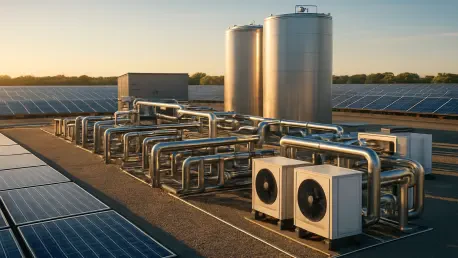
Integrating industrial heat pumps requires a shift from thinking about combustion to thinking about heat recovery and electrification. According to the Berkeley analysis, these systems are now the most cost-effective clean solution for low-temperature needs below 200 degrees Celsius, often reaching cost parity with fossil fuel alternatives. To ensure success, a plant manager must track the Coefficient of Performance (COP) specifically under varying load conditions to see how much thermal energy is being moved per unit of electricity. You also need to monitor the “delivered cost of heat” in real-time, comparing it against the volatile fluctuations of natural gas prices that have historically plagued the manufacturing industry. When you see the steady, predictable hum of a heat pump providing consistent thermal energy without the sensory “roar” and emissions of a boiler, the operational benefits become physically and financially tangible.
Thermal batteries are becoming more competitive for high-temperature applications where solar and wind are available. What are the step-by-step engineering considerations for installing these systems on-site, and how do they help mitigate the risks associated with the price volatility of fossil fuels?
The engineering journey for thermal batteries begins with a rigorous audit of the site-specific renewable potential, as the Berkeley researchers did for thousands of locations across the country. First, you must size the on-site wind or solar array to ensure it can charge the thermal medium—often crushed rock or molten salts—during peak production hours. Second, you design the discharge interface to match the high-temperature requirements of the specific industrial process, ensuring the heat is delivered at the exact pressure and temperature needed. These batteries act as a physical hedge against the market, allowing a facility to “lock in” its energy costs for decades and ignore the unpredictable price spikes of natural gas. By decoupling the heat supply from the external fuel market, manufacturers gain a level of cost predictability that was simply impossible when we were entirely dependent on fossil fuel pipelines.
Roughly 27% of industrial heat demand is located in urban areas where physical space for solar or wind arrays is limited. What creative spatial solutions or off-grid configurations can facilities in dense areas use, and how can they overcome these specific geographical constraints?
The 27% of facilities located in dense urban environments face the most significant hurdle because they lack the “footprint” for massive solar farms or wind turbines. For these sites, we have to look at vertical integration or modular off-grid configurations that might utilize adjacent industrial brownfields or rooftop space more aggressively. However, the Berkeley report highlights that for many of these sites, the challenge is truly about the limitation of local renewable potential versus the high heat density required. In these cases, we might see more “micro-grid” clusters where multiple urban factories pool their resources to develop a shared renewable hub just outside the city limits. Overcoming these constraints requires a mix of industrial geothermal energy and high-density thermal storage that can sit in a basement or a small outdoor plot, maximizing every square inch of available urban land.
While clean heating technologies have reached cost parity in many regions, many manufacturers remain unaware of their potential. What specific strategies should developers use when pitching these alternatives, and what common misconceptions about reliability or transition timelines do they need to address with data?
Developers need to move away from purely environmental pitches and start leading with the hard economic data found in the Berkeley study, specifically targeting the “delivered heat” cost. The biggest misconception is that renewable heating is an “intermittent” liability, but developers can counter this by showing how thermal energy storage provides a continuous, uninterrupted supply even when the sun isn’t shining. You have to address the “reliability gap” by demonstrating that an on-site system, free from grid outages or pipeline failures, is actually a more secure asset for a factory. Using data from the 3,000-plus sites analyzed in the report, developers can show that from 2026 to 2035, the economic advantage of these systems will only grow as renewable costs continue to plummet. It is about proving that the transition is no longer a futuristic dream but a present-day strategy for financial stability and operational resilience.
What is your forecast for the adoption of these renewable-powered industrial systems?
I expect a rapid acceleration in adoption, particularly in regions like California and the Northeast where the combination of high natural gas prices and low-cost renewables makes the economics undeniable. By 2035, I forecast that we will see at least one-third of the U.S. industrial heat demand being met by these off-grid systems, representing a massive departure from our current reliance on the gas grid. This shift will be driven by the realization that “cost parity” has already arrived for many processes, and the desire for “predictability” will outweigh the comfort of staying with legacy fossil fuel systems. As more facilities successfully integrate thermal batteries and heat pumps, the “reliability” myth will vanish, and we will see a domino effect across sectors like food processing, chemicals, and paper manufacturing. The technology is ready, the economics are favorable, and the next decade will be defined by an industrial landscape that is both cleaner and far more energy-independent.