
Christopher Hailstone is a seasoned veteran in energy management and utility security, renowned for his deep understanding of grid reliability and global electricity delivery. In this discussion, we explore the economic shifts triggered by Iranian-Omani maritime deals, the logistical strain of navigating narrow territorial waters, and the critical role of international military protection in maintaining global supply volumes. As geopolitical tensions test the physical limits of the world’s most vital chokepoint, Hailstone provides a necessary perspective on how these administrative shifts dictate the future of energy stability.
Iran and Oman have reportedly reached a deal to share revenue and control of the Strait of Hormuz. How would a revenue-sharing agreement and a potential transit fee fundamentally change the economics of global shipping, and what specific financial impact would this have on oil benchmarks like Brent and WTI?
A transit fee would fundamentally shift energy security costs directly to the consumer. We recently saw Brent crude futures close 74 cents lower at $87.84, while West Texas Intermediate settled at $82.23. If Tehran implements a revenue-sharing model, it essentially turns a free international passage into a regulated toll road. This creates a geopolitical premium that could cause benchmarks to swing wildly based on diplomatic sentiment, especially with prices already down more than 5% for the week as markets digest these developments.
Under the proposed arrangement, ships would enter the Persian Gulf via Iranian waters and exit through a joint corridor. What logistical challenges does this specific routing pose for tanker captains, and how might Gulf nations respond to paying Tehran for passage?
Moving the entry point entirely into Iranian waters adds significant legal and psychological pressure on tanker captains who must navigate strict coastal regulations. The proposed exit through a joint corridor means ships will be constantly transitioning between different jurisdictions in a very tight space. Many Gulf nations that have historically faced conflict remain hostile toward the idea of funding an adversary through transit fees. There is a high probability these nations will demand continued international protection to avoid a scenario where they are essentially paying Tehran to maintain regional influence.
The U.S. has utilized economic pressure and military protection for tankers rather than direct strikes. How does the military’s role in ferrying 660 million barrels of crude since May interact with these new diplomatic developments, and what happens to market stability if Washington refuses to accept the agreement?
The fact that 660 million barrels of crude oil have exited the strait under military protection since May highlights how dependent the world remains on a U.S. security umbrella. If Washington refuses to recognize this new Iran-Oman pact, we face a dangerous stalemate where the Revolutionary Guard may attempt to block unauthorized vessels. U.S. economic pressure recently kept prices lower, with oil falling more than 3% as war fears eased. However, a total rejection of the deal by Washington could shatter this fragile calm, potentially halting flows and forcing a massive price correction.
With the Strait of Hormuz being only 21 miles wide at its narrowest point, the physical geography creates a bottleneck. Can you explain the tactical difficulties of managing a joint shipping route in such a confined space and what metrics define whether the strait is “functioning”?
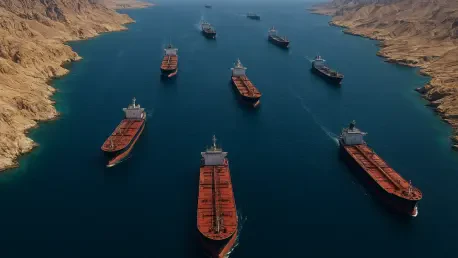
Managing a shipping route in a space that is only 21 miles wide is a logistical challenge with zero room for error. The tactical difficulty is high because inbound and outbound traffic must be separated while avoiding territorial disputes in the chokepoint. We define the strait as “functioning” primarily through throughput volume, which recently saw 10 million barrels of oil exiting in a single day. As long as those 10 million barrels keep moving without physical obstruction or seizure, the market considers the strait operational despite the high political friction.
Public statements suggest that over 10 million barrels of oil are currently exiting the strait daily despite threats of military escalation. What is the process for maintaining these volumes during a crisis, and how do insurance premiums fluctuate with these deals?
Maintaining a flow of 10 million barrels daily during a crisis requires tankers to move in monitored patterns with military assets often nearby to deter harassment. The process involves real-time communication between vessel operators and regional commands to ensure the “pouring out” of oil continues without a hitch. Insurance premiums are the first to feel the heat; they typically skyrocket at the mention of joint control because underwriters view shared revenue as a precursor to potential seizures. The lack of clarity regarding international acceptance keeps premiums high as the risk of a ship being caught in a jurisdictional tug-of-war increases.
What is your forecast for global oil prices and the security of the Strait of Hormuz?
With prices down more than 5% for the week, I expect a period of volatile consolidation as the market waits for a formal reaction to the Tehran-Muscat deal. Brent at $87.84 and WTI at $82.23 reflect a cautious hope that diplomacy will prevail over direct military conflict. My forecast suggests prices will stay within this current range as long as the 10 million barrel daily flow remains unhindered. Security will remain a hybrid model where the U.S. continues to protect the 660 million barrels moving through the region while regional players attempt to formalize their administrative grip.