
The persistent hum of jet engines crisscrossing the globe represents the lifeblood of modern commerce, but it also carries the weight of an enormous and growing carbon footprint that the logistics industry can no longer afford to ignore. As global supply chains face mounting pressure to decarbonize, the air freight sector, a significant contributor to greenhouse gas emissions, finds itself at a critical turning point. The industry’s path toward sustainability is not one that can be walked alone.
This journey is now being charted by a coalition of forward-thinking stakeholders. Global logistics firms like Kuehne+Nagel, major airlines such as SWISS, and pioneering clean energy companies like Synhelion are forming powerful alliances to tackle the emissions challenge head-on. Their efforts are amplified by a clear and growing chorus from customers who increasingly demand and prioritize environmentally responsible logistics, transforming sustainability from a corporate ideal into a market imperative.
A New Sunrise for Aviation The Rise of Solar Powered Fuel
Forging a Greener Path Strategic Alliances and Solar Fuel Innovation
The aviation industry is witnessing a pivotal shift toward cross-sector collaboration as the primary vehicle for accelerating the adoption of Sustainable Aviation Fuel (SAF). These partnerships are essential for sharing risks, pooling resources, and validating emerging technologies. The strategic agreement between Kuehne+Nagel and SWISS serves as a compelling model, demonstrating how a logistics provider and an airline can jointly de-risk the investment required to bring novel clean energy solutions to market.
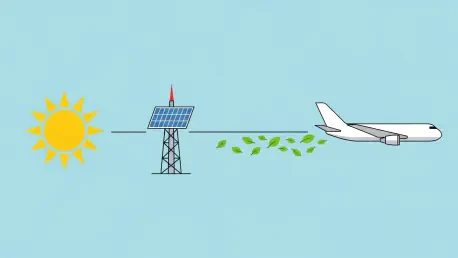
At the heart of this initiative is Synhelion’s breakthrough technology, which uses concentrated solar energy to produce synthetic liquid fuel. This process creates a “drop-in” fuel that is chemically identical to conventional jet fuel, allowing it to be used in existing aircraft and distributed through current airport infrastructure without any modifications. By converting solar power into a transportable, high-energy-density fuel, Synhelion offers a scalable and carbon-neutral pathway for aviation.
Fueling the Future Market Signals and Growth Projections for Solar SAF
Long-term offtake agreements are proving to be a cornerstone in the financial architecture of the green transition. By guaranteeing the purchase of a product years in advance, these commitments provide fuel producers with the financial certainty needed to secure investment and build out their infrastructure. This strategy effectively creates a stable market before the first drop of fuel is even produced.
The five-year purchase commitment from Kuehne+Nagel to SWISS, set to begin in 2027, sends a powerful signal to the wider market. It validates the commercial potential of solar-derived SAF and encourages further investment in clean energy technologies. This model is expected to create a ripple effect, stimulating broader market growth and helping to build a robust supply chain for SAF that can meet the future demands of the aviation industry.
Navigating the Headwinds Overcoming SAFs Cost and Scarcity Hurdles
Despite its promise, the widespread adoption of SAF has been hampered by two significant obstacles: extremely limited availability and prohibitively high production costs. This “green premium” makes it difficult for SAF to compete with traditional fossil fuels on a purely economic basis, slowing its integration into the global fuel supply.
The strategy employed by Kuehne+Nagel and its partners directly confronts these challenges. By guaranteeing future demand for Synhelion’s fuel, they create a bankable revenue stream that attracts the capital necessary to construct industrial-scale production facilities. This approach helps bridge the gap between innovative technology and commercial viability. Early adopters play a crucial role in this ecosystem, absorbing initial higher costs to help create a functioning market, which, in turn, is expected to drive down the green premium over time as production scales and technologies mature.
The Verdict Is Solar Fuel the Ultimate Co Pilot for Green Air Freight
This analysis finds that solar-powered synthetic fuel represents one of the most promising and scalable solutions for decarbonizing the air cargo industry. Its ability to serve as a “drop-in” replacement for kerosene, combined with its carbon-neutral lifecycle, positions it as a key technology for achieving ambitious climate targets. However, its success is not guaranteed and depends entirely on surmounting the significant hurdles of cost and production volume.
The path forward requires a unified and unwavering commitment from all corners of the industry. The consensus is clear: isolated efforts are insufficient to drive the systemic change required. Strategic, long-term partnerships that connect innovators, financiers, suppliers, and customers are essential for building the momentum needed to transform the aviation landscape.
Ultimately, the future of green air freight will be built on the foundation of such collaborations. By leveraging long-term purchase commitments to de-risk new technologies and foster market growth, the logistics and aviation sectors can collectively steer toward a sustainable future. The model pioneered by Kuehne+Nagel, SWISS, and Synhelion offers a powerful blueprint for turning the promise of sun-powered logistics into a global reality.