
As the global community navigates the complexities of the mid-2020s, the drive to decouple national economies from volatile fossil fuel markets has elevated tidal stream energy from a niche experimental field to a vital component of the renewable portfolio. Unlike wind or solar power, which fluctuate based on atmospheric conditions, the tides follow a rhythmic, mathematically certain cycle. This characteristic provides a rare commodity in the green energy sector: a guaranteed baseline of power that allows grid operators to plan with pinpoint accuracy.
Harnessing the Deep: Current Landscape of the Tidal Stream Sector
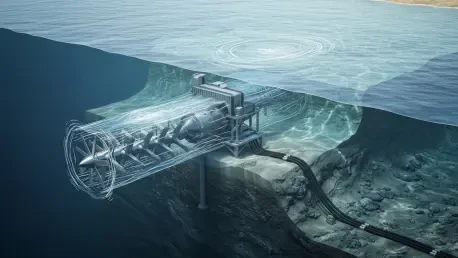
The fundamental mechanics of this technology rely on the extraordinary density of seawater, which is roughly 800 times greater than that of air. This physical advantage means that horizontal axis turbines can generate immense torque and electricity even when moving at relatively slow velocities. By positioning these units in high-flow areas like narrow straits and coastal channels, developers maximize energy extraction without the massive footprint required by onshore wind farms. Current deployments in the United Kingdom and France have already proven that these systems can withstand the harsh realities of the marine environment, moving the industry toward a phase of standardized, utility-scale rollout.
Strategically, the predictability of tidal streams serves as a stabilizing force for national power grids, reducing the need for expensive long-term battery storage or peaker plants fueled by gas. Pioneering projects in the North Sea and the English Channel have successfully demonstrated the reliability of subaquatic arrays, attracting interest from key industry stakeholders and maritime planners. These early successes highlight the importance of maritime spatial planning, as identifying the most efficient locations for turbine placement is crucial for maximizing global capacity while minimizing interference with existing naval and commercial traffic.
Market Dynamics and the Evolution of Marine Power
Emerging Trends and Technological Innovations in Subaquatic Energy
The sector is currently witnessing a transition toward modularity, where smaller, mass-produced turbine units are linked together to form submerged power parks. This approach lowers manufacturing costs and simplifies the replacement of components. In deeper waters where seabed-mounted foundations become prohibitively expensive, floating tidal platforms are becoming a preferred solution. These platforms are moored to the ocean floor but remain near the surface, allowing for easier access during maintenance cycles and reducing the specialized vessel requirements that once drove up operational expenses.
Moreover, the integration of tidal energy with green hydrogen production is gaining traction in remote coastal regions. By using excess tidal power to electrolyze seawater, islands and coastal communities can create a storable fuel source, solving the challenge of energy transport. Advancements in subsea cabling and long-distance transmission infrastructure are also closing the gap between offshore generation and inland demand. This technological synergy has intensified investor interest, particularly as the limitations of intermittent solar and wind power become more apparent in a world demanding constant electricity.
Growth Projections and Quantifying the Practical Resource
Current research identifies a staggering 110 terawatt-hours of annual output potential across the most viable marine sites worldwide. While the theoretical energy contained in all global currents is vast, the industry focuses on the practical resource, which accounts for technical limitations and environmental restrictions. Analysis suggests that even capturing a small fraction of this energy could satisfy the total electricity demand of medium-sized nations. Market share projections indicate that top-tier nations, including the United States, the United Kingdom, Canada, and China, will lead the initial wave of commercial expansion.
The concentration of tidal energy in specific hotspots plays a critical role in global energy security. For instance, a handful of high-velocity channels in Alaska and Scotland contain a disproportionate amount of the world’s harvestable tidal power. Investment is increasingly flowing toward these geographic centers, as they offer the highest return on energy for every dollar spent on infrastructure. As more regions transition from pilot programs to full-scale commercial arrays, the global capacity is expected to rise sharply, providing a predictable buffer against the volatility of other energy markets.
Navigating Structural and Environmental Hurdles
A persistent challenge remains the data deficit in emerging markets, where localized oceanographic measurements are often insufficient to secure large-scale private investment. Establishing a reliable power profile for a specific channel requires years of acoustic Doppler current profiling and sediment analysis. Furthermore, the economic complexity of installing heavy infrastructure in remote, high-velocity environments creates a logistical bottleneck. Transporting electricity from isolated coastal regions to urban centers requires a massive overhaul of subsea cabling and transmission architecture, which often adds layers of complexity to early-stage projects.
Beyond the technical difficulties, developers must balance commercial energy extraction with marine conservation goals. Protecting biodiversity is a primary concern, as turbine blades must be designed to avoid harming fish or marine mammals. Mitigation strategies include the use of acoustic monitoring and slow-rotation designs that allow wildlife to navigate around the arrays. Additionally, shipping lane restrictions and the needs of the commercial fishing industry require careful negotiation to ensure that tidal farms do not obstruct vital trade routes or deplete local marine resources.
Regulatory Frameworks and the Path to Compliance
Managing the transition to marine power requires navigating complex international maritime laws and seabed leasing structures. Government-backed Contract for Difference schemes have become the gold standard for de-risking these ventures, providing developers with price stability that encourages long-term capital commitment. These subsidies act as a bridge, allowing the industry to achieve the economies of scale necessary to compete with established renewable sources. Without these frameworks, the high upfront costs of subsea installation would likely remain a barrier for many private firms.
Environmental impact assessment standards are also evolving to provide clearer guidelines for developers. Compliance protocols now frequently involve multi-use ocean space management, where energy companies collaborate with tourism and fishing sectors to minimize conflict. By establishing clear standards for protecting marine biodiversity, regulators can speed up the permitting process while ensuring that the expansion of tidal energy remains sustainable. This regulatory clarity is essential for transforming the seabed into a productive and protected industrial zone.
Future Outlook: Tidal Energy as a Global Grid Pillar
Technological breakthroughs are expected to unlock deeper waters and lower-velocity currents, significantly expanding the global footprint of tidal power. As nations strive to meet net-zero targets over the coming decades, tidal stream energy will likely transition from a supplemental source to a primary pillar of the energy grid. Untapped markets in South Korea, Norway, and the Philippines represent the next frontier for expansion. When integrated with smart grid technologies, these systems will provide automated load balancing, ensuring that carbon-free electricity is always available to meet peak demand.
The synergy between tidal power and other marine technologies, such as wave energy and offshore wind, will likely result in the creation of hybrid energy islands. These hubs will maximize the utility of ocean spaces, providing a diverse and resilient supply of electricity. As the industry matures, the cost of tidal power is projected to drop, making it an attractive option for developing nations with extensive coastlines. This expansion will play a pivotal role in achieving global energy independence and reducing the reliance on long-distance fuel supply chains.
Strategic Roadmap for Sustained Maritime Energy Growth
The strategic analysis demonstrated that bridging the gap between theoretical potential and commercial viability required a coordinated global investment in standardized turbine designs. Decision-makers prioritized the deployment of subsea infrastructure in high-value hotspots to prove the technology’s reliability to institutional investors. This roadmap suggested that the successful integration of tidal power into the broader energy mix depended on regional cooperation and shared oceanographic data. Future priorities shifted toward creating hybrid energy hubs where tidal power operated in tandem with green hydrogen production to maximize the utility of remote marine resources.
The transition toward a diversified renewable portfolio eventually placed tidal stream energy at the heart of coastal energy strategies. Governments that invested early in seabed leasing and grid connectivity reaped the benefits of a stable, carbon-free power supply. Analysts concluded that the long-term success of the sector rested on the ability to harmonize industrial growth with environmental stewardship. As the technology matured, the focus turned to optimizing maintenance cycles through automated subsea robotics, further reducing the costs associated with the harsh marine environment. Final assessments highlighted that tidal power was not merely a replacement for fossil fuels, but a foundational element of a modern, resilient electrical grid.