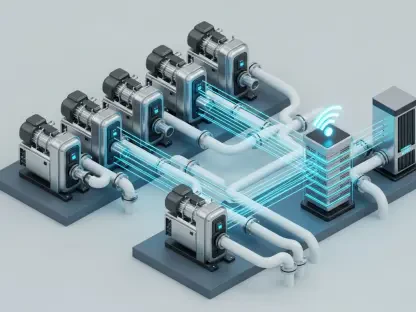

The proliferation of billions of interconnected sensors across global infrastructure has reached a critical bottleneck where the labor costs of battery maintenance often exceed the initial value of the hardware itself. Nanopower Semiconductor has addressed this fundamental economic and technical challenge through the commercial launch and volume production of its nPZero Power-Saving Integrated Circuit (PSIC). As a specialized silicon solution, the nPZero enables developers to bypass the traditional power constraints that have long limited the deployment of sophisticated remote monitoring systems in isolated environments. By decoupling the primary monitoring tasks from the energy-hungry host microcontroller, this technology allows for a massive reduction in idle power draw. This milestone represents a shift from theoretical energy efficiency to practical, large-scale implementation for original equipment manufacturers seeking to extend the operational lifespan of their products from months to potentially a full decade without intervention.
System Architecture: Moving Beyond Polling Waste
Traditional Internet of Things designs have historically relied on a host microcontroller to manage the logic of checking sensor states, which necessitates frequent wake-up cycles that drain batteries even when no significant data is present. This phenomenon, known as polling waste, occurs because the high-performance processor must fully power its internal circuits and oscillator to perform even the simplest check on a temperature sensor or accelerometer. The nPZero operates as an ultra-low-power gatekeeper that manages these peripheral interactions autonomously while the main system remains in a deep-sleep state. By functioning as a dedicated intermediary, the integrated circuit can monitor up to four separate sensors and only trigger the host processor when a specific environmental threshold or user-defined rule is met. This architectural shift ensures that the most power-intensive components, including wireless transmission radios and high-speed processors, are only activated during critical events.
The autonomy of the nPZero is particularly impactful for systems integrated with energy-harvesting technologies, such as those relying on solar, thermal gradients, or kinetic energy. These sources often provide only a trickle of current, making every nano-ampere vital for the sustained operation of the device in the field. By taking over the configuration and data reading roles, the nPZero streamlines the sensing-to-decision pipeline, allowing the overall system to achieve energy savings of up to ninety percent compared to traditional polling architectures. Empirical data from reference implementations, which utilized a combination of three-axis accelerometers and temperature sensors, demonstrated that current consumption during routine polling drops to almost negligible levels. Such efficiency is crucial for industrial applications where sensors must operate at high frequencies to catch transient faults but only need to report data to the cloud when an anomaly is actually detected by the local monitoring logic.
Economic Sustainability: Reducing Total Cost of Ownership
As industrial networks scale from small-scale pilot programs to thousands of nodes across smart cities and logistics hubs, the logistics of battery replacement have become a significant operational liability. Frequent maintenance visits to remote locations or hazardous industrial environments are not only expensive in terms of manual labor and fuel but also introduce risks to personnel safety and system uptime. The introduction of the nPZero provides a clear competitive advantage by significantly lowering the total cost of ownership for these massive sensor arrays. By extending the interval between service requirements, companies can deploy more comprehensive monitoring solutions without expanding their maintenance budgets. Furthermore, this longevity supports broader environmental sustainability goals by reducing the volume of battery waste generated by short-lived electronic devices. The ability to guarantee multi-year performance on a single charge makes large-scale Internet of Things investments far more attractive to risk-averse stakeholders.
Beyond the immediate financial benefits, the increased energy efficiency provided by this silicon solution directly enhances the reliability of critical infrastructure monitoring. In sectors like the pharmaceutical cold chain or industrial safety, a device that fails due to an exhausted battery represents a potential breach in regulatory compliance or a threat to worker safety. The nPZero ensures that monitoring remains active for much longer durations, providing constant vigilance without the risk of sudden power failure. Additionally, the energy headroom created by this ninety percent reduction in power drain allows engineers to include more complex sensors or increase the resolution of data collection. This means that a device formerly limited to basic temperature tracking can now incorporate vibration analysis or gas detection while maintaining the same battery footprint. This versatility enables the development of high-fidelity digital twins and predictive maintenance models that were previously considered too power-hungry for remote use.
Design Integration: Accelerating Time to Market
Simplifying the hardware design process is essential for the rapid adoption of new semiconductor technologies, which is why the inclusion of specialized development tools is so critical. The nPZero Configurator serves as a graphical user interface that allows embedded engineers to define complex monitoring parameters without the need for manual, low-level register programming. Through this interface, developers can set polling intervals, sensor thresholds, and trigger conditions, and the tool then automatically generates the necessary application programming interface code. This high-level approach reduces the manual effort required for system bring-up and significantly shortens the development cycle for new products. By removing the barriers of complex firmware development, the manufacturer has ensured that even small engineering teams can implement sophisticated power management strategies. This streamlined workflow allows for faster iterations and a quicker transition from the initial prototyping phase to full commercial deployment.
The transition of the nPZero to volume production provided a clear path forward for industries seeking to eliminate the energy constraints of remote sensing. Organizations that prioritized the integration of these power-saving integrated circuits into their hardware roadmaps observed immediate improvements in system longevity and operational efficiency. Moving forward, the industry adopted a more proactive stance toward event-driven monitoring, moving away from the wasteful legacy of continuous polling. Stakeholders who invested in these autonomous gatekeeper technologies simplified their logistical frameworks and enhanced the accuracy of their data collection by utilizing the recovered energy budget for more sophisticated analysis. Engineers and product managers evaluated their existing sensor architectures to identify where the offloading of routine tasks could maximize battery life. The adoption of such intelligent power management proved to be a foundational step in creating a truly autonomous and sustainable global sensor network that required minimal human oversight.