
As the automotive industry pivots toward a full-scale electrification of the global fleet, the challenge of securing raw materials has transitioned from a logistical hurdle into a foundational quest for environmental and economic survival. The current landscape of 2026 represents a critical junction where the early adopters of electric vehicles have moved beyond the novelty phase, and the industry is now confronting the physical reality of battery longevity and material scarcity. General Motors has positioned itself at the forefront of this transition by moving away from the traditional model of resource extraction toward a sophisticated, closed-loop ecosystem. This shift is not merely a response to environmental pressure but a calculated strategic move to insulate the supply chain from global volatility while proving that the lifecycle of a battery does not have to end at the scrapyard.
The modern electric vehicle sector is currently defined by a high-stakes race for mineral dominance, yet the true winners are emerging as those who can master the art of reclamation. With millions of battery-powered cars now on the road, the industry is witnessing the birth of a secondary resource market that rivals primary mining in strategic importance. Key market players are increasingly judged not just on their kilowatt-hour efficiency or 0-to-60 acceleration, but on their ability to account for every gram of lithium, cobalt, and nickel within their production cycle. Technological influences, such as advanced hydrometallurgical refining and automated disassembly, are now standard components of the manufacturing narrative. Furthermore, rigorous regulations regarding domestic sourcing and carbon footprint reporting have turned circularity from a corporate social responsibility goal into a mandatory operational requirement for any manufacturer seeking to remain competitive in North America and abroad.
The Shift from Linear to Circular: A New Era for EV Battery Lifecycles
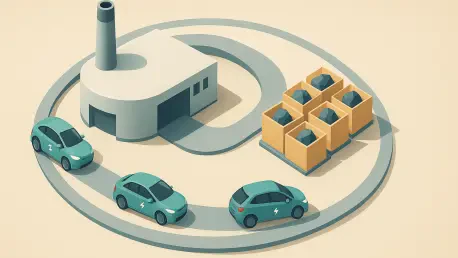
The historical approach to automotive manufacturing followed a predictable linear path where raw materials were extracted, processed into components, and eventually discarded at the end of a vehicle’s utility. However, the sheer volume of minerals required for the current generation of electric vehicles has rendered this model obsolete. In its place, a circular framework has emerged, treating the battery pack as a rolling warehouse of valuable assets rather than a consumable part. General Motors has recently demonstrated the viability of this approach through a landmark pilot program that successfully integrated one hundred percent recycled critical minerals into new, consumer-ready battery cells. This development signals a transition where the opening chapter of a battery’s life in a vehicle is seen as just one phase of an ongoing value cycle.
Success in this circular era requires a fundamental reimagining of the supply chain, moving from a rigid hierarchy to a collaborative network of specialized partners. By focusing on circularity, manufacturers are essentially decoupling their growth from the environmental and geopolitical risks associated with traditional mining. The significance of this shift cannot be overstated, as it allows for the stabilization of material costs over time. As more vehicles reach their end-of-life, the pool of available recycled material grows, creating a self-sustaining loop that reduces the need for new extraction. This evolution marks the beginning of an era where the value of an electric vehicle remains tied to its physical materials long after the chassis has been retired.
Emerging Trends and Market Dynamics in Battery Sustainability
Technological Breakthroughs in Urban Mining and Material Recovery
The concept of urban mining has moved from the fringes of industrial theory to the center of battery production strategies in 2026. Recent breakthroughs in mechanical separation and chemical refining have enabled the recovery of up to ninety-five percent of high-value minerals such as nickel and cobalt from spent battery packs. The process begins with the creation of black mass, a concentrated mixture of cathode and anode materials that serves as the feedstock for the next generation of cells. Unlike earlier methods that relied on energy-intensive smelting, modern hydrometallurgical processes allow for the extraction of these minerals at a much lower thermal footprint, preserving the chemical integrity of the materials and ensuring they meet the stringent purity standards required for automotive use.
These technological advancements are also addressing the complexity of battery disassembly, which has traditionally been a labor-intensive and hazardous task. Automated systems are now capable of identifying and isolating different cell chemistries, allowing recyclers to process various battery types more efficiently. This flexibility is crucial as the industry experiments with different cathode compositions to reduce costs and improve energy density. The ability to refine recycled materials to a point where they are indistinguishable from virgin minerals is the ultimate technological goal. Current validation tests show that cells manufactured with these recovered materials perform with total parity to those made from newly mined ore, effectively debunking the myth that recycled components lead to inferior battery performance.
Growth Projections for the Recycled Battery Material Market
The market for recycled battery materials is entering a period of exponential growth that is expected to continue from 2026 through the end of the decade. Market data suggests that the volume of end-of-life batteries available for recycling will increase dramatically as the first large-scale wave of electric vehicles reaches the ten-year mark. This influx of material is projected to drive a multi-billion dollar industry dedicated to the processing and resale of battery-grade minerals. Financial analysts view these recycled assets as a critical hedge against the price fluctuations of the global commodities market, providing a more predictable cost structure for automakers who have invested heavily in domestic battery plants.
Looking toward the window of 2026 to 2032, the reliance on primary mining is expected to plateau as circular systems become more efficient. Forecasts indicate that recycled content could account for nearly one-third of the total material demand for new battery production within the next six years. This transition is being accelerated by the scaling of specialized recycling facilities that are strategically located near major vehicle assembly hubs. The synergy between battery manufacturers and recycling firms is creating a new industrial sub-sector that prioritizes resource efficiency. Performance indicators show that companies successfully integrating these recycled materials are already seeing a reduction in their overall carbon intensity, a metric that is becoming increasingly important for institutional investors and regulators alike.
Overcoming Technical and Economic Obstacles in Closed-Loop Systems
Despite the clear benefits of a circular economy, the path to a fully closed-loop system is fraught with significant technical and economic hurdles. One of the primary complexities involves the diverse range of battery designs and chemistries currently in use. Standardizing the recycling process is difficult when different manufacturers utilize unique pack architectures and proprietary cell formulations. This lack of uniformity necessitates a high degree of adaptability in recycling facilities, often increasing the operational costs of recovery. To address this, some industry leaders are advocating for a design-for-recycling approach, where future battery packs are engineered from the outset to be easily dismantled and processed.
Economic considerations also play a pivotal role in the speed of circular adoption. At various points, the cost of refining recycled minerals can fluctuate relative to the price of virgin materials obtained from global markets. When primary mineral prices are low, the financial incentive for recycling can diminish, making it difficult for recovery firms to maintain profitability without government subsidies or long-term contracts with automakers. Furthermore, the logistical challenge of transporting heavy, potentially hazardous end-of-life batteries to central processing centers adds a layer of expense that must be managed. Strategic solutions involve the development of localized recycling micro-hubs that reduce transport distances and integrate directly with the existing automotive logistics network.
The Regulatory Landscape and the Push for Resource Independence
The regulatory environment in 2026 has become a primary driver for the adoption of circular battery practices. Significant laws and standards now mandate a minimum percentage of recycled content in new electric vehicle batteries, pushing manufacturers to secure their secondary material streams early. These regulations are often tied to broader goals of national security and resource independence, as many of the critical minerals required for electrification are sourced from geographically concentrated and sometimes politically unstable regions. By incentivizing domestic recycling, governments are effectively creating a strategic mineral reserve that stays within their borders, protecting the local automotive industry from external supply shocks.
Compliance with these evolving standards requires a sophisticated level of transparency and data tracking across the entire battery lifecycle. The implementation of digital battery passports is one such measure that allows regulators and consumers to verify the origin, chemistry, and recycled content of a specific battery pack. This level of oversight ensures that environmental claims are backed by verifiable data and that safety standards are maintained throughout the reclamation process. Moreover, the shift toward resource independence is influencing trade policies, with tariffs and tax credits increasingly linked to the sustainability of the material supply chain. This regulatory pressure is forcing a rapid evolution in industry practices, making circularity a core component of legal and operational compliance.
Future Outlook: Second-Life Applications and Industrial Scaling
The horizon for the battery industry extends far beyond the initial recycling of minerals into second-life applications that maximize the utility of every cell. Even when a battery is no longer capable of meeting the high-power demands of a vehicle, it often retains substantial capacity for less intensive uses. One of the most promising emerging trends is the deployment of these retired batteries into stationary energy storage systems. These second-life units are being used to support the electrical grid, store energy from renewable sources like wind and solar, and provide backup power for industrial facilities. This intermediate step before final recycling significantly extends the economic life of the battery and provides a lower-cost solution for the growing energy storage market.
Scaling these initiatives from pilot programs to industrial-level operations is the next great challenge for the sector. Between 2026 and 2030, the industry must transition from processing thousands of batteries to processing millions. This will require massive investments in infrastructure and the continued development of high-speed, automated sorting and refining technologies. Global economic conditions will inevitably influence the pace of this scaling, but the long-term trend toward electrification remains robust. Innovation in battery chemistry, such as the rise of solid-state or sodium-ion batteries, may introduce new variables into the recycling equation, but the fundamental principles of circularity will remain applicable regardless of the specific materials being used.
Conclusion: The Viability of a Self-Sustaining Electric Vehicle Ecosystem
The research and pilot programs conducted through 2026 established a definitive proof of concept for the circular battery economy. It was determined that the integration of recycled minerals did not compromise vehicle performance, as evidenced by the successful deployment of high-end electric models featuring circular battery cells. The industry successfully demonstrated that the transition from a linear to a circular model was technically feasible and strategically necessary. These efforts proved that the recovery of nearly all critical minerals from end-of-life units was achievable at an industrial scale, providing a clear roadmap for reducing the automotive sector’s reliance on primary mining. The collaboration between automakers, specialized recyclers, and cell manufacturers created a robust foundation that significantly enhanced supply chain resilience.
Future initiatives must now focus on the global standardization of battery pack designs to further streamline the disassembly and recovery process. It is recommended that manufacturers prioritize the development of hydro-metallurgical refining facilities closer to assembly hubs to minimize the carbon footprint associated with logistics. Investment should be directed toward the expansion of second-life microgrids, which can provide a valuable bridge between a battery’s automotive life and its final recycling phase. As the volume of retired electric vehicles continues to grow, the industry should look toward establishing a unified digital infrastructure for tracking material flows. By treating every battery as a permanent asset, the automotive world moved toward a future where the materials of the past directly fueled the innovations of tomorrow, ensuring the long-term viability of electric mobility.