
Christopher Hailstone is a seasoned authority in the realm of energy management and grid infrastructure, bringing decades of experience in integrating renewable resources into complex urban environments. As a leading expert on utility reliability, he has spent his career navigating the intricate balance between modern technology and the aging electrical grids of major metropolitan areas. His recent work focuses on the intersection of distributed energy resources and commercial efficiency, particularly how modular storage can provide immediate relief to businesses facing rising power costs. By bridging the gap between sophisticated software control and hardware deployment, he offers a unique perspective on the future of decentralized power and its role in stabilizing the regional distribution networks.
In this discussion, we explore the strategic deployment of plug-in battery systems within the demanding atmosphere of high-tech commercial kitchens. We delve into the technical specifications of lithium iron phosphate chemistry and the software-driven logic that enables significant cost reductions through time-of-use arbitrage. The conversation also highlights the regulatory advantages of bypassing traditional utility interconnection queues, the financial viability of zero-capital expenditure models for small businesses, and the role of virtual power plants in mitigating grid stress during peak summer heatwaves.
How do you approach the challenge of integrating consumer-grade battery systems into the high-intensity environment of a commercial kitchen, and what ensures they can reliably manage heavy refrigeration and food prep loads?
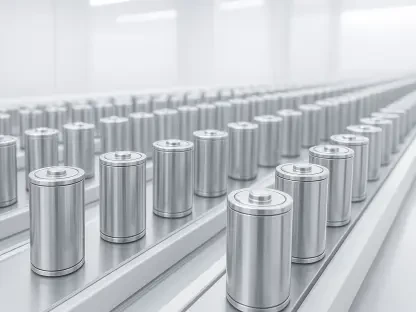
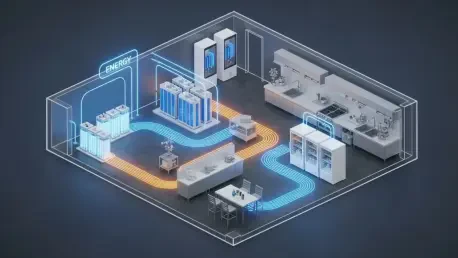
When we look at the high-stakes environment of a commercial kitchen, reliability is the only metric that truly matters because a failure in power management could mean thousands of dollars in spoiled inventory. To address this, we utilize EcoFlow STREAM Ultra modular hardware units that leverage lithium iron phosphate chemistry, which is specifically chosen for its safety and long-cycle life. Each base unit provides a storage capacity of 1.92 kWh and an 800 W output, which might seem modest individually, but they are incredibly effective when scaled across a facility. By connecting these units directly to standard 120-volt AC circuits within the store breaker rooms, we avoid the heat and chaos of the main kitchen area while still providing the necessary juice to keep refrigerators humming. The real magic happens through custom software integration rather than standard battery management, allowing us to orchestrate how these units interact with the kitchen’s most power-hungry equipment.
What are the primary strategic advantages of using a plug-in model that operates behind the meter, particularly regarding the hurdles of traditional utility approval processes?
The most significant bottleneck in modern energy deployment is the utility interconnection queue, which can often stall a project for months or even years in a territory like Con Edison’s. By utilizing 120-volt consumer-grade units that operate strictly behind the meter with zero backfeeding onto the distribution network, we can completely bypass those bureaucratic delays. This non-interconnected operational profile allowed us to rapidly deploy across 21 different locations without waiting for the usual utility studies or approval timelines that typically plague commercial storage projects. It changes the timeline from years to weeks, which is vital for a growing food technology platform like Wonder. Furthermore, because there is no power being pushed back onto the grid, the installation is much simpler and doesn’t require the complex protection relays required for larger, grid-tied systems.
Can you explain the logic behind the software-driven time-of-use arbitrage and how it translates into tangible financial savings for a business owner?
The financial engine of this project is our proprietary software platform, which acts as a conductor for the kitchen’s energy consumption by automating commercial load-shifting. The batteries are programmed to draw power during the overnight hours when wholesale market prices are at their lowest and the grid is relatively quiet. When the morning rush begins and utility demand windows hit their peak high-cost period, the system discharges that stored energy to power the kitchen’s refrigeration and prep equipment. This strategy, combined with demand charge reduction and capacity tag mitigation, results in a total electricity bill reduction of 3% to 5% for the customer. Because we offer this under a 36-month zero-capex contract, the business owner sees these savings immediately without having to put up a single dollar of upfront capital for the hardware.
Looking at the wider impact, how do these distributed batteries function as a virtual power plant to support the regional grid during periods of extreme thermal stress?
By aggregating these plug-in batteries across dozens of locations, we create a virtual power plant that can be dispatched to alleviate local feeder congestion when the city is sweltering under a summer heatwave. We have enrolled eligible locations into Con Edison’s Commercial System Relief Program and the Distribution Load Relief Program, which allows us to respond to grid stress in real-time. When the grid is under peak thermal stress, these batteries take the load off the distribution system, which directly mitigates the need for the utility to fire up expensive and polluting fossil-fired peaker plants. It’s a sensory experience for the grid—instead of a sudden surge in demand that strains transformers, there is a smooth, managed reduction in load that keeps the lights on for everyone in the metropolitan area. We are currently hitting a simple payback period of about three years, and as we refine our algorithms, that timeline will only get shorter while the grid becomes more resilient.
What is your forecast for the adoption of this decentralized energy model across other power-dense urban business sectors?
I anticipate a massive shift where modular, plug-in storage becomes a standard architectural requirement for any small business with a high power density, from laundromats to independent grocers and convenience stores. We are already working with engineering teams to develop back-of-house architectural templates for future builds in 2027, ensuring that battery placements are integrated directly into the construction blueprints. As hardware costs continue to decline and our software control algorithms become even more predictive, these systems will move from being an optional upgrade to an essential utility management tool. Within the next five years, the five boroughs of New York will likely see thousands of these small-scale systems acting in unison, effectively turning every storefront into a micro-pillar of grid stability and financial efficiency.