
The unrelenting thirst of hyperscale data centers for power has finally pushed traditional magnetic-based voltage regulation to its physical breaking point, necessitating a departure from the electromagnetic paradigms that have governed the industry for decades. As the digital economy pivots toward massive artificial intelligence models and high-performance computing, the infrastructure supporting these systems faces a silent crisis in efficiency. Every watt of electricity that enters a server must be precisely stepped down from a high-voltage distribution rail to the millivolt levels required by silicon processors, yet the components tasked with this conversion have remained largely unchanged for generations.
This review examines the emergence of the hybrid piezoelectric resonator, a technology that seeks to replace bulky, heat-generating magnetic inductors with solid-state mechanical vibrations. This shift represents more than just a component upgrade; it is a fundamental reconfiguration of how energy is stored and moved within a circuit. By merging the precision of ceramic resonators with the stability of capacitor networks, engineers have unlocked a path toward extreme miniaturization and thermal efficiency that was previously considered theoretically impossible under standard electromagnetic constraints.
The goal here is to analyze the mechanics of this hybrid transition, evaluating its performance against the current benchmarks of the power electronics industry. By scrutinizing the design successes and the remaining manufacturing hurdles, this analysis provides a clear-eyed perspective on whether piezoelectricity can truly sustain the power-hungry future of global computing. This is not merely an incremental improvement but a radical attempt to bypass the “thermal wall” that threatens to stall the next decade of hardware innovation.
Evolution of Power Conversion and the Rise of Piezoelectrics
The fundamental architecture of power conversion has historically relied on the relationship between electricity and magnetism, utilizing inductors to temporarily store energy in a magnetic field. However, as the industry demands higher switching frequencies to shrink component sizes, these magnetic components suffer from “core losses” and “proximity effects” that generate excessive heat. This inefficiency creates a bottleneck where the cooling systems required to manage the heat take up more space than the power electronics themselves. In response, researchers have turned to the piezoelectric effect, a mechanical process where physical stress in a crystal structure generates an electric charge.
This transition marks a move away from the limitations of copper windings and ferrite cores toward the use of high-frequency mechanical resonators. Because these resonators store energy in the form of physical vibrations rather than magnetic fields, they can achieve significantly higher energy densities in a fraction of the volume. The rise of this technology is a direct result of the industry’s need to pack more processing power into existing data center footprints, where every square millimeter of motherboard space is contested. By leveraging mechanical resonance, engineers can now envision a future where the power management system is nearly as slim as the processor it serves.
Core Components of the Hybrid Architecture
Piezoelectric Resonators as Energy Storage Units
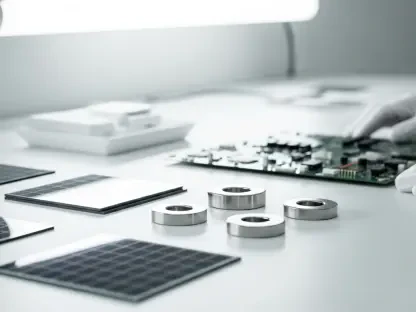
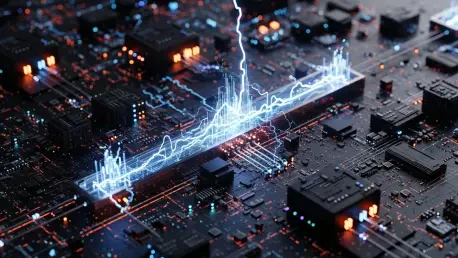
At the heart of this technological shift is the piezoelectric resonator, a component typically manufactured from high-grade ceramic materials designed to oscillate at millions of cycles per second. Unlike a traditional inductor that occupies a three-dimensional volume to maintain its magnetic field, a resonator can be manufactured as a thin, flat plate. This geometry is inherently more compatible with modern surface-mount technology and high-density chip packaging. The resonator functions by converting incoming electrical energy into a standing acoustic wave, which is then harvested back into electrical energy at the desired lower voltage.
The primary advantage of using these materials lies in their Q-factor, or quality factor, which measures how much energy is lost during each cycle of vibration. Advanced piezoelectric ceramics offer Q-factors that far exceed those of even the best magnetic inductors, meaning they dissipate significantly less energy as waste heat. Moreover, because the energy storage is mechanical, the system is less susceptible to the electromagnetic interference that often plagues high-speed computing environments. This allows for a cleaner power delivery profile that is essential for the stability of sensitive AI hardware.
Integrated Multi-Pathway Capacitor Networks
A significant innovation that separates modern hybrid designs from earlier, unsuccessful piezoelectric attempts is the integration of multi-pathway capacitor networks. Early piezoelectric converters often struggled with high voltage differentials and low current stability, as the mechanical material alone could not handle the rapid transients required by modern GPUs. To solve this, engineers created a hybrid topology where the piezoelectric resonator works in tandem with a series of high-speed capacitors. This arrangement allows the electrical load to be split, using the capacitors to stabilize the voltage while the resonator handles the bulk of the energy transfer.
This hybrid synergy creates a robust power delivery network that can manage the jump from 48V distribution rails down to the sub-1V levels needed by modern silicon. By providing multiple pathways for the current to flow, the design reduces the mechanical strain on the piezoelectric material, preventing it from overheating or shattering under high-load conditions. This balanced approach ensures that the system can deliver the high amperage required for peak computing tasks without sacrificing the efficiency gains provided by the mechanical resonator. It is this specific combination of electrical and mechanical storage that has finally made piezoelectric conversion a viable competitor to magnetism.
Innovations in Conversion Efficiency and Thermal Management
Recent breakthroughs in this field have yielded prototypes that achieve a peak efficiency of 96.2 percent, a figure that was unthinkable for mechanical-based conversion just a few years ago. This efficiency is not just a technical curiosity; it represents a massive reduction in the energy overhead of large-scale computing facilities. In a data center environment, the energy not lost to heat during conversion is energy that does not need to be removed by expensive cooling infrastructure. Consequently, the adoption of hybrid resonators could lead to a cascading series of energy savings, reducing both the direct power draw of the servers and the indirect power draw of the facility’s air conditioning.
The trend toward these high-efficiency chips is also being driven by a new focus on interdisciplinary engineering, where high-speed switching logic is synchronized perfectly with the mechanical resonance of the ceramic material. By timing the electrical switches to open and close at the precise moment when the resonator’s vibration is at its peak, energy loss is kept to an absolute minimum. This level of synchronization requires sophisticated control algorithms that bridge the gap between material science and digital logic, creating a power management system that is as much a piece of software as it is a piece of hardware.
Real-World Applications in High-Density Computing
The primary theatre for the implementation of hybrid piezoelectric technology is the modern AI data center, where massive clusters of GPUs are used to train large language models. In these environments, power density is the most critical metric; the goal is to deliver as much current as possible to the processor in the smallest possible space. By utilizing the slim profile of piezoelectric resonators, manufacturers can move the voltage regulation modules directly next to the processor, or even stack them vertically. This proximity is vital because it minimizes the distance electricity must travel, thereby reducing the resistive losses that occur when high-current power flows through copper traces on a circuit board.
Beyond the server room, this technology is finding potential in edge computing and mobile workstations where thermal management is a constant struggle. For instance, high-performance laptops and mobile AI accelerators often face performance throttling because they cannot dissipate the heat generated by their power converters. Replacing traditional inductors with hybrid piezoelectric chips could allow these devices to maintain peak performance for longer durations without increasing their physical thickness. Any application that requires high-current, low-voltage power in a thermally constrained environment is a prime candidate for this technology.
Technical Challenges and Implementation Hurdles
Despite the clear performance benefits, the road to mass adoption is fraught with significant manufacturing and durability concerns. One of the most pressing issues is the integration of these vibrating components into standard electronic assembly lines. Traditional manufacturing processes like wave soldering or high-pressure encapsulation are designed for static components; the vibrations inherent in piezoelectric operation could potentially interfere with the solder joints or cause the packaging to delaminate over time. Engineers must develop specialized “soft” mounting techniques that secure the component while allowing it the physical clearance necessary to oscillate freely.
Furthermore, the long-term reliability of piezoelectric ceramics under continuous high-frequency stress remains an open question for 24/7 industrial applications. While these materials are durable, the sheer number of vibration cycles they undergo in a single year of operation—reaching into the trillions—can lead to microscopic fatigue or cracking. To address this, ongoing research is focused on developing new crystalline alloys that are more resilient to mechanical wear. Until these materials are fully validated through long-term stress testing, some industries may be hesitant to replace their tried-and-true magnetic components in mission-critical systems.
Future Outlook and Industry Impact
The trajectory of hybrid piezoelectric resonator technology suggests a looming shift toward a more sustainable and compact digital infrastructure. As the manufacturing processes mature, we can expect to see these resonators integrated into a wider variety of consumer electronics, from smartphones to electric vehicle control units. The ability to eliminate bulky copper-wound inductors will not only save space but also reduce the reliance on heavy metals and complex manufacturing chains associated with magnetic components. This evolution aligns perfectly with the global push toward carbon neutrality and resource efficiency in the tech sector.
Future breakthroughs will likely involve the creation of “smart” resonators that can adjust their resonant frequency in real-time to match fluctuating power loads. This would ensure that the converter remains at peak efficiency even when the processor is in a low-power idling state, a major challenge for current designs. As AI continues to integrate into every facet of life, the demand for invisible, efficient, and ultra-dense power management will only grow. The piezoelectric chip is poised to become the silent heartbeat of this revolution, transforming the way we think about the relationship between physical motion and digital power.
Assessment of the Technology’s Current State
The development of the hybrid piezoelectric resonator was a decisive response to the limitations of traditional electromagnetism in an increasingly dense computing world. By successfully demonstrating peak efficiencies that rivaled or surpassed established inductor-based systems, researchers proved that mechanical energy storage was no longer a fringe concept but a legitimate contender for the future of power electronics. The introduction of capacitor-integrated architectures finally resolved the stability issues that previously hindered piezoelectric materials, allowing for the high-current output necessary for high-performance hardware.
While the challenges of mechanical fatigue and specialized manufacturing remained significant hurdles, the progress made in the mid-2020s shifted the conversation from theoretical viability to practical implementation. The industry recognized that the “thermal wall” was insurmountable without such a radical departure from the status quo. Ultimately, the successful deployment of these vibrating power chips marked the beginning of a move toward more sustainable, high-density digital architectures. The transition away from bulky magnetics was not just a design choice; it was a necessary evolution to ensure the continued growth of the global digital economy.