



Energy markets are being restructured at a pace most organizations did not plan for. The shift away from fossil fuels is no longer a distant policy objective. It is a commercial reality reshaping capital allocation, operational strategy, and competitive positioning across industries. For businesses, the challenge is not simply adopting cleaner energy sources. It is rebuilding the systems that generate, store, distribute, and account for energy in an environment that is increasingly digital, decentralized, and data-dependent. This article explores the technologies driving that transformation and what energy leaders need to prioritize to stay ahead.
The Commercial Case for Energy Transformation
According to the Renewable Energy Institute, a record 692GW of renewable capacity was added globally in 2025, a 15.5% increase on the previous year, with solar alone contributing 511GW, cementing its position as the world’s leading renewable source. Today, renewable energy accounts for nearly half of global electricity capacity, a milestone that reflects a structural shift in how the market allocates capital.
Enterprises that once treated decarbonization as a compliance obligation are now building it into their competitive strategy, using technology to turn sustainability commitments into operational and financial advantages. That shift is most visible in how industrial operations are being redesigned to accommodate energy sources that do not produce at a constant rate.
Real-time analytics and predictive modeling are giving energy-intensive organizations the tools to manage that variability without sacrificing productivity. Simulating grid responses and market conditions before committing to infrastructure investment is changing the risk profile of energy decisions in ways that didn’t exist a decade ago.
The result is a more responsive energy market. Supply and demand imbalances that once took hours to correct can now be addressed in minutes. For organizations that have built the digital capability to join in on that speed, energy becomes a managed asset rather than a fixed cost.
Digital Intelligence and the Modern Energy Grid
Behind that responsiveness is a grid that has grown more complex. The energy grid is one of the most data-intensive environments in the industrial world, with AI and machine learning at the center of how that complexity is managed, processing inputs from millions of distributed energy sources, storage systems, and consumption points to balance supply and demand in real time.
For energy-intensive businesses, this shift has meaningful commercial implications. Machine learning algorithms analyze historical usage patterns and weather forecasts to optimize when and how renewable energy is dispatched. Surplus production is stored or redirected rather than wasted. Energy costs that once fluctuated unpredictably are becoming more foreseeable, even as the underlying mix of sources grows more varied.
Large-scale industrial consumers are also gaining the ability to participate directly in demand-response programs, adjusting their consumption in exchange for financial incentives when grid conditions require it. This turns energy consumption from a passive cost into an active revenue opportunity.
Research indicates that AI-optimized grid management can improve energy efficiency by up to 15%, reduce operational downtime by up to 40%, and cut emissions by up to 25%, while improving reliability across distribution networks. For organizations operating at scale, that efficiency improvement directly impacts margins. But capturing those gains depends on one capability that digital intelligence alone cannot provide: Storing energy when it is abundant and deploying it when it is needed.
Energy Storage: Solving the Intermittency Problem
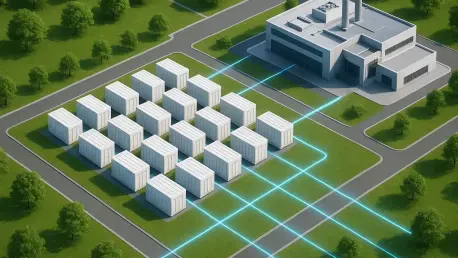
Renewable energy’s dependence on weather conditions has historically made it difficult to rely on as a primary power source for energy-intensive industrial operations. Advances in long-duration energy storage are changing that reality.
Modern battery chemistries, including iron-air and flow batteries, can sustain energy-intensive processes over multiple days without drawing from the primary grid, providing the operational continuity that manufacturing and industrial facilities require.
Beyond chemical storage, thermal and mechanical energy storage systems capture excess industrial heat and convert it into a steady power supply. Together, these technologies let facilities operate through periods of grid instability or high price volatility without interrupting production schedules.
Energy storage is becoming easier to justify financially as costs continue to decline. Industry projections suggest that grid-scale battery costs could decline by a further 40% by 2030, accelerating adoption across manufacturing and industrial sectors. For energy leaders evaluating infrastructure investment, the question is increasingly not whether storage makes financial sense but how quickly the transition can be executed before competitors capture the cost advantage.
Green Hydrogen: Reaching the Parts of Industry That Electrification Cannot
Not every industrial process can be decarbonized through electrification alone. Steel production, cement manufacturing, and chemical processing generate heat requirements that current electric technologies cannot reliably sustain at industrial scale. Green hydrogen, produced through electrolysis powered by renewable energy, is filling that gap by providing a zero-emission fuel source with the energy density needed for high-heat industrial applications.
The emergence of green hydrogen as a viable industrial input is creating new energy trade routes and export opportunities, particularly for nations with abundant renewable resources. Companies are investing in hydrogen-ready infrastructure now, partly to future-proof operations against tightening carbon regulations and partly to position themselves in a supply chain that is still being built.
The infrastructure investment required for hydrogen handling, including specialized pipelines, storage systems, and safety protocols, is establishing a new engineering sub-sector and driving down costs as the market scales. For energy leaders in hard-to-abate industries, green hydrogen is transitioning from a long-term consideration to a near-term operational decision.
Transparent Energy Accounting Through Blockchain
As sustainability claims face increasing scrutiny from investors, regulators, and corporate buyers, the ability to verify where energy comes from and how carbon is being accounted for has become a commercial requirement in energy markets. Blockchain technology is providing that verification by creating immutable records of every unit of energy produced, traded, and consumed.
For energy-intensive businesses operating in supply chains where sustainability credentials influence contract decisions, this transparency is not a reporting nicety. It is a competitive necessity. Smart contracts automate energy purchases based on pre-defined criteria such as price thresholds or carbon intensity limits, reducing administrative overhead and removing intermediaries from energy transactions that previously required manual oversight.
The fractional ownership of energy assets through tokenization is also broadening access to renewable investment. Smaller enterprises that previously lacked the capital to participate in large-scale energy projects can now take positions in renewable infrastructure without needing to fund an entire project.
This shift in how energy investment is accessed is accelerating capital flow toward the renewable energy projects that need it most. For energy leaders, blockchain is not a financial technology experiment. It is an energy accountability tool that is becoming part of how clean energy claims are verified, traded, and acted on.
Carbon Capture as an Industrial Input, Not Just a Mitigation Tool
Carbon capture technology is moving beyond its role as an emissions offset and into the industrial value chain as a feedstock. Direct air capture and point-source sequestration are being integrated into production processes that convert captured carbon dioxide into building materials, synthetic fuels, and industrial chemicals.
For energy leaders, this reframes carbon from a liability into a potential input with commercial value. Organizations that position themselves early in the carbon capture value chain can close the loop on their emissions profile while opening new revenue streams from what was previously a waste product.
The infrastructure required to transport and store captured carbon is creating a new market for pipeline operators and geological services, adding another dimension to the energy transition investment landscape. As these technologies scale and costs decline, carbon capture is becoming a practical component of energy strategy. But production-level solutions only go so far.
Supply Chain Visibility Through Connected Energy Monitoring
The energy performance of the broader supply chain requires a different kind of visibility. Managing energy efficiency across a global supply chain requires a level of detail that traditional reporting cannot provide. For example, connected sensors embedded in manufacturing equipment deliver real-time data on energy consumption at the asset level, enabling immediate adjustments that reduce waste and operational costs.
When integrated with enterprise resource planning systems, this data allows production schedules to be dynamically adjusted based on the real-time availability and cost of renewable energy. For organizations managing Scope 3 emissions, this visibility is becoming as much a reporting requirement as an operational advantage.
Investors and corporate buyers are demanding evidence of energy performance across supply chains, not just at the organizational level. Research indicates that connected energy management systems that optimize energy can lead to cost reductions of up to 20% within the first year of implementation. Energy efficiency, managed with the same discipline as financial performance, is becoming a measurable competitive differentiator.
Managing the Risks That Come With the Energy Transition
The energy transition introduces categories of risk that did not exist at scale a decade ago. Technology risk is significant in an environment where innovation cycles are compressing. Infrastructure that represents a sound investment today may be economically challenged within a decade as successor technologies mature. Energy leaders must balance the urgency of decarbonization against the practical risk of locking capital into solutions that a faster-moving market renders obsolete.
Regulatory risk adds another layer of complexity. Policy frameworks supporting renewable energy have proven sensitive to political cycles, creating uncertainty for long-term capital planning in markets where government support is a significant factor in project economics. Organizations with geographic diversification and flexibility built into their infrastructure investments are better positioned to absorb policy shifts without strategic disruption.
Supply chain vulnerability is a third risk category that energy organizations are actively managing. The concentration of critical mineral extraction and processing in a small number of countries creates geopolitical exposure that can affect manufacturing timelines and input costs. Forward-thinking energy companies are developing alternative sourcing strategies and investing in recycling technologies to reduce dependence on primary extraction and the supply chain fragility that comes with it.
Conclusion: The Energy Transition Is Not Waiting for Organizational Readiness
Energy market technologies have moved past the experimental stage. They are actively determining which organizations compete effectively and which fall behind. Companies that have invested in digital energy management, storage infrastructure, and hydrogen-ready operations are not simply more sustainable. They are structurally more cost-efficient, resilient, and attractive to the investors and corporate buyers making decisions based on energy performance.
The energy transition is not a single event with a defined endpoint. Grid infrastructure is being upgraded. Carbon regulations are tightening. Capital is flowing toward organizations that have demonstrated the capability to operate in a low-carbon energy environment. Those that treat this as a future consideration are already behind organizations that have acted on it.







