
The sight of a classic Fiat touring the streets of Havana with a series of improvised metal cylinders and hissing hoses strapped to its exterior provides a striking visual testament to the power of human adaptation. While the world’s leading economies race toward high-capacity solid-state batteries and green hydrogen, communities facing systemic fuel shortages have turned back to the mid-20th century to find a working solution. Wood gasification is not a new discovery, but its current resurgence represents a fascinating, albeit dangerous, departure from the centralized energy model that has dominated the last century.
Understanding Wood Gasification and the Gasifier Process
At its core, wood gasification is a thermochemical conversion process that bypasses the need for liquid petroleum by transforming solid biomass into a combustible gaseous fuel. Unlike simple combustion, which releases heat and CO2, gasification occurs in an oxygen-deprived environment. This limitation prevents the fuel from burning completely, instead triggering a chemical reaction that breaks down the wood or charcoal into “syngas.” This synthetic gas is primarily composed of carbon monoxide, hydrogen, and a small amount of methane, all of which are highly flammable and capable of powering a standard internal combustion engine.
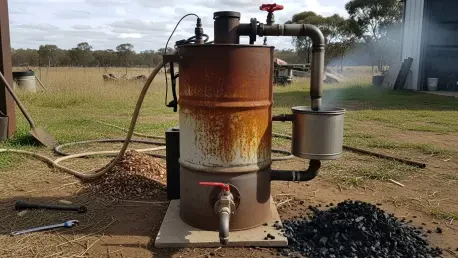
The architecture of a gasifier is inherently mechanical, consisting of a reactor vessel where the biomass is heated, followed by a series of filtration and cooling stages. While the concept found its industrial footing in the 1800s, it became a survival staple during World War II when civilian gasoline supplies vanished across Europe. Today, this technology is reappearing in regions where economic isolation or infrastructure collapse has made traditional refueling impossible, serving as a vital bridge between pre-industrial resources and modern machinery.
Technical Components and Mechanical Performance
The Reactor Vessel and Thermochemical Conversion
The reactor is the heart of the system, acting as a pressurized furnace where temperatures must reach approximately 1,000 degrees Celsius to ensure a clean conversion. In this intense heat, the wood undergoes pyrolysis, releasing volatile gases that are then pulled through a “reduction zone” of hot glowing coals. This specific zone is critical; if the temperature drops too low, the resulting gas will be laden with heavy tars that can instantly seize an engine. Achieving the perfect balance of limited oxygen intake is what separates a functional power source from a smoky, inefficient fire.
Filtration and Cooling Systems for Engine Integration
Raw syngas exiting the reactor is far too hot and dirty to be piped directly into an intake manifold. It carries ash, soot, and vaporized tars that would destroy cylinder walls and valves within minutes. To solve this, the gas must pass through a series of centrifugal “cyclone” filters and scrubbers—often filled with wood shavings or fabric—to strip away particulates. Furthermore, cooling the gas is essential for performance; as the gas cools, it becomes denser, allowing more energy-packed molecules to enter the combustion chamber with every stroke.
Even with optimized cooling, the performance trade-offs are unavoidable. Syngas has a lower energy density than gasoline vapor, typically resulting in a 30% to 50% loss in engine horsepower. Drivers must manage a vehicle that feels sluggish, requiring frequent gear changes and a much longer “warm-up” period before the reactor begins producing high-quality fuel. It is a slow-motion form of motoring that prioritizes arrival over speed.
Contemporary Innovations and Shifts in Biomass Utilization
Modern practitioners are increasingly moving away from raw wood logs in favor of processed charcoal or agricultural residues like corn cobs and coconut shells. Charcoal is particularly favored in improvised settings because it has already undergone a preliminary carbonization process, meaning it produces significantly less tar and a more consistent gas quality. This shift reduces the maintenance burden on the filtration system, allowing for longer run times between cleanings and reducing the risk of catastrophic engine “tarring.”
Furthermore, there is a burgeoning trend in “grassroots engineering” where enthusiasts use modern heat-resistant alloys and CAD modeling to create portable, small-scale units. While the core science remains rooted in the past, these newer designs are more compact and efficient than their wartime predecessors. This evolution reflects a broader movement toward decentralized energy independence, where individuals seek to decouple their mobility from the volatile pricing and availability of global oil markets.
Real-World Applications and Geographic Implementations
In Cuba, the modification of vehicles like the Fiat Polski into charcoal-burners is a direct response to a chronic energy crisis. These vehicles are not hobbyist projects; they are essential tools for transport and logistics in a landscape where gasoline is often a luxury. By mounting reactors on the rear or in the trunk, operators can keep their cars on the road using locally sourced carbon, effectively bypassing the national fuel grid.
Beyond transport, stationary gasifiers are finding use in remote agricultural settings to power electrical generators. For a farm located miles from the nearest power line, a wood-powered generator provides a way to run water pumps and refrigeration using nothing more than fallen branches or husk waste. In these specific contexts, the technology serves as a critical safety net for communities facing the reality of a fractured or non-existent infrastructure.
Technical Hurdles and Safety Considerations
The most pressing concern with wood gasification is the invisible danger of carbon monoxide (CO) poisoning. Because the process intentionally maximizes CO production for fuel, any leak in the piping or back-pressure in the reactor can release lethal concentrations of this odorless gas into the cabin or workshop. Without electronic sensors and rigorous airtight seals, which are often missing in “backyard” builds, the risk to the operator is substantial.
In addition to toxicity, the physical heat of the reactor poses a constant fire hazard. Operating a metal vessel at 1,000 degrees Celsius near a vehicle’s bodywork or a farm’s wooden structure requires significant insulation and careful management. The lack of regulatory oversight or safety certifications for these improvised systems means that the burden of safety rests entirely on the skill and vigilance of the builder, making it a high-stakes endeavor for the untrained.
Future Outlook and Potential for Modern Refinement
The integration of low-cost sensors and microcontrollers could fundamentally change the safety profile of small-scale gasifiers. By automating the air-to-fuel ratio and monitoring CO levels in real-time, the “art” of gasification could be turned into a predictable science. There is also potential for advanced ceramic filtration systems that could eliminate the tar problem entirely, extending the lifespan of the engines they fuel and making the technology more palatable for light-industrial use.
As global supply chains become increasingly fragile, the role of decentralized, “primitive” energy sources may expand. While it is unlikely to replace liquid fuels in stable economies, wood gasification offers a blueprint for resilience. It proves that even when the most complex systems of the modern world fail, the ability to extract energy from the earth remains a viable, if demanding, path forward.
Summary of Findings and Assessment
The review of wood gasification revealed a technology that stood as a fascinating paradox, blending crude mechanical survivalism with sophisticated thermochemical principles. The analysis showed that while the system successfully liberated users from fossil fuel dependence, it did so at the cost of extreme mechanical inefficiency and significant personal risk. The reliance on manual filtration and the constant threat of carbon monoxide meant that the technology remained a solution of last resort rather than a modern standard.
Looking ahead, the most viable path for this technology lies in its transition from improvised survival gear to a more regulated, automated off-grid power solution. Future efforts should prioritize the development of standardized, “plug-and-play” gasification units that incorporate fail-safe shutoffs and modular filtration. By shifting the focus toward stationary power generation rather than mobile transport, the industry could provide a stable energy alternative for isolated regions, turning a “technology of necessity” into a reliable pillar of decentralized infrastructure.