The global economy currently teeters on a knife’s edge as a silent paralysis grips the most vital artery of the international energy trade. When Brent crude oil surged past the $100 mark for two consecutive days, it did more than just inflate gas prices; it signaled a fundamental shift in the perceived stability of the modern world. With the Strait of Hormuz effectively shuttered by a three-week standoff, the energy market is no longer reacting to mere speculation, but to a physical blockade that threatens the very foundation of global commerce.
This sudden escalation has transformed a regional friction point into a systemic threat that could redefine the cost of living for billions. As tankers sit idle and maritime insurance rates skyrocket, the realization is setting in that triple-digit oil might be the new baseline rather than a temporary anomaly. The situation has moved beyond a simple price hike, evolving into a test of whether the global supply chain can survive a prolonged disconnection from its primary source of fuel.
The $100 Threshold and the Fragility of Global Energy Security
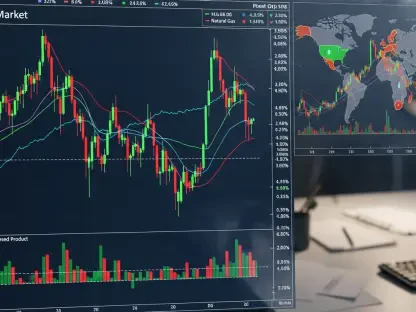
The recent surge to $103.14 for Brent crude represents a psychological Rubicon that has left analysts and policymakers scrambling for answers. This price level acts as a warning shot, indicating that the buffer zones typically provided by diverse energy sources and strategic reserves are no longer sufficient to offset the fear of a total supply collapse. The persistence of these high prices over several trading sessions suggests that the market has priced in a long-term disruption rather than a short-lived geopolitical flare-up.
Energy security is inherently fragile because it relies on the uninterrupted flow of millions of barrels through narrow, contested waters. When this flow is compromised, the resulting supply deficit creates a cascading effect that touches everything from manufacturing costs to consumer inflation. The current trajectory indicates that without a swift resolution, the world is facing a reality where high energy costs become a permanent drag on economic growth, forcing nations to reconsider their reliance on vulnerable maritime corridors.
The Strategic Choke Point: Why the Strait of Hormuz Dictates Global Prosperity
Measuring only 21 miles wide at its narrowest point, the Strait of Hormuz facilitates the movement of 20 million barrels of oil every single day, making it the most critical energy artery on the planet. The ongoing standoff involving the United States, Israel, and Iran has turned these waters into a primary theater of geopolitical friction, effectively holding the global economy hostage. When vessels are targeted and traffic stalls, the immediate impact is a vacuum in the physical market that cannot be easily filled by other producers.
The weight of this crisis is felt most acutely in the logistics and shipping sectors, where the threat of kinetic conflict has halted regular operations. Because there are no viable immediate alternatives to move such massive volumes of crude, the closure of the Strait creates an existential threat to global prosperity. This bottleneck ensures that any local skirmish has the potential to trigger a global recession, as the energy required to power industrial nations becomes both scarce and prohibitively expensive.
Market Resistance Against Supply Interventions and Regulatory Countermeasures
One of the most concerning developments in the current crisis is the failure of traditional cooling mechanisms to stabilize prices. Despite a historic release of 400 million barrels from International Energy Agency stockpiles and aggressive U.S. policy shifts, such as sanctions waivers for Indian purchases of Russian oil, Brent futures continue their upward march. Traders are seemingly ignoring these administrative maneuvers, focusing instead on the visceral reality of regional instability and the very real possibility of a complete supply cutoff.
This resilience suggests a fundamental breakdown in the relationship between government intervention and market behavior. In the past, the announcement of a massive reserve release would have triggered a sell-off, but current market participants appear to be prioritizing physical availability over paper promises. This shift indicates that the tools once used to manage energy crises are losing their efficacy, leaving the global economy more exposed to the whims of geopolitical actors than at any time in recent memory.
Echoes of the 1970s: Analyst Warnings of a $200 Oil Reality
Financial experts from institutions like Barclays have begun drawing chilling parallels between today’s volatility and the stagflationary shocks of the 1970s Arab oil embargo. The central fear is a sustained period where high energy costs collide with stagnant economic growth, creating a cycle of poverty and industrial decline. While political narratives from Washington and Tehran remain contradictory—ranging from claims of imminent surrender to vows of prolonged struggle—the consensus among analysts is that a daily loss of 20 million barrels could realistically push prices toward $200.
Such a price spike would be catastrophic, effectively doubling the cost of energy in a matter of weeks and triggering a massive contraction in global consumption. The expert community is increasingly convinced that the era of cheap, reliable energy is facing its greatest threat in decades. If the stalemate continues, the transition from $100 to $200 oil may not be a gradual climb but a sudden, violent leap that catches the global financial system entirely off guard.
Assessing Geopolitical Risk: Indicators for Monitoring the Energy Crisis
To navigate this volatile landscape, stakeholders must focus on specific metrics that signal whether the crisis will stabilize or spiral toward the $200 mark. The primary indicator remains the daily volume of maritime traffic through the Strait; any further reduction in vessel movement serves as a direct lead-in to higher prices. Additionally, the tone of diplomatic rhetoric between major powers must be monitored closely, as aggressive public vows often serve as precursors to physical market disruptions and further attacks on infrastructure.
Strategic planners also looked at the “supply-to-intervention” ratio as a final diagnostic tool. If prices rose despite further strategic reserve releases, it confirmed a fundamental market breakdown that necessitated a total shift in economic strategy. Decision-makers began to prioritize energy diversification and the acceleration of alternative transport routes to mitigate the risk of future blockades. The crisis forced a move toward localized energy production and more robust maritime security protocols to ensure that a single choke point could never again hold the global economy in such a precarious grip.