
The delicate machinery of global commerce has ground to a sudden halt as the vital artery of the world energy supply, the Strait of Hormuz, transforms into a theater of active kinetic engagement. This maritime chokepoint remains the most critical segment for energy stability, and its current obstruction has sent shockwaves through the international market. As the conflict between the United States and Iran escalates, the traditional rules of energy trading are being rewritten in favor of military objectives. Market players now find themselves navigating a landscape where geopolitical volatility is the only constant, and the limitations of regulatory frameworks are laid bare by the realities of active combat.
The scope of this energy crisis is defined by a staggering 8 million barrel-per-day deficit, a direct consequence of the ongoing maritime blockades. While the world relies on the consistent transit of crude to maintain industrial momentum, the physical closure of shipping lanes has created a void that no amount of diplomatic posturing can fill. This shortfall represents a systemic threat to global stability, forcing a shift in focus from market-based solutions to the raw application of naval power to secure the remaining supply routes.
The Intersection of Global Energy Security and Modern Warfare
The current state of the global energy market reflects a total disruption of the status quo as the Strait of Hormuz becomes the focal point of military strategy. This narrow passage, which typically facilitates the transit of a massive portion of the world’s daily oil consumption, has effectively been transformed into a no-go zone for commercial vessels. The consequence of this disruption is a profound instability that transcends traditional economic cycles, as the safety of tankers becomes the primary variable in the pricing equation.
Geopolitical volatility has forced market participants to look beyond the usual supply-and-demand metrics. In an environment defined by kinetic strikes and naval skirmishes, traditional regulatory frameworks have reached the end of their utility. The ability of international bodies to stabilize prices through policy or rhetoric has vanished, leaving the market to react to the immediate movements of carrier groups and missile batteries rather than central bank announcements or production quotas.
The Failure of Economic Levers in a Kinetic Environment
Market Drivers and the Shift Toward Military Solutions
A fundamental pivot in the industry has occurred, characterized by the transition from the art of the deal to the art of war. For years, observers noted a phenomenon where the administration would retreat from aggressive postures if the markets reacted poorly, a trend often labeled as the tendency to avoid risk when economic indicators faltered. However, the current high-risk military posture suggests that this pattern has been permanently discarded in favor of a decisive, albeit costly, engagement strategy.
Emerging consumer behaviors are now dictated by a reality where economic administrative policy is insufficient to offset physical supply losses. Even as the government attempts to ease sanctions on alternative sources, such as Russian oil, the volume gained is insufficient to replace the missing Middle Eastern barrels. The pivot toward military solutions acknowledges that the only way to restore economic normalcy is through the total elimination of the threat to maritime security, regardless of the immediate inflationary consequences.
Performance Indicators and Growth Projections Amidst Conflict
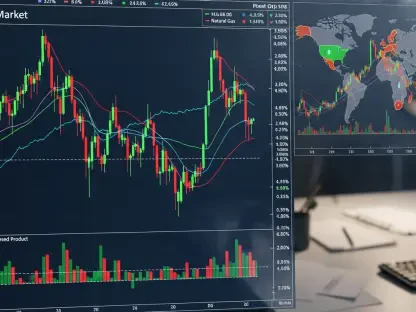
The performance indicators for early 2026 tell a stark story of a market in turmoil. Gas prices have surged by 23% in a short period, while crude oil prices have leaped from $63 to $97 per barrel as the reality of the shortfall sets in. These data points underscore the failure of economic math when faced with a kinetic interruption of the supply chain. A global strategic release of 3 million barrels per day, while significant, remains a minor palliative against a total deficit of 8 million barrels, leaving a massive gap that keeps prices elevated.
Forward-looking perspectives suggest that domestic energy production must serve as the primary counterbalance to Middle Eastern instability. Growth projections for U.S.-based extraction are being revised upward as the necessity of self-reliance becomes clear. However, the lead time required to bring new domestic supply online means that the current shortfall will continue to drive global prices until the military situation in the Gulf is resolved.
Overcoming the Physical and Logistical Obstacles of War
Reopening the Strait of Hormuz is not merely a matter of declaring victory; it involves overcoming the profound hesitance of commercial ship captains and insurance providers. Even if the waters are cleared of immediate threats, the lingering risk of mines or asymmetrical attacks makes transit a high-stakes gamble that many in the private sector are unwilling to take. The logistical complexity of restarting the flow of 20 million barrels per day through a combat zone is a challenge that requires more than just naval presence.
Tactical hurdles remain, particularly regarding the implementation of a comprehensive naval tanker escort system. Moving massive tankers in a high-threat environment requires a level of coordination and resource allocation that stretches even the most capable navies. The current strategy prioritizes the dismantling of hostile nuclear capabilities and regional threats, operating on the belief that long-term market stability can only be achieved by removing the source of the disruption rather than merely treating the symptoms.
The Regulatory Landscape and the Mandate of Energy Security
The U.S. Department of Energy and the Treasury have worked in tandem to attempt market stabilization through aggressive strategic reserve releases. These efforts were designed to provide a buffer against the immediate shock of the blockade, yet the scale of the deficit has tested the limits of these reserves. Regulatory shifts are also being implemented to allow for greater flexibility in shipping and compliance, all aimed at maintaining some semblance of energy security while the military mission continues.
Significant standards are changing as the mandate shifts toward a total restoration of maritime security. Government-backed insurance programs have been introduced to encourage shipping companies to resume operations, but private-sector confidence remains low. The lack of traditional market certainties has forced the government to step in as a guarantor of last resort, a move that highlights the degree to which energy security has become a core function of national defense.
Future Growth and the Paradigm Shift in Energy Policy
U.S. energy independence is no longer a distant goal but a survival necessity in a world where geopolitical blackmail can freeze global transit. The potential for domestic expansion to survive high-cost shocks is being tested, and the results suggest a resilient infrastructure that can adapt to high prices if the regulatory environment permits. Emerging technologies in energy extraction and automated transport are being accelerated to serve as disruptors against future maritime vulnerabilities.
The long-term shift in the energy sector points toward a reality where military victory and geopolitical force are the primary predictors of economic conditions. Investors are beginning to realize that a stable market is dependent on the ability of a nation to project power and protect its interests. This paradigm shift means that energy policy and defense strategy are now inextricably linked, and the recovery of the market will follow the milestones of the military campaign rather than the shifts in the interest rate.
Synthesizing Military Success with Economic Stability
The administration recognized that traditional economic strategy was superseded by military necessity as the only viable path to restore global order. It was determined that the resilience of the U.S. economy allowed it to weather the initial shock of high barrel prices, even as the global supply chain faced its greatest challenge. Officials noted that the massive release from strategic reserves was a temporary measure that bought the necessary time for the Pentagon to execute its broader security mandate.
The shift from the art of the deal to the art of war marked a definitive moment in national policy. Investors and industry leaders were advised to focus on military achievements as the true indicators of future market recovery, as the Treasury’s ability to influence the situation reached its functional limit. Ultimately, the restoration of energy security depended on the successful dismantling of threats in the Middle East, establishing a new precedent where the strength of the nation’s military determined the health of its economy.