
Christopher Hailstone is a seasoned veteran in the global energy sector, specializing in grid reliability, renewable transition, and the complex geopolitics of utility management. As Europe faces a dual crisis—the ongoing decoupling from Russian energy and a volatile conflict in Iran—his expertise offers a vital lens into how infrastructure and policy intersect during times of war.
The following discussion explores the strategic hurdles of maintaining an energy blockade against Moscow while Brent Crude prices test the $100 mark. We delve into the specific vulnerabilities of landlocked nations, the logistical reality of replacing Arctic LNG, and the long-term implications for the European Green Deal amidst a global supply crunch.
With Brent Crude prices surging toward $100 and a regional war in Iran disrupting global supply, how can the EU maintain its commitment to ditching Russian fossil fuels? What specific fiscal tools, such as state aid or price caps, are most effective for stabilizing member economies during this crunch?
The commitment to abandon Russian energy is being tested by a “perfect storm” where geopolitical tensions in the Middle East have pushed ICE Brent Crude to approximately 98.10, a significant 6.6% jump in a very short window. To prevent a “strategic blunder” and a return to Russian dependence, the EU must lean heavily into internal financial shielding. We are seeing a shift toward aggressive state aid measures and power purchasing agreements that provide a buffer for industries that would otherwise buckle under these costs. Implementing price caps or direct subsidies is a delicate balancing act; these tools must be targeted enough to prevent market distortion while being robust enough to stop the political momentum of those calling for a lifting of sanctions. By utilizing these fiscal levers, the bloc can maintain its moral and strategic stance without allowing domestic energy poverty to fracture European unity.
Russia is currently considering a preemptive halt of energy supplies to Europe to secure “more promising” markets elsewhere. What are the immediate risks for European infrastructure if these flows stop before the 2027 deadline, and how quickly can these volumes realistically be redirected to alternative global partners?
The threat from the Kremlin to “halt supplies right now” rather than waiting for the 2027 deadline creates a massive logistical headache for European grid operators who rely on predictable flow volumes. If Moscow moves to redirect these flows to what they call “reliable partners” in the East, Europe loses its primary transition cushion, potentially leaving some regions with sudden deficits. While Russia claims they can easily pivot to more promising areas, the reality of infrastructure means redirecting gas isn’t as simple as turning a valve; it requires massive pipeline capacity or liquefaction facilities that aren’t always ready. For Europe, the immediate risk is a winter of extreme volatility where the 13% of gas still coming from Russia suddenly vanishes, forcing a frantic and expensive scramble for remaining global cargoes.
While oil imports from Russia have dropped below 3%, significant volumes of LNG from the Arctic Yamal facility are still reaching European ports. Why is it proving so difficult to replace these specific shipments, and what logistical steps must be taken to completely diversify gas sources within the next two years?
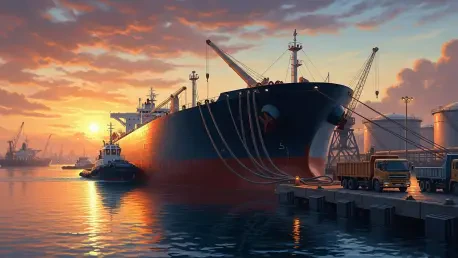
The persistence of Yamal LNG in European ports—accounting for the entirety of Russia’s LNG exports this past February—highlights a glaring hole in the diversification strategy. These shipments are difficult to replace because they are tied to specialized ice-breaking tankers and long-term contracts that are deeply integrated into the European port infrastructure. To fully diversify by the end of 2027, we need a massive scale-up of regasification terminals in Western Europe and a coordinated “buy-together” strategy to outbid competitors for non-Russian cargoes. It isn’t just about finding the gas; it is about the physical reality of offloading it and moving it through a pipeline network that was historically designed to flow from East to West, not the other way around.
Landlocked member states like Hungary and Slovakia are facing severe supply shortages following the closure of the Druzhba pipeline. How should the EU balance its unified sanctions strategy against the specific economic vulnerabilities of these nations, and what are the diplomatic implications of the current “oil blockade” accusations?
The situation with the Druzhba pipeline has become a diplomatic flashpoint, with accusations of an “oil blockade” creating friction between Kyiv, Budapest, and Brussels. For landlocked nations like Hungary and Slovakia, the loss of this pipeline isn’t just an inconvenience; it’s a threat to their basic industrial survival, as they lack the coastal infrastructure to receive global seaborne tankers. The EU must provide these states with specific exemptions or enhanced technical support to find alternative routes, such as the Adria pipeline, to prevent them from breaking the unified sanctions front. If the EU fails to address these specific vulnerabilities, the internal political pressure within these nations will continue to “smell blood,” potentially leading to a veto on broader security policies.
G7 energy ministers are currently weighing the release of emergency oil stocks to curb price volatility. What specific metrics determine the success of such a release, and how do these short-term interventions influence long-term private sector investment in renewable energy versus fossil fuel alternatives?
The primary metric for success in an emergency stock release is the immediate cooling of the futures market, aiming to pull prices back from that $100 threshold to prevent a wider inflationary spiral. However, these releases are temporary “band-aids” that only provide a few weeks of breathing room; the real impact is how they signal stability to the private sector. While high prices usually drive investment toward renewables, extreme volatility can actually scare off investors who fear a total market collapse. By stabilizing the market through G7 intervention, we create a more predictable environment where long-term capital can flow into sustainable infrastructure rather than being diverted to emergency fossil fuel procurement.
What is your forecast for the future of European energy security?
I believe we are entering a period of “forced maturity” for the European energy grid where the next 24 months will be the most difficult in the continent’s modern history. We will see a permanent shift where the 13% of gas and 3% of oil currently sourced from Russia will be entirely replaced by a mix of North American LNG, Norwegian pipeline gas, and a drastically accelerated roll-out of domestic renewables. While the war in Iran adds a layer of extreme price pain in the short term, it will ultimately serve as the final catalyst that breaks the centuries-old reliance on Eurasian fossil fuels. The Europe that emerges in 2027 will be more expensive to power, but it will be strategically sovereign for the first time in decades.