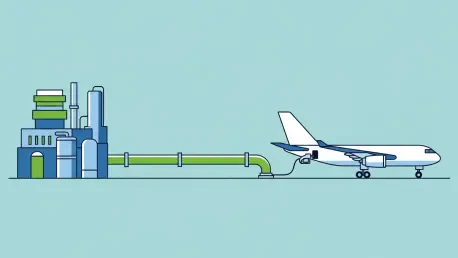

As the aviation sector accelerates its journey toward decarbonization, a critical question looms over the horizon: can the production of Sustainable Aviation Fuel (SAF) scale quickly enough to satisfy the industry’s ambitious climate goals? The recent expansion of SAF usage by major carriers like FedEx to key hubs such as Dallas Fort Worth and JFK International Airport signals a palpable momentum. However, this progress also illuminates a growing tension between soaring demand and a supply chain that is struggling to keep pace, creating a potential bottleneck on the industry’s path to a greener future. This report examines the intricate dynamics of the SAF market, dissecting the forces driving adoption, the hurdles impeding growth, and the strategic interventions required to harmonize supply with aspiration.
The Dawn of a Greener Sky: Charting the Current SAF Landscape
Pioneering Adoption: How Carriers Like FedEx Are Leading the Charge
Forward-thinking air carriers are actively translating sustainability pledges into operational reality, setting a precedent for the broader industry. A prime example is FedEx, which has expanded its SAF program to five key U.S. airports. Through a strategic agreement with World Fuel Services, the logistics giant is procuring the equivalent of five million neat gallons of SAF, which will be blended to a minimum of 30% before delivery.
This initiative is not merely about volume; it is about breaking new ground. The deployment at Dallas Fort Worth International Airport (DFW), for instance, established FedEx as the first carrier to purchase SAF on a consistent commercial basis at that hub, moving beyond limited pilot programs. Such tangible commitments demonstrate a clear market signal that demand is real and growing, encouraging investment and development throughout the nascent SAF value chain.
The Collaborative Ecosystem: Airlines, Fuelers, and Airports Unite
The successful integration of SAF into the complex logistics of modern aviation is not a task for any single entity. Instead, it requires a synchronized effort across a diverse ecosystem of stakeholders. The recent expansions underscore the necessity of robust partnerships between airlines, fuel producers and distributors, and airport authorities. Each party plays an indispensable role, from securing and blending the fuel to integrating it seamlessly into existing hydrant systems without disrupting daily operations.
This collaborative model is essential for overcoming the logistical and infrastructural challenges inherent in introducing a new fuel type. Statements from leaders at FedEx, World Fuel Services, and DFW Airport consistently emphasize that shared goals and coordinated action are the bedrock of progress. By working in concert, these organizations are creating a scalable framework that can be replicated at other airports, paving the way for wider SAF adoption across the global aviation network.
The Widening Chasm: Analyzing SAF Supply and Demand Dynamics
Surging Ambitions: Airlines Double Down on Decarbonization Goals
Across the aviation sector, carriers are setting increasingly aggressive targets for emissions reduction, with SAF positioned as the most viable near-term solution. FedEx, for example, has updated its environmental goals to include a 40% reduction in aircraft emissions intensity by 2034, from a 2005 baseline. This commitment is reflective of an industry-wide trend where airlines are looking beyond operational efficiencies and fleet modernization to make substantial cuts in their carbon footprint.
These ambitious goals are creating a powerful demand signal for alternative fuels. As more airlines and cargo operators publicly commit to specific SAF usage targets, the collective demand is beginning to surge. This pull from the market is crucial for de-risking investments in new production facilities and technologies, yet it also exposes the fragility of the current supply landscape.
The Production Bottleneck: Why Supply Growth Is Failing to Keep Pace
In stark contrast to the rapidly accelerating demand, the global production of SAF is not expanding at a commensurate rate. Projections from the International Air Transport Association (IATA) indicate a potential slowdown in the growth of SAF output, creating a significant mismatch between what airlines need and what the market can provide. This supply-side constraint represents the single greatest threat to the industry’s decarbonization timeline.
The reasons for this production bottleneck are multifaceted, ranging from feedstock availability and refining capacity to economic viability. While the appetite for SAF is undeniable, the infrastructure required to produce it at a scale that can meaningfully impact global aviation emissions is still in its infancy. Without a dramatic acceleration in production capacity, the industry risks a future where its climate ambitions are grounded by a simple lack of available fuel.
Turbulence Ahead: Key Obstacles Hindering SAF Scalability
The Economics of Production: Overcoming Cost and Infrastructure Hurdles
The fundamental challenge hindering the scalability of SAF lies in its economics. Currently, SAF is significantly more expensive to produce than conventional jet fuel, creating a cost barrier that many airlines find difficult to overcome without incentives. This price premium stems from the high cost of sustainable feedstocks, the capital-intensive nature of building new biorefineries, and the logistical complexities of transporting and blending the finished product.
Furthermore, the existing energy infrastructure is overwhelmingly designed for fossil fuels. Integrating SAF production and distribution requires substantial investment in new facilities or the costly retrofitting of old ones. Until the cost of production declines through technological advancements and economies of scale, or until policy mechanisms bridge the price gap, the financial hurdles will continue to limit the pace of SAF’s expansion.
The Policy Paradox: When Demand Incentives Outstrip Supply Support
A critical imbalance has emerged in the regulatory landscape, creating what can be described as a policy paradox. Many current government policies and industry initiatives are heavily focused on stimulating demand, encouraging airlines to commit to SAF offtake agreements. While well-intentioned, these measures are not being sufficiently matched by policies designed to support and accelerate SAF production.
As noted by sustainability leaders like FedEx’s Chief Sustainability Officer, Karen Blanks Ellis, a strategy that exclusively drives demand risks failure if the supply side is neglected. Without robust support for producers—such as production tax credits, loan guarantees for new facilities, and investment in feedstock research—the market will remain constrained. This lopsided approach creates a scenario where airlines are incentivized to seek a product that is simply not available in the required quantities, ultimately undermining the very goals the policies aim to achieve.
Crafting the Framework: The Urgent Need for Supportive Regulations
Beyond Mandates: Policies to Supercharge SAF Production
To effectively close the supply-demand gap, regulatory frameworks must evolve beyond simply mandating usage. A more holistic approach is needed, one that actively fosters a vibrant and competitive production market. This involves implementing a suite of supply-side incentives designed to de-risk investment and accelerate the construction of new SAF facilities.
Policies such as long-term production tax credits, similar to those that have successfully spurred growth in the wind and solar industries, can provide the financial certainty needed for capital-intensive projects. Additionally, governments can play a crucial role by funding research into next-generation feedstocks and conversion technologies, streamlining the permitting process for new biorefineries, and supporting the development of essential supply chain infrastructure. By focusing on cultivating supply, policymakers can create the conditions for a self-sustaining market.
A Global Approach: Aligning International Standards for a Stable Supply Chain
Aviation is an inherently global industry, and its transition to sustainable fuels requires a globally coordinated regulatory approach. A fragmented landscape of differing national standards, sustainability criteria, and incentive structures creates uncertainty and complexity for producers, investors, and airlines alike. This lack of harmonization acts as a significant brake on the development of a stable and efficient international SAF supply chain.
Achieving this alignment is a complex but necessary task. International bodies, in cooperation with national governments, must work to establish a consistent set of rules for feedstock sustainability, lifecycle emissions accounting, and fuel certification. A predictable and unified global framework would provide the market stability needed to unlock large-scale, cross-border investment in SAF production, ensuring that fuel produced in one region can be confidently used in another.
The Flight Path Forward: Envisioning the Future of Sustainable Aviation
Technological Horizons: Innovations Set to Reshape SAF Production
Looking ahead, technological innovation holds the key to unlocking the full potential of Sustainable Aviation Fuel. While current production relies heavily on a limited range of feedstocks like used cooking oils and agricultural residues, a new wave of technologies is on the horizon. These advancements promise to diversify feedstock options and dramatically improve the efficiency and scalability of the production process.
Pathways such as power-to-liquids (PtL), which uses renewable electricity, water, and captured carbon dioxide to synthesize jet fuel, offer a path to virtually unlimited production capacity, decoupled from land and biomass constraints. Similarly, breakthroughs in cellulosic biofuels and algae cultivation could open up vast new sources of sustainable raw materials. As these technologies mature and move from pilot projects to commercial-scale deployment, they will be instrumental in reshaping the economics and availability of SAF.
From Niche to Norm: Projecting the Tipping Point for Mass Adoption
The transition of SAF from a niche alternative to the industry standard will not be a single event but a gradual process, reaching a tipping point when several key factors align. This pivotal moment will occur when the price of SAF approaches parity with conventional jet fuel, production capacity reaches a scale sufficient to meet a significant portion of global demand, and the necessary logistical infrastructure is widely available at major airports.
Projecting the exact timing of this tipping point is challenging, but it is contingent on the successful implementation of the strategies discussed throughout this report. Sustained investment in technology, the enactment of supportive and globally aligned policies, and continued commitment from across the aviation value chain will all serve to accelerate its arrival. Once this threshold is crossed, SAF adoption is expected to grow exponentially, becoming the default fuel for a new era of sustainable flight.
A Call to Action: Bridging the Gap Between Aspiration and Availability
Key Takeaways: The Critical Imbalance in the SAF Equation
The current state of the Sustainable Aviation Fuel market is defined by a fundamental imbalance. On one side, the aviation industry’s commitment to decarbonization has created a powerful and growing demand for lower-emission fuels. On the other, the SAF supply chain remains underdeveloped, constrained by economic hurdles, technological immaturity, and a lack of robust policy support for producers. This chasm between aspiration and availability stands as the most critical challenge to achieving the sector’s climate targets.
Progress from pioneers has demonstrated that SAF adoption is operationally feasible and that a collaborative spirit exists within the industry. However, these individual efforts cannot compensate for a systemic shortfall in production. The core issue is no longer about generating demand; it is about enabling a supply chain capable of meeting it.
Recommendations for a Sustainable Future: Fueling Supply to Meet Demand
To secure a sustainable future for aviation, a decisive shift in focus was needed from stimulating demand to aggressively fostering supply. This required a multi-pronged strategy led by policymakers, industry stakeholders, and investors. Governments were urged to implement long-term, stable incentives aimed directly at SAF producers to de-risk investment and spur the development of new refining capacity.
Simultaneously, the industry had to intensify its investment in next-generation SAF technologies and feedstock diversification to move beyond current limitations. Finally, establishing internationally aligned standards and a transparent, predictable regulatory environment was paramount to building a resilient global supply chain. By taking these concerted actions, the aviation sector successfully bridged the gap, ensuring that the supply of sustainable fuel could finally match the altitude of its environmental ambitions.