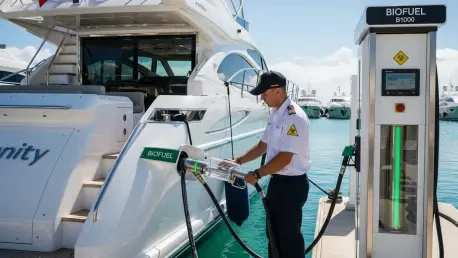

The familiar scent of diesel at the docks is beginning to give way to a cleaner alternative as the maritime industry steers a decisive course toward decarbonization, driven by both regulatory pressure and a growing environmental consciousness. Sustainable marine fuel represents a significant advancement in this global effort, offering a pathway to reduce the sector’s carbon footprint. This review explores the evolution of these fuels by focusing on a pioneering biofuel initiative within the leisure marine industry. The purpose is to provide a thorough understanding of this technology, its current capabilities as demonstrated through a real-world application, and its potential for future development in creating a more responsible maritime future.
An Introduction to Marine Biofuels
Marine biofuels are a class of renewable energy sources derived directly from organic matter, such as plant oils, animal fats, or agricultural waste. Their emergence as a viable power source is a direct response to global decarbonization mandates, including ambitious goals like the UAE’s Net Zero 2050 targets. As the maritime world seeks alternatives to conventional fossil fuels, biofuels have gained significant relevance due to their potential to lower greenhouse gas emissions.
A key advantage driving their adoption is that many biofuels are formulated as “drop-in” fuels. This means they can be used in existing marine engines without requiring costly and time-consuming mechanical modifications. This compatibility makes them an exceptionally practical solution for the current global fleet, enabling vessel owners to transition toward more sustainable operations immediately. Consequently, biofuels represent a critical bridge technology, facilitating emission reductions while more advanced, long-term solutions are developed.
Anatomy of a Pioneering Biofuel Initiative
A leading example of marine biofuel application is the Sustainable Bio Yacht Fuel (SBYF) initiative, a strategic partnership between Emaar Hospitality Group and the specialized producer Lootah Biofuels. This collaboration focuses on the high-end leisure marine sector, providing a tangible solution for environmentally conscious yacht owners. The initiative serves as a powerful case study, demonstrating how targeted partnerships can accelerate the adoption of green technologies within specific market segments.
A Circular Economy in Action from Waste to Wake
The primary innovation of the SBYF initiative lies in its circular economy framework. The process begins with the collection of used cooking oil, a common waste product, from Emaar’s extensive portfolio of hotels, residences, and mixed-use developments. This approach transforms a local waste stream into a valuable resource, creating a self-sustaining loop that benefits both the environment and the local economy.
Lootah Biofuels then employs a specialized process to convert this collected waste oil into a high-grade marine biofuel suitable for recreational vessels. This model of upcycling is profoundly effective; it not only produces a lower-emission energy source but also provides a sustainable solution to waste management. By closing the loop between waste generation and energy consumption, the initiative creates a replicable and highly efficient system for localized fuel production.
Fuel Performance and Environmental Gains
From a technical standpoint, SBYF offers compelling performance characteristics. It is engineered as a direct, drop-in replacement for conventional marine diesel, which is a critical factor for its acceptance among yacht owners. This feature eliminates the need for expensive engine retrofits or new infrastructure investments, significantly lowering the barrier to adoption and allowing for a seamless transition to a cleaner fuel source.
The most significant benefit, however, is its environmental impact. The use of SBYF leads to a substantial reduction in carbon emissions when compared to traditional marine fuels. For yacht owners, this provides a practical and immediate way to minimize their ecological footprint without sacrificing vessel performance or operational convenience. This balance of environmental responsibility and user-friendliness is central to the initiative’s appeal and its potential for wider influence.
An Integrated Approach to Maritime Sustainability
The introduction of SBYF is not an isolated measure but rather a component of a much broader trend toward integrated sustainability strategies within the marine leisure industry. Progressive marina operators are increasingly adopting a holistic approach to environmental stewardship, where fuel is just one part of a larger ecosystem of green practices. Emaar’s marinas exemplify this comprehensive strategy, embedding sustainability into multiple facets of their operations.
This commitment is evident in existing accolades and initiatives at the Dubai Marina Yacht Club, which holds both Clean Marina and Fish Friendly certifications. Furthermore, the club has implemented an innovative technology that generates potable drinking water for captains and crew by converting moisture from the air. The launch of the biofuel service, therefore, builds upon a solid foundation of environmental responsibility, reflecting a cohesive and multi-pronged effort to promote greener maritime leisure.
Real World Deployment a Dubai Case Study
The real-world application of SBYF is centered at two of Dubai’s premier marine destinations: the Dubai Marina Yacht Club and the Creek Marina Yacht Club. The initiative’s deployment has been structured as a phased rollout, a deliberate strategy designed to ensure operational excellence from the outset. This careful planning aims to guarantee a consistent and reliable supply chain while maintaining the highest standards of fuel quality for all users.
To facilitate easy access for yacht owners, dedicated refueling points have been established at both marinas. Initially, the refueling service operates on a scheduled basis, allowing the operators to manage logistics and gauge interest effectively. The plan includes scaling the service in direct response to consumer demand, demonstrating a flexible and customer-centric approach to introducing a novel and sustainable product into a mature leisure market.
Challenges and Operational Considerations
Despite its innovative model, the technology faces notable challenges, primarily centered on the logistics of feedstock collection. Establishing and maintaining a consistent supply chain for used cooking oil requires a robust and highly efficient collection network. Any disruptions in this supply could impact fuel production, making logistical reliability a critical factor for the initiative’s long-term success.
Furthermore, technical considerations are paramount. Upholding stringent fuel quality standards is non-negotiable, as any impurities or inconsistencies in the biofuel could risk damaging sensitive marine engines. Operationally, the phased rollout demands meticulous planning, from the physical installation of dedicated refueling points to the scheduling of services and the training of staff to handle the new product, all while adapting to fluctuating consumer demand.
Future Outlook for Green Yachting
The SBYF initiative provides a compelling outlook on the future of green yachting. Its localized, circular economy model holds significant potential for scalability. The success of this project in Dubai can serve as a proven blueprint for other marinas, both regionally and globally, demonstrating a commercially viable path for implementing sustainable fueling solutions tailored to local resources and waste streams.
In the broader context, this initiative is likely to spur further innovation in the marine biofuel sector, including research into alternative feedstocks beyond cooking oil. As more consumers in the leisure marine industry embrace such options, it will foster a powerful market-driven push for greater environmental responsibility. Over the long term, such pioneering efforts will contribute to a cultural shift, embedding sustainable practices as the new standard throughout the entire marine sector.
Conclusion a Tangible Step Toward a Greener Maritime Future
The Sustainable Bio Yacht Fuel initiative successfully demonstrated how a localized partnership could effectively reduce the environmental footprint of the leisure marine industry. It integrated an innovative circular economy model with the practical demands of yacht owners by delivering a high-performance, drop-in fuel that required no significant changes from the end-user. This approach provided a seamless and accessible pathway to more responsible boating.
Ultimately, the project represented more than just the introduction of a new fuel; it served as an impactful proof of concept. The collaboration between Emaar and Lootah Biofuels highlighted how targeted action and creative thinking could yield tangible environmental progress. In doing so, it established a new benchmark for sustainable practices in the maritime leisure sector and illuminated a practical route toward a cleaner and more responsible future on the water.