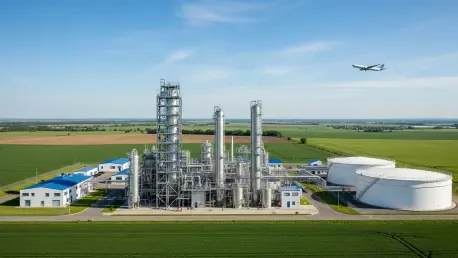

A landmark agreement signed at the World Economic Forum in Davos is set to catalyze India’s journey toward energy independence and decarbonization, marking a significant step forward in the global transition to cleaner aviation. Sankla Renewables, the renewable energy arm of the Sankla Group, has entered into a Memorandum of Understanding (MoU) with the Government of Maharashtra, committing to a monumental ₹15,000 crore investment for the establishment of a state-of-the-art Sustainable Aviation Fuel (SAF) production facility. This venture not only represents a massive infusion of capital into the nation’s green energy infrastructure but also signals a strategic diversification for the real estate-focused Sankla Group into the high-growth clean technology sector. The project, located in Chalisgaon, is poised to become a cornerstone of Maharashtra’s low-carbon industrial development strategy, transforming the regional economic landscape while addressing the urgent need to reduce the carbon footprint of air travel.
A Strategic Pivot into Clean Energy
This ambitious project represents a transformative strategic pivot for the Sankla Group, a conglomerate primarily known for its extensive work in real estate development through Sankla Buildcoon. The decision to allocate ₹15,000 crore through its renewable energy division, Sankla Renewables, signifies a deliberate and large-scale entry into the burgeoning clean energy manufacturing space. The selection of Chalisgaon in Maharashtra’s Jalgaon district for the plant’s location is a calculated move, designed to leverage the region’s rich agricultural resources. This initiative, formalized at a global economic summit, is more than just a new business venture; it reflects a fundamental shift in the company’s long-term vision. By aligning its growth trajectory with national and global sustainability goals, the Sankla Group is positioning itself at the forefront of India’s green industrial revolution, aiming to build a legacy rooted in environmental responsibility and innovative energy solutions for a carbon-constrained world.
The facility’s development plan is structured around a phased implementation, with full operational capacity targeted for 2029, a strategy designed to meticulously manage both financial outlay and technological integration. At the core of the plant’s operations will be internationally approved technologies capable of converting diverse agricultural waste into high-grade, sustainable aviation fuel. The primary feedstock for this process will be sourced directly from the surrounding agricultural community, utilizing materials such as sugarcane bagasse, cotton stalks, and soybean husk that are often otherwise discarded or burned. This approach not only ensures a steady supply of raw materials but also integrates the project deeply within the local agrarian economy. By adopting a phased rollout, Sankla Renewables can de-risk the complex undertaking, allowing for adjustments and optimizations at each stage, ensuring the plant meets its production and sustainability targets efficiently upon final commissioning.
Economic and Environmental Impact
The strategic importance of this SAF plant extends far beyond corporate diversification, aligning directly with India’s most pressing national objectives. A primary benefit lies in its potential to significantly reduce the country’s heavy reliance on imported fossil fuels, a long-standing challenge to its energy security and economic stability. By producing aviation fuel domestically from renewable sources, the project will help insulate a critical sector from volatile global oil markets and contribute to a more favorable balance of trade. Furthermore, the initiative is a crucial component of India’s commitment to curbing greenhouse gas emissions, directly targeting the aviation industry, which is one of the most difficult sectors to decarbonize. On the economic front, the plant is projected to be a powerful engine for job creation, generating over 3,000 direct and indirect employment opportunities while fostering thousands more across the entire supply chain, from agriculture to logistics. Sankla’s planned collaboration with local institutions on targeted skill development programs will further ensure that the regional workforce is equipped to capitalize on these new opportunities.
The project is designed to deliver profound and lasting benefits to the local community, particularly for the region’s farmers. By establishing a large-scale, consistent demand for agricultural residue, the plant will create a stable and lucrative new market for materials that were previously considered waste. Through long-term supply agreements, farmers will gain an additional, reliable income stream, enhancing their financial security and stimulating the rural economy. This model transforms agricultural byproducts into valuable commodities, fostering a circular economy that benefits both producers and the industry. Critically, this initiative also offers a sustainable solution to the pervasive environmental problem of crop-stubble burning. This common practice, undertaken to clear fields, is a major contributor to severe air pollution in many parts of India. By providing a commercial alternative, the SAF plant will help mitigate this public health hazard, turning an environmental liability into a key component of a cleaner energy future and improving the quality of life for communities across the region.
A New Standard for Green Industrialization
The project’s comprehensive sustainability framework set a new benchmark for industrial development in India. From its inception, the facility was designed to operate with a minimal environmental footprint, adhering to the most stringent global standards. The entire plant was planned to be powered exclusively by renewable energy sources, ensuring that the production of clean fuel did not rely on carbon-intensive energy. A zero-liquid-discharge water management system was integrated into the design, a critical feature that would eliminate the release of industrial wastewater and promote the recycling and reuse of all water within the facility. Furthermore, a commitment was made to utilize a fleet of electric vehicles for all internal transport and logistics, further reducing the plant’s operational emissions. This holistic approach, which addressed energy consumption, water usage, and transportation, demonstrated a forward-thinking commitment to sustainable manufacturing that went beyond the core product, solidifying the project’s role as a model for future green industrialization.