
The End of An Era: Clean Energy Outpaces Global Demand
The age of powering global growth with more fossil fuels is over. In the first half of 2025, the world passed a quiet but historic milestone: for the first time, the expansion of solar and wind generation surpassed all new global electricity demand. This is not a forecast. It is a realized event that fundamentally breaks the century-old link between economic growth and carbon-intensive energy.
For decades, the equation was simple. A growing economy required more energy, and that meant burning more coal, oil, and gas. That equation is now broken. The data from early 2025 confirms clean energy is mature and scalable enough to power global expansion, placing a definitive cap on the growth of fossil fuel electricity. For leaders across the energy sector, the conversation has shifted. The challenge is no longer proving renewable viability but mastering the complex reality of a grid dominated by clean, variable power.
The Surge That Redefined the Grid
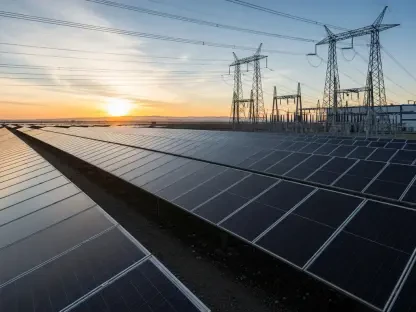
The engine behind this transformation was a record-breaking expansion of solar power. In the first six months of 2025, solar generation surged by an astonishing 31%, adding 306 terawatt-hours (TWh) to the global grid. This increase alone was enough to meet 83% of the world’s new electricity demand. Solar is no longer an emerging technology; it is the world’s primary source of new electricity, driven by falling costs and rapid deployment.
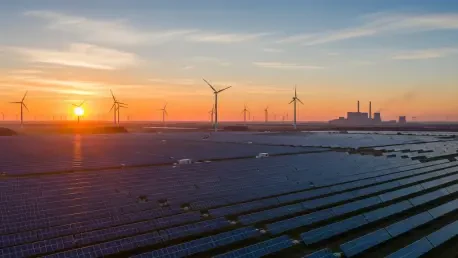
While solar led the charge, wind energy played a critical supporting role. Wind generation grew by 7.7%, adding another 97 TWh of clean power. Combined, the 403 TWh of new solar and wind energy easily outstripped the 369 TWh of new global demand. This created a surplus, allowing the power sector to begin actively displacing fossil fuels instead of just supplementing them. The complementary generation profiles of solar and wind prove that a diversified renewable portfolio has the power to get ahead of demand growth, setting the stage for a structural decline in emissions.
A Tipping Point in the Global Power Mix
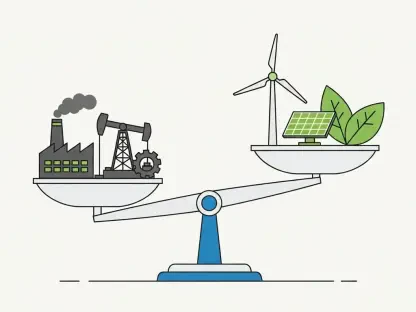
This clean energy boom triggered a historic reordering of the global power mix. For the first time ever in a half-year period, renewables, including hydro and bioenergy, generated more electricity than coal. Total renewable generation reached 5,072 TWh, while coal’s output fell to 4,896 TWh.
This crossover pushed renewables to a 34.3% share of global electricity, while coal’s share shrank to 33.1%. The milestone signals that renewables are no longer an alternative energy source. They are becoming the foundational pillar of the global grid, displacing the fuel that powered the industrial revolution and marking an irreversible inflection point in the energy transition.
The Great Divergence: Asia Leads, The West Lags
Beneath the global trend lies a sharp regional divergence. China and India, the world’s two largest energy consumers, drove this historic outcome. In both nations, the deployment of new clean power dramatically outpaced increases in electricity demand, enabling them to reduce their reliance on fossil fuels while their economies grew.
China’s performance is particularly structural. A massive, sustained industrial policy in solar and wind manufacturing has created a momentum that consistently beats demand growth. [Human Editor: Insert source to support this claim]. This demonstrates that emerging economies can leapfrog traditional development pathways and lead global decarbonization efforts.
In stark contrast, fossil fuel generation increased in both the European Union and the United States. In the U.S., the build-out of new solar and wind projects failed to keep pace with rising electricity demand, forcing utilities to rely on natural gas and coal to fill the gap. In the EU, lower-than-expected output from wind and hydro created a shortfall compensated for by burning more coal and gas. These setbacks are a critical reminder that the transition is not linear. They highlight persistent challenges with grid integration, permitting delays, and the need for a resilient energy mix.
Beyond Capacity: The New Bottlenecks Emerge
Achieving this renewable milestone reveals a new set of challenges that were once secondary. The central problem is no longer generating enough clean energy; it is delivering it reliably where and when it is needed. The industry’s next frontier is defined by three critical bottlenecks.
First, grid modernization is paramount. Existing transmission and distribution networks were built for a centralized, one-way flow of power from large fossil fuel plants. They are ill-equipped for the distributed, intermittent, and two-way flows from renewable sources. Upgrading this infrastructure to create a smarter, more flexible grid is now the primary obstacle to faster decarbonization.
Second, energy storage is non-negotiable. The sun does not always shine, and the wind does not always blow. Deploying vast amounts of battery storage for short-duration needs and investing in long-duration technologies like pumped hydro or green hydrogen are essential to ensure grid stability and reliability. Without it, renewable curtailment will rise, and reliance on gas peaker plants will remain.
Finally, supply chain resilience is a growing concern. The transition requires a massive increase in the mining and processing of critical minerals like copper, lithium, and cobalt. Geopolitical concentration of these supply chains presents significant risk. According to some analyses, demand for lithium could increase by over 400% by 2030, creating a potential bottleneck for battery and electric vehicle production. [Human Editor: Insert source to support this claim].
Decoupling Growth from Emissions
The most significant outcome of this transition is the clear decoupling of electricity demand from carbon emissions. Despite a 2.6% rise in global power consumption, CO2 emissions from the sector fell by 12 million metric tons. This proves that economic growth is no longer contingent on rising emissions.
This decoupling was made possible entirely by solar and wind absorbing all new demand. Regional emissions data mirrored generation trends. Substantial emissions reductions in China and India were large enough to offset increases in the EU and the U.S. This delicate balance marks a monumental victory, halting the upward march of power sector emissions and creating the conditions for future declines. Recent reports confirm that investment in clean energy is now more than double the amount flowing to fossil fuels, signaling a definitive shift in capital allocation. [Human Editor: Insert source to support this claim].
A Compact Playbook for the New Energy Reality
The events of 2025 solidified a new reality. The core question is no longer whether renewables can meet global demand but how to manage their integration into a grid designed for a different era. For executives and policymakers, navigating this next phase requires a strategic shift from capacity addition to system optimization.
- Prioritize Grid Investment Over Generation: Shift capital focus from solely building new solar and wind farms to aggressively modernizing transmission and distribution networks. The primary ROI is now in alleviating grid congestion and enabling clean power delivery.
- Develop a Diversified Storage Strategy: Invest in a portfolio of energy storage solutions. Deploy utility-scale batteries to manage daily intermittency while piloting long-duration storage technologies to ensure seasonal reliability and reduce dependence on gas.
- Secure Mineral Supply Chains: Move beyond short-term procurement and engage in long-term partnerships, offtake agreements, and recycling initiatives to de-risk exposure to volatile critical mineral markets. Treat supply chain security as a core component of energy security.
- Streamline Permitting and Interconnection: Champion policy reforms to accelerate the approval process for new renewable projects and, crucially, for the transmission lines needed to connect them. The speed of the transition is now limited by bureaucracy, not technology.