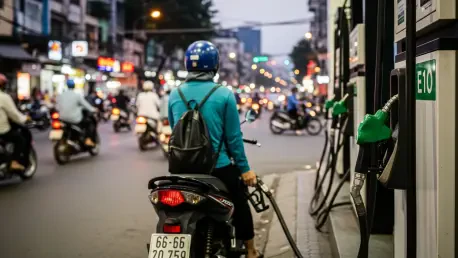

Recent strategic policy shifts within key Southeast Asian nations have dramatically reshaped the regional energy landscape, creating unprecedented market opportunities for U.S. ethanol producers seeking to supply clean and affordable fuel alternatives. As governments across the region intensify their efforts to reduce carbon emissions and improve air quality, ethanol has emerged as a viable and immediate solution. The convergence of new government mandates and favorable trade agreements is now unlocking a multi-billion-gallon market that was previously difficult to access. This transformation is not merely theoretical; it is being driven by concrete regulatory action that establishes a clear and substantial demand for ethanol imports. Consequently, what was once a region of potential interest has rapidly become a primary focus for the American biofuel industry, heralding a new era of transatlantic energy cooperation centered on renewable resources.
Vietnam’s Mandate Creates a Substantial Import Gap
Vietnam has taken a decisive step toward energy diversification by implementing a new national roadmap designed to expand ethanol blending across its entire road fuel supply. Under the direction of the Ministry of Industry and Trade, this policy mandates the widespread adoption of both E5 (a blend of 5% ethanol and 95% gasoline) and E10 (10% ethanol) fuels. The most impactful part of this initiative began in January, with a directive to convert all RON95 gasoline to an E10 blend. Since RON95 constitutes a remarkable 80% of the country’s total gasoline consumption, this change fundamentally alters the fuel market. The policy requires full compliance by June 1, a rapid timeline that puts immediate pressure on the supply chain. This mandate affects Vietnam’s entire 2.7-billion-gallon annual gasoline pool, creating a sudden and significant need for ethanol. Projections show the country’s total fuel ethanol demand will now reach 243 million gallons per year, while its domestic production capacity stands at only 84 million gallons. This leaves a massive import gap of approximately 160 million gallons, representing a potential $300 million market for U.S. suppliers.
Malaysia’s Trade Agreement Unlocks New Avenues
In a parallel development, Malaysia has significantly enhanced market access for U.S. ethanol through the finalization of a new U.S.–Malaysia Reciprocal Trade Agreement. This landmark agreement delivers immediate and long-term benefits for American producers. A key provision of the deal is the instant elimination of the existing import duty on U.S. denatured ethanol, making it far more price-competitive overnight. Furthermore, the agreement initiates a structured nine-year phase-out of the tariff on undenatured ethanol, ensuring sustained market access and growth. This policy shift is particularly impactful given Malaysia’s position as the second-largest gasoline market in Southeast Asia, with an annual consumption of 4.5 billion gallons. The improved competitiveness of U.S. ethanol opens up diverse applications beyond traditional gasoline blending. It paves the way for its use as a critical feedstock for advanced biofuels, including sustainable aviation fuel (SAF) and low-carbon marine fuels, aligning with global efforts to decarbonize the transportation sector. Malaysia’s policy change therefore represents a crucial step toward building a more sustainable and cleaner energy future for the entire region.
The Dawn of a New Energy Partnership
The proactive policy decisions made in both Vietnam and Malaysia solidified a new chapter in energy trade between the United States and Southeast Asia. These developments moved the conversation from potential to practice, establishing tangible demand and removing long-standing trade barriers. Vietnam’s aggressive blending mandate created an immediate and quantifiable import requirement that domestic production could not meet, while Malaysia’s tariff elimination provided a powerful incentive for market entry and expansion into next-generation fuels. Together, these actions provided U.S. ethanol producers with the market certainty they needed to invest in logistics and supply chains for the region. This pivotal moment served as a powerful case study for neighboring countries, demonstrating how integrating biofuels could help achieve climate goals while ensuring energy security. Ultimately, these moves established a foundational partnership that promised sustained growth and collaboration in the pursuit of a cleaner global energy system.