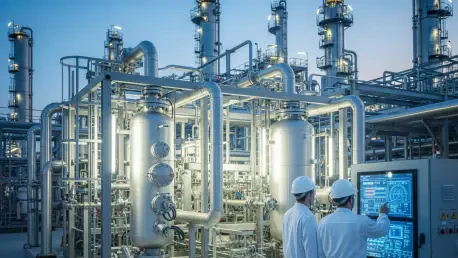

Transforming one of the energy sector’s most hazardous waste streams into clean fuel and a vital raw material is no longer a theoretical concept but a demonstrated industrial reality. The direct conversion of hydrogen sulfide into hydrogen and sulfur represents a significant advancement in the petrochemical, natural gas, and coal processing industries. This review will explore the evolution of this technology, its key features, performance metrics, and the impact it has had on industrial waste management and resource recovery. The purpose of this review is to provide a thorough understanding of the technology, its current capabilities, and its potential for future development.
Understanding the Hydrogen Sulfide Challenge and a Novel Solution
Hydrogen sulfide (##S) is a toxic and environmentally harmful byproduct of industries that process fossil fuels, posing a significant global management challenge. With over 70 billion cubic meters generated annually, its safe disposal is a costly and complex problem for operators worldwide.
This technology offers a novel solution by directly splitting ##S into high-purity hydrogen and sulfur. Such an approach shifts the paradigm from hazardous waste management to value creation, aligning with the global push for a circular economy and cleaner industrial operations by turning a dangerous liability into valuable assets.
A Deep Dive into the Conversion Technology
The Off Field Electrical Method at its Core
At the technology’s heart is an “off-field electrical method,” an electrochemical process that efficiently breaks down ##S molecules without requiring extreme heat or complex catalysts. This direct approach is fundamental to its effectiveness.
The method’s high efficiency is crucial for enabling a near-total conversion rate. This precision maximizes the yield of valuable end products while minimizing residual waste, a significant improvement over conventional techniques.
Separated Reactor Design for Unprecedented Safety and Scale
A key architectural innovation is the system’s use of reactors for hydrogen and sulfur generation that are physically separated from the electrical electrodes. This design choice is fundamental to the system’s robust safety profile.
This separation enhances operational safety by mitigating the risk of forming explosive gas mixtures, a critical concern in hydrogen production. This feature is what allows the technology to be confidently applied at a large industrial scale.
Industrial Scale Performance Validation
The technology’s effectiveness has been validated at an industrial demonstration facility in China capable of processing 100,000 cubic meters of ##S annually. This project successfully transitioned the concept from laboratory to industry.
Operational data from the project confirms a conversion rate exceeding 99.999%. Furthermore, the resulting hydrogen and sulfur meet high commercial quality standards, proving the process is viable for producing market-ready commodities.
Applications and Socio Economic Impact
This technology finds immediate application across the natural gas, petrochemical, and coal processing sectors. It provides a dual benefit by transforming a dangerous pollutant into valuable commodities that can be sold or reused.
The potential economic and environmental impact is immense. If this method were applied across China using renewable power, researchers estimate it could generate 730,000 tonnes of low-carbon hydrogen annually, supporting decarbonization goals.
Overcoming Hurdles and Addressing Limitations
Primary challenges to widespread adoption include the energy requirements of the electrical process and the capital cost of retrofitting existing industrial plants. Further engineering is also needed to optimize the design for even larger capacities.
Ongoing development efforts are focused on integrating the system with renewable energy sources. This strategy would reduce operating costs and improve its carbon footprint, making it a more sustainable long-term solution.
Future Trajectory and Global Potential
The technology is heading toward further process optimization to lower energy consumption and reduce costs. Future breakthroughs could make it more competitive for global adoption in a variety of industrial settings.
Its long-term impact on industrial decarbonization and the hydrogen economy could be substantial. It offers a unique pathway for heavy industries to sustainably manage waste and contribute to the green energy supply chain.
Concluding Assessment
The direct electrical conversion of ##S stands as a proven, highly efficient, and safe solution for industrial waste management. Its validated performance at an industrial scale confirms its readiness for broader commercial deployment.
This technology represents a transformative step in turning a hazardous waste stream into a valuable resource. It provides a tangible tool for industries to enhance sustainability and participate in the green energy transition.