
As India charts an ambitious course toward a net-zero future, its strategic alliance with Germany has emerged as a critical engine for sustainable transformation, backed by substantial financial and technological investment. This collaboration moves beyond conventional development aid, representing a mature partnership poised to reshape India’s energy landscape, modernize its urban infrastructure, and build a workforce ready for the green economy. The union between one of the world’s fastest-growing major economies and Europe’s industrial powerhouse is not merely a bilateral agreement but a blueprint for global cooperation in the face of climate change.
A Landmark Partnership Forged in Green Ambition
The cornerstone of this evolving relationship is the Green and Sustainable Development Partnership (GSDP), an ambitious framework designed to align the developmental priorities of both nations. Following the recent India-Germany Government Negotiations on Development Cooperation, Germany has formalized a commitment of approximately €1.3 billion, predominantly in the form of concessional loans. This substantial financial injection is a clear signal of confidence in India’s green transition and its capacity to implement large-scale, impactful projects.
This funding is strategically channeled into sectors critical for a sustainable future. Key areas of focus include climate and energy projects, the advancement of sustainable urban development, the promotion of green mobility, and the responsible management of natural resources. Crucially, a significant portion is dedicated to skills development, aiming to cultivate a pool of local talent proficient in renewable energy technologies. Officials on both sides have emphasized that this is a “mature collaboration between two nations,” reflecting a shift toward an equal partnership rather than a traditional donor-recipient dynamic.
Driving Tangible Change and Future Growth
Innovating on the Ground Landmark Projects in Action
The impact of this partnership is already visible in tangible projects that serve as models for sustainable development. A prime example is the recently inaugurated Yellow Line Metro in Bangalore, which received a €340 million loan from Germany’s development bank, KfW. This initiative not only offers a crucial alternative to congested urban roadways but has also generated around 25,000 jobs, with German firms like Siemens and Bosch contributing essential technology and components.
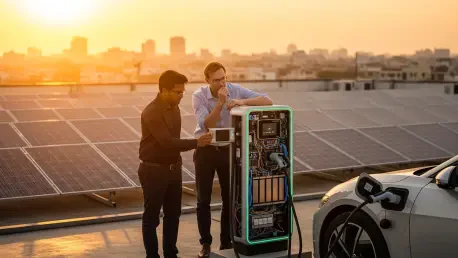
Technological synergy is further demonstrated by pioneering projects like the Living Lab in Bangalore. This initiative successfully developed India’s first rooftop solar-powered EV charging station that ingeniously utilizes second-life batteries, creating a closed-loop system that maximizes resource efficiency. The success of this pilot has already led to its expansion into other cities, showcasing the partnership’s ability to test, prove, and scale innovative solutions tailored to India’s unique urban challenges.
Investing in Tomorrow The Financial Backbone of a Greener India
The €1.3 billion financial commitment acts as a powerful catalyst, enabling the scaling of green technologies across the subcontinent. This investment extends beyond mere project financing; it is designed to de-risk private sector investment and create a favorable market environment for renewable energy and sustainable infrastructure. The long-term economic impact is projected to be significant, fostering a new wave of green industries and enhancing India’s energy security.
Furthermore, the involvement of leading German companies is instrumental in facilitating technology transfer and building local manufacturing capabilities. Firms such as Siemens and Bosch are not only supplying advanced equipment but are also investing in local production and training. This approach helps to build a self-reliant ecosystem, ensuring that India can not only adopt but also innovate and produce the green technologies of the future.
Navigating the Path Forward Challenges in a Cross Continental Collaboration
Despite the partnership’s clear successes, its path forward is not without challenges. Deploying large-scale infrastructure projects across India’s diverse states presents significant logistical complexities, from navigating varied regulatory landscapes to securing land and permits. Each region possesses unique geographical and socio-economic conditions, demanding a flexible and adaptive approach rather than a one-size-fits-all implementation strategy.
Another considerable hurdle involves adapting advanced German technologies to local Indian conditions, supply chains, and operational capacities. Ensuring seamless integration requires more than just technical expertise; it demands a deep understanding of the local market and the ability to overcome administrative bottlenecks. Efficient and transparent allocation of funds is paramount to maximizing impact and maintaining public trust. Consequently, a continuous focus on upskilling the local workforce is essential to ensure that sophisticated green technologies can be operated and maintained effectively over the long term.
The Governance Framework Ensuring a Sustainable and Equal Partnership
The GSDP, established in 2022, provides the essential policy framework that guides all collaborative projects, ensuring they align with shared strategic goals. This overarching structure is solidified through regular bilateral government negotiations, where commitments are renewed and priorities are adjusted to meet evolving needs. These high-level dialogues are critical for maintaining momentum and ensuring that both partners remain strategically aligned on key outcomes.
A defining feature of this governance model is its emphasis on an “equal partnership,” which profoundly influences project ownership, decision-making processes, and mutual accountability. This modern approach fosters a sense of shared responsibility and ensures that projects are co-designed to meet India’s specific developmental needs. German development institutions like KfW play a vital role in this framework, ensuring that all funded initiatives comply with stringent international environmental and social standards, thereby safeguarding the long-term sustainability of the investments.
Beyond 2025 The Long Term Vision for Indo German Cooperation
Looking ahead, the partnership is poised to expand into new and emerging frontiers of sustainability. Future growth areas include collaborations in green hydrogen, a critical fuel for decarbonizing heavy industry, and the circular economy, which aims to minimize waste and maximize resource use. The digital transformation of the energy sector also presents a significant opportunity for joint initiatives, using data and smart grids to enhance efficiency and reliability.
The potential for joint research and development initiatives is another promising avenue, which could lead to the creation of next-generation sustainable solutions tailored for global markets. By fostering a self-sustaining ecosystem of green innovation, the partnership is not just about transferring existing technology but about co-creating the technologies of tomorrow. Continued investment in skills development will be the backbone of this vision, empowering a new generation of Indian engineers, technicians, and policymakers to lead the green transition.
A Symbiotic Alliance Charting a Course for a Greener Planet
The Indo-German partnership stands as a powerful testament to what can be achieved through focused international cooperation. Germany’s financial and technological support is tangibly accelerating India’s journey toward its ambitious climate goals, from expanding renewable energy capacity to building sustainable urban centers. This collaboration enables India to leapfrog traditional development pathways and embrace a greener, more resilient economic model.
Ultimately, the benefits of this alliance are mutual, strengthening both economies and deepening their strategic relationship on the global stage. It enhances Germany’s role as a key partner in the Indo-Pacific while providing India with the critical tools it needs to power its growth sustainably. The Green and Sustainable Development Partnership offers more than just a bilateral success story; it serves as a compelling and replicable model for how nations can unite to address the universal challenge of climate change.