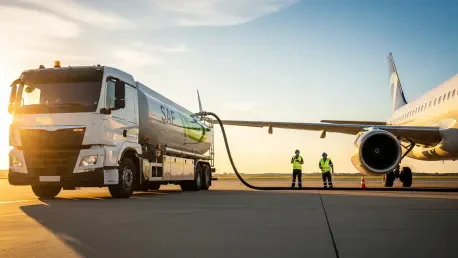

Transforming the primary driver of climate change into the very fuel that powers modern air travel is no longer a concept confined to science fiction but a tangible reality being pioneered today. The development of sustainable aviation fuel (SAF) from captured carbon dioxide represents a significant advancement in the aviation and energy sectors. This review will explore the evolution of OXCCU’s innovative technology, its key features, performance milestones, and the impact it is poised to have on decarbonizing air travel. The purpose of this review is to provide a thorough understanding of this breakthrough approach, its current capabilities, and its potential for future development.
The Emergence of OXCCU’s Carbon to Fuel Innovation
Founded in 2021, the Oxford-based startup OXCCU has emerged as a key player in the clean energy landscape with a clear and ambitious mission: to convert waste carbon dioxide into high-value fuel. The company’s approach directly confronts one of the most persistent challenges in environmental technology by creating a productive use for a ubiquitous greenhouse gas.
This innovation arrives at a critical juncture for the aviation industry, which faces intense pressure to reduce its carbon footprint. With limited viable alternatives to liquid hydrocarbon fuels for long-haul flights, the need for scalable and economically feasible SAF solutions has never been more urgent. OXCCU’s technology offers a promising pathway to bridge the gap between aviation’s operational needs and global decarbonization targets.
Core Technology and Process Advantages
The Patented Single Step Conversion Process
The primary innovation at the heart of OXCCU’s technology is a direct, single-step process that converts carbon dioxide and green hydrogen into jet-fuel-range hydrocarbons. This method bypasses the complex, multi-stage procedures often required by conventional synthetic fuel production, such as the Fischer-Tropsch synthesis, which typically involves intermediate steps that add cost and complexity.
Central to this streamlined reaction is a proprietary iron-based catalyst developed and patented by the company. This catalyst is designed to facilitate the conversion with high efficiency and selectivity, ensuring that the chemical reaction predominantly yields the desired long-chain hydrocarbons suitable for aviation fuel. By consolidating the process into a single reactor, the technology simplifies the engineering and operational requirements significantly.
Economic and Environmental Efficiency
The single-step conversion process yields substantial economic benefits. By eliminating the need for multiple reactors and intermediate processing stages, OXCCU’s method dramatically reduces both the initial capital expenditure (CAPEX) and ongoing operating costs (OPEX). This cost efficiency is a critical factor in making the resulting SAF price-competitive with conventional fossil-based jet fuel, a major barrier that has historically hindered widespread SAF adoption.
Moreover, the high selectivity of the catalyst minimizes the production of unwanted byproducts, leading to a more resource-efficient process with less waste. This not only improves the environmental profile of the fuel but also simplifies the downstream refining requirements. The result is a cleaner, more direct route from captured carbon to a finished, drop-in-ready sustainable fuel.
Recent Milestones and Industry Recognition
The viability and promise of OXCCU’s approach have been validated through significant industry recognition. The company was recently named the winner of the Startups 100 Sustainability Award, an honor celebrating businesses with exceptional environmental impact. Furthermore, its 4th-place ranking in the overall Startups 100 Index highlights its position as one of the UK’s most promising new ventures across all sectors.
This external validation has been matched by strong investor confidence. OXCCU successfully secured £20.75 million in a Series B funding round, providing the necessary capital to accelerate its growth. These funds are being allocated toward scaling operations, expanding the team, and advancing the development of its next-generation facilities.
Real World Demonstration and Viability
Moving beyond theoretical models and laboratory tests, OXCCU has proven the practical application of its technology at its OX1 demonstration facility. This pilot plant has provided definitive proof-of-concept, establishing the system’s capacity to consistently produce liquid fuel from CO₂ and hydrogen feedstocks in a real-world setting.
The facility’s performance metrics underscore its success, having logged over 1,000 hours of continuous, stable operation. During this time, the system demonstrated high conversion rates and excellent selectivity for SAF, confirming the reliability and effectiveness of the proprietary catalyst and single-step process. This milestone provides the tangible evidence required to proceed with commercial-scale deployment.
Overcoming Barriers to Scalable Production
The journey from a promising technology to a commercial-scale industry solution is fraught with challenges, primarily related to cost, efficiency, and feedstock availability. Many emerging SAF technologies struggle to compete economically with established fossil fuels, limiting their market penetration and impact.
OXCCU’s technology is engineered to directly address these hurdles. The use of an inexpensive and abundant iron-based catalyst, combined with a highly streamlined process, fundamentally lowers the production cost. This approach tackles the economic barrier head-on, creating a more feasible pathway toward widespread adoption and helping to de-risk the investment required for building commercial-scale production plants.
The Future Trajectory Scaling SAF and Beyond
With its technology validated and funding secured, OXCCU is pursuing an ambitious growth strategy. The company is already proceeding with plans for its next, larger demonstration plant, known as OX2. The ultimate goal is to achieve an annual production capacity of 10,000 tonnes of SAF before 2030, a target that would mark a significant contribution to the SAF market.
The company’s vision extends beyond aviation fuel. The core conversion technology is adaptable and holds the potential to produce other essential carbon-based products, including chemicals and plastics. This flexibility opens new markets and supports the creation of a broader circular carbon economy, where waste CO₂ is repurposed as a valuable feedstock for multiple industries, reducing reliance on fossil resources across the board.
Conclusion A Paradigm Shift in Fuel Production
This review assesses OXCCU’s technology as a mature and validated solution that is poised to make a tangible impact on aviation decarbonization. The combination of a novel single-step process and a cost-effective catalyst successfully addresses the economic and technical barriers that have long constrained the growth of the SAF industry. Its proven performance and strong investor backing confirm its status as a leader in the carbon-to-value sector.
Ultimately, OXCCU’s approach represents a fundamental paradigm shift in how carbon dioxide is perceived and managed. By transforming an environmental liability into a critical industrial resource, the technology paves the way for a more sustainable future for air travel. It stands as a powerful example of how targeted innovation can create circular economic models that benefit both the planet and industry.