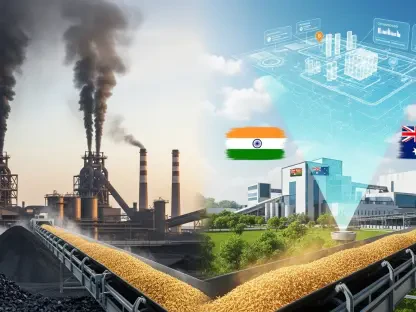

Despite a concerted Western pressure campaign designed to choke Moscow’s oil revenues, India’s imports of Russian crude are not only holding steady but are projected to reach a six-month high, revealing a fascinating and deep-seated division among the nation’s most powerful refiners. This resilience in trade masks a turbulent realignment happening within the Indian market, where a high-stakes game of economic opportunity versus geopolitical risk is forcing a dramatic split in strategy. The once-unified pursuit of cheap energy has given way to a fractured landscape, pitting companies with deep international ties against those more insulated from Western sanctions.
India’s Evolving Role as a Global Refining Powerhouse
India has firmly established itself as a central player in the global energy ecosystem, ranking as the world’s third-largest importer of crude oil. But its role extends far beyond mere consumption. The nation is a critical refining hub, transforming raw crude into valuable petroleum products like diesel and gasoline that fuel both its booming domestic economy and are exported to markets across the globe. This dual function gives India significant leverage and strategic importance in the international oil trade.
The country’s refining sector is a complex mix of powerful entities. State-owned giants such as Indian Oil Corporation (IOCL) and Bharat Petroleum Corporation (BPCL) operate with a mandate that often aligns with national policy objectives. In contrast, private sector titan Reliance Industries runs one of the world’s most sophisticated refining complexes, with a business model heavily dependent on global exports. Finally, foreign-affiliated players like Nayara Energy, which is partially owned by Russia’s Rosneft, bring their own unique set of strategic priorities and risk calculations to the table.
This diverse ownership structure is central to understanding the current divide. For India, maintaining and expanding its refining capacity is a matter of both economic prosperity and energy security. The ability to source crude flexibly and sell refined products competitively on the world stage is paramount. Consequently, the procurement decisions made by these distinct players have profound implications not only for their own bottom lines but also for India’s geopolitical standing.
The Shifting Tides of Crude Procurement
The Great Russian Pivot: Chasing Discounts Amid Global Turmoil
The primary catalyst for India’s dramatic increase in Russian crude imports was the significant price discount offered by Moscow following its invasion of Ukraine. As Western nations imposed sanctions and shunned Russian barrels, a supply glut forced sellers to offer their oil at a steep markdown compared to global benchmarks like Brent. For a price-sensitive market like India, this presented an irresistible economic opportunity to lower its massive energy import bill.
This pursuit of discounted crude has fundamentally reshaped India’s traditional procurement patterns. For decades, Indian refiners relied heavily on long-term contracts with Middle Eastern suppliers from nations like Saudi Arabia and Iraq. The availability of cheap Russian oil disrupted these established relationships, causing a strategic pivot toward Moscow. This shift not only altered trade flows but also introduced a new layer of geopolitical complexity into India’s energy sourcing strategy, balancing newfound economic advantages against diplomatic considerations with both Western and Middle Eastern partners.
By the Numbers: Tracking the Unabated Flow of Russian Barrels
The data clearly illustrates the durability of this new trade relationship. Projections show India’s imports of Russian crude are on track to hit approximately 1.85 million barrels per day (bpd) in December, marking the third consecutive month of rising volumes. This figure represents a six-month high, approaching the peak of 2.10 million bpd seen in June and underscoring the nation’s sustained appetite for the discounted barrels.
This trend is not occurring in a vacuum. China, the only other major global buyer of Russian seaborne crude, is exhibiting a similar pattern of robust purchasing, with its imports expected to reach 1.36 million bpd. The parallel import activity from the world’s two largest oil-importing nations demonstrates that while Western sanctions may have rerouted Russian oil, they have so far failed to significantly curtail its physical flow into the global market.
A House Divided: Contrasting Strategies of Private and State-Linked Refiners
A fascinating divergence is emerging among India’s key refiners, led by the aggressive procurement strategy of Nayara Energy. The company, which is 49.13% owned by Russian state oil giant Rosneft, is dramatically ramping up its intake. Its imports are estimated to reach 658,000 bpd, a volume that far exceeds its refinery’s processing capacity of 405,000 bpd. This discrepancy strongly suggests Nayara is not just refining the crude but is also actively stockpiling it, likely building inventory in anticipation of future market shifts or to supply other buyers willing to navigate the sanctions environment.
In stark contrast, Reliance Industries, India’s largest private refiner, is moving in the opposite direction. The company is slashing its intake of Russian crude to just 293,000 bpd, a sharp decline from previous months. This decision is driven by a pragmatic need to ensure compliance with U.S. and European sanctions. With significant export operations catering to Western markets, Reliance cannot afford the risk of secondary sanctions or legal entanglements that could jeopardize its access to global finance and key customers.
The vacuum created by Reliance’s pullback is being filled by India’s state-owned refiners. These government-backed entities are collectively maintaining a high level of Russian crude imports, ensuring that the nation as a whole continues to capitalize on the price discounts. This demonstrates a clear, if unofficial, national-level policy to prioritize economic benefits, with state-owned firms absorbing the volumes that internationally exposed private players are now avoiding.
Navigating the Sanctions Maze: The West’s Pressure Campaign
The intricate web of U.S. and European sanctions, particularly those targeting Russian energy producers like Rosneft and Lukoil, lies at the heart of this strategic split. These measures were designed to cripple Russia’s ability to fund its war efforts by restricting its oil revenue. However, their impact on the ground in India has been more nuanced than a simple reduction in trade volumes.
Instead of curbing India’s overall imports, the sanctions have successfully created a schism among its buyers. The measures have effectively sorted refiners into two camps: those, like Nayara, that are relatively insulated from Western financial systems or have a high tolerance for risk, and those, like Reliance, whose global footprint makes them highly sensitive to compliance. This division allows the trade to continue while still applying pressure on specific entities.
The primary driver behind this caution is the ever-present threat of secondary sanctions. For a company like Reliance, with extensive international operations and dependencies on Western technology and finance, the risk of being blacklisted is a powerful deterrent. This forces a conservative approach, where the long-term imperative of maintaining access to global markets outweighs the short-term allure of cheaper crude.
The Road Ahead: Geopolitical Risks and Strategic Gambles
The divergent paths chosen by Indian refiners carry distinct long-term risks. Nayara’s strategy of aggressive stockpiling is physically unsustainable; its storage capacity of approximately 20 million barrels is finite, and this high rate of importation cannot continue indefinitely without an outlet. This raises questions about its endgame and whether it is betting on a future easing of sanctions or has another plan to offload the surplus.
Meanwhile, the geopolitical landscape remains volatile. If the current price cap and entity-based restrictions are deemed insufficient to reduce Moscow’s oil revenues, Western nations may be prompted to enact more stringent sanctions. Such a move could further complicate the calculus for all Indian buyers, potentially making it more difficult and costly to transact, insure, and ship Russian crude, regardless of their current risk appetite.
Ultimately, Indian refiners are engaged in a delicate balancing act. They must constantly weigh the immediate financial gains from discounted Russian oil against the long-term commercial and geopolitical stability that comes from maintaining strong relationships with Western partners. The strategic gambles they make today will define their market position and resilience in an increasingly unpredictable global energy landscape.
The Final Verdict: A High-Stakes Balancing Act
The analysis of India’s crude import patterns revealed a fundamental realignment within its refining sector. Western sanctions, while failing to halt the flow of Russian oil, effectively reshuffled the deck of Indian buyers. This created a new dynamic where the aggregate national import level remained high, even as individual companies dramatically altered their procurement strategies based on their unique risk profiles.
The divergence in strategy reflected a classic split between prioritizing short-term economic gain and long-term risk mitigation. Entities with direct links to Russia or a primary focus on the domestic market, including state-owned refiners, capitalized on the deep discounts. In contrast, privately-owned, globally integrated companies like Reliance prioritized compliance to protect their vital access to international markets and financial systems.
This internal division positioned India at the epicenter of a complex geopolitical and economic tug-of-war. The nation’s energy giants were forced to navigate a treacherous path, balancing the immediate imperatives of energy security and cost reduction against the enduring need for stable commercial relationships in an interconnected world. The result was a fractured but functional market that continues to absorb Russian crude, albeit through a changing cast of characters.