
While overall domestic vehicle sales are shrinking under economic pressure, new energy models now command a dominant 68.4 percent share of the internal market, signifying a profound transformation in consumer behavior even as the broader automotive sector navigates a complex financial landscape. Recent data from the China Association of Automobile Manufacturers shows the industry achieved a record-breaking performance in October, with total sales reaching an unprecedented monthly high of 1.94 million units. This represents a robust 13.1 percent year-on-year increase, driven primarily by the relentless expansion of the electric vehicle segment. However, beneath these record numbers lies a significant divergence in performance across different geographic regions. While international shipments are reaching new peaks, the local retail environment continues to grapple with cooling demand, creating a situation where manufacturers must rely on foreign buyers to maintain growth.
The Global Expansion: Surpassing New Export Thresholds
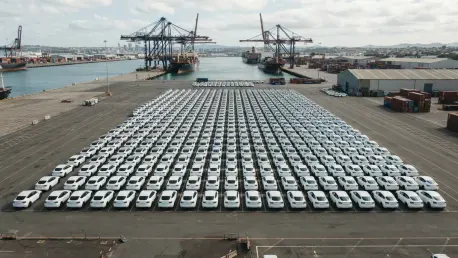
The narrative of growth is currently being written in the international arena, where manufacturers have achieved a historic milestone. In October, exports of new energy vehicles skyrocketed by approximately 140 percent year-on-year to reach 606,000 units, marking the first time in history that monthly outbound shipments have surpassed the critical 600,000-unit threshold. This remarkable international expansion now accounts for more than 31 percent of total sales, providing a vital buffer that effectively offsets the persistent weakness observed in the local market. Both battery electric vehicles and plug-in hybrid models have witnessed triple-digit growth in these foreign markets, signaling a robust global appetite for the advanced automotive technology coming out of the region. This trend highlights a successful pivot toward global trade as a primary survival strategy for firms facing a saturated and increasingly competitive domestic environment where margins are very thin.
Analyzing the technical preferences of the market reveals a clear leaning toward pure electric solutions over hybrid alternatives. Battery electric vehicles remained the undisputed dominant force in the industry throughout October, with sales hitting a record 1.353 million units, representing a substantial 22 percent increase compared to the same period in the previous year. This surge in pure electric adoption suggests that consumer confidence in charging infrastructure and range capabilities has reached a tipping point. In contrast, plug-in hybrid electric vehicles experienced a slight year-on-year decline of approximately 3 percent, suggesting that while they once served as a bridge technology, the market is now moving decisively toward full electrification. The cumulative performance for the first ten months of 2026 reinforces this trend, with total sales reaching 14.41 million units, fueled by a 129 percent surge in exports that compensated for a 10.3 percent domestic lag.
Navigating the Supply-Demand Gap: Market Stabilization Strategies
Despite the record-breaking headline figures, the domestic landscape presents a much more challenging outlook for manufacturers and retailers alike. Local sales of new energy vehicles fell by 8.6 percent year-on-year in October, dropping to 1.334 million units and marking the eleventh consecutive month of annual declines. This contraction is a direct reflection of broader economic pressures that have dampened consumer spending and fostered a more cautious approach to big-ticket purchases. Nevertheless, within this shrinking pool of buyers, electric models are continuing to capture a larger portion of the available market share. They now account for a staggering 70.4 percent of the passenger vehicle segment, indicating that traditional internal combustion engine vehicles are losing relevance at a much faster rate than their electric counterparts. The transition is inevitable, but the pace is being dictated by external economic factors rather than a lack of product appeal.
The recent data provided by the industry association demonstrated that the automotive sector reached a critical crossroads where global success and domestic stagnation collided. To ensure long-term stability and sustainable growth, industry leaders recognized the urgent need for coordinated interventions that could bolster consumer confidence. Moving forward, the focus shifted toward implementing targeted financial incentives and improving the economic outlook to stabilize expectations within the internal market. Analysts suggested that manufacturers needed to diversify their export destinations even further to mitigate risks associated with potential trade barriers or shifting global regulations. Furthermore, the stabilization of the supply-demand gap required a more disciplined approach to capacity expansion and an emphasis on high-margin models. By addressing the underlying economic hurdles, the industry aimed to create a more balanced ecosystem where domestic strength could once again complement record performance.