
A significant breakthrough from Porsche Engineering is set to redefine electric vehicle efficiency by addressing a persistent energy drain hidden deep within the powertrain, promising a substantial increase in driving range through an advanced software solution. The innovation centers on an AI-driven control system for the vehicle’s inverter, a component critical for powering the electric motor. By intelligently managing the inverter’s operation, this system dramatically reduces energy losses that have long been an accepted limitation of EV technology. This development signals a pivotal shift, moving beyond the industry’s focus on larger batteries to unlock performance gains through sophisticated code, leading to more compact, durable, and longer-range electric vehicles for the future. The core finding is a potential reduction in key energy losses by up to 95 percent, a figure that could have a profound impact on the next generation of electric cars.
The Core Challenge of Powertrain Inefficiency
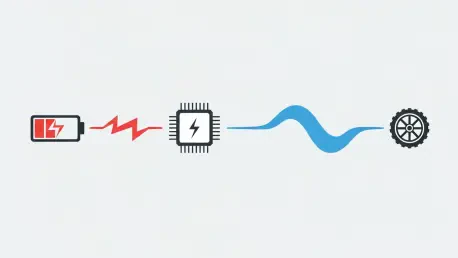
At the heart of every electric vehicle’s powertrain, the inverter performs the essential task of converting direct current (DC) from the battery into the alternating current (AC) that drives the electric motor, but this process is inherently inefficient. Within the inverter’s power transistors, energy is lost in two primary ways. The first, known as line losses, is a physical characteristic of the components themselves; even when fully active, their residual resistance generates waste heat. The second, and far more significant, category is switching losses. These occur in the infinitesimally brief moments when transistors transition between their “On” and “Off” states. Traditional inverter designs employ a technique called “hard switching,” where this change happens abruptly. During that transition, a brief overlap of high voltage and high current creates a substantial spike in power loss, dissipating valuable energy as heat. While small for each individual switch, these losses become a major drain on the battery when multiplied by the thousands of switches that occur every second.
This operational reality creates a fundamental engineering dilemma that has constrained EV design for years. To achieve smooth and responsive motor control, a high switching frequency is desirable, as it produces a cleaner AC waveform and improves performance. However, every increase in frequency multiplies the number of switching events, which in turn amplifies the total energy lost to heat. This direct trade-off forces designers to choose between optimal motor performance and maximum energy efficiency, with one invariably compromising the other. This inherent limitation of hard switching has been a persistent bottleneck, directly impacting not only the vehicle’s maximum achievable range but also influencing the size and complexity of the cooling systems required to manage the excess heat generated by the inverter. Overcoming this challenge has required a fundamental rethinking of how the inverter’s power electronics are controlled, moving beyond static rules to a more dynamic and intelligent approach.
An Intelligent Solution Through AI Powered Soft Switching
To dismantle this long-standing trade-off, Porsche Engineering has pioneered an intelligent system based on “soft switching.” In contrast to the abrupt nature of hard switching, this methodology precisely times the transistor’s transition to occur when either the voltage across it or the current flowing through it is virtually zero. By minimizing the product of voltage and current during the switch, power loss is drastically reduced. The development team focused specifically on a technique called Zero Voltage Switching (ZVS), which has proven to be exceptionally effective with the advanced silicon-carbide (SiC) and gallium-nitride (GaN) transistors used in modern EVs. Furthermore, ZVS performs better at the high frequencies needed for superior motor control, generates less disruptive electromagnetic interference (EMI), and is naturally better suited for managing the inductive loads presented by electric motors. To create the necessary conditions for ZVS, a small auxiliary circuit is added, but the true innovation lies not in the hardware but in the intelligence that governs it.
The primary obstacle to implementing soft switching in vehicles has always been the chaotic and unpredictable nature of real-world driving. An EV’s powertrain operates under constantly fluctuating conditions of torque, speed, and temperature, making it nearly impossible for a conventional, rule-based algorithm to consistently find the optimal switching moment. Porsche Engineering’s solution is a sophisticated, pre-trained AI algorithm that functions as the inverter’s central control unit. This AI processes dozens of live data points from vehicle sensors in real-time, analyzing the information to accurately predict the vehicle’s immediate future state. Based on this prediction, it calculates the precise timing to actuate the auxiliary circuit and the main power transistors, achieving “full soft switching” across the entire spectrum of driving conditions—a feat previously considered impractical. The development team is exploring both Recursive Neural Networks (RNNs) for their high predictive accuracy and Reinforcement Learning (RL) for its rapid calculation speed to meet the system’s demanding real-time requirements.
Transformative Benefits and the Path to Market
The tangible outcomes of this AI-driven approach are profound and extend far beyond a simple boost in efficiency. The most striking result is the reduction of switching losses by a remarkable 70 to 95 percent. This significant energy saving translates directly into a more efficient powertrain, which is projected to increase an electric vehicle’s overall range by a “high single-digit percentage.” In a market where every mile of range is a critical competitive advantage, this represents a substantial leap forward. Moreover, the benefits cascade throughout the vehicle’s architecture. By converting far less energy into waste heat, the system drastically reduces the thermal load on the inverter. This lessens the burden on the vehicle’s cooling system, paving the way for smaller, lighter, and less complex cooling components, which in turn contributes to overall weight reduction and further efficiency gains.
This new technology created a ripple effect of system-level improvements that promised to reshape EV design. The reduction in thermal waste, combined with the potential elimination of certain filter components required in hard-switched systems, was projected to decrease the inverter’s total volume by 20 to 50 percent, freeing up valuable space for designers. In addition to these physical benefits, the “gentle” nature of soft switching alleviated the high stress placed on power transistors by hard switching, thereby extending their service life and enhancing the long-term reliability of these critical components. Porsche Engineering developed this technology as a complete software solution intended for automotive original equipment manufacturers (OEMs) and suppliers. The AI algorithm was delivered as a software library, a “plug-in” that could be integrated into existing control units with only minor, low-cost hardware modifications. This software-centric deployment strategy made it a highly accessible and cost-effective upgrade, ideally suited for introduction during a planned model update or the development of a new vehicle platform, heralding a new era of software-defined vehicle efficiency.