
With a deep background in energy management and grid security, Christopher Hailstone is uniquely positioned to analyze Morocco’s ambitious national strategy. His expertise provides a critical lens through which to view the country’s massive infrastructure investments, which are designed not just to move goods, but to reshape its entire economic and energy landscape. This conversation explores how Morocco is engineering its future by building on the success of Tanger Med, leveraging its strategic geography with new deepwater ports, and pioneering an integrated approach to trade, industry, and the green energy transition. We delve into the specifics of the Nador West Med and Dakhla projects, examining how they will serve as catalysts for industrial growth, energy independence, and regional influence.
The Nador West Med port is planned to have a 5,000-hectare industrial zone, surpassing Tanger Med. What specific steps are being taken to attract investors to this massive space, and how will the new LNG terminal directly support these industries from its 2026 opening?
The strategy for Nador West Med is a masterclass in integrated development, learning directly from the Tanger Med playbook. To attract investors to such a vast area—starting with 800 hectares and scaling to 5,000—you can’t just offer empty land. You have to offer a full-service industrial ecosystem. The cornerstone of this offering is energy security. The LNG terminal, a floating storage and regasification unit, is not an afterthought; it’s the central pillar of the value proposition. When it comes online in 2026, it will provide a stable, cleaner, and more predictable energy source than coal, which is critical for heavy industry. This facility will be directly linked via a new pipeline to the industrial hubs, essentially creating a “plug-and-play” energy solution for any manufacturer looking to set up shop, which significantly de-risks their investment.
You mentioned the new $1 billion Dakhla port will be Morocco’s deepest at 23 meters to serve Sahel nations. Can you walk us through the logistical plan to connect these landlocked countries to the port and detail how the surrounding industrial and agricultural zones will be developed by 2028?
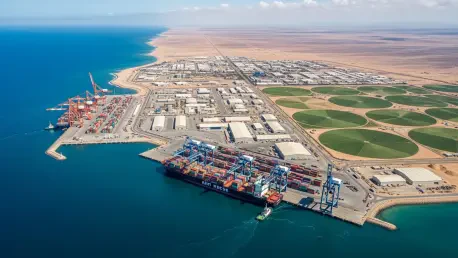
The Dakhla project is fundamentally about transforming regional supply chains. Its 23-meter depth is a game-changer, allowing it to accommodate the largest vessels that transport raw materials. The logistical plan isn’t just about building roads into the interior; it’s about making Dakhla the destination for value-add processing. Rather than simply trans-shipping raw materials from the Sahel, the vision is to process them right there in the 1,600-hectare industrial zone. This creates an economic magnet. Surrounding this industrial core will be a vast 5,200-hectare agricultural zone, all irrigated by desalinated water. This creates incredible synergy—a self-sufficient economic hub where food, industry, and global trade converge, all set to be operational by 2028.
The goal is to replicate the success of Tanger Med, which hosts 1,400 firms. What key lessons learned from Tanger Med’s development are you applying to the Nador and Dakhla projects to ensure they also become major economic hubs, particularly for attracting new high-value sectors?
The most crucial lesson from Tanger Med is that a port’s success is defined by the economic ecosystem built around it, not just its container throughput. Tanger Med thrived because it integrated world-class port infrastructure with dedicated industrial zones for sectors like automotive and aeronautics, attracting 1,400 firms. For Nador and Dakhla, we are applying this “port-city” concept from day one. This means co-developing the industrial zones, the energy infrastructure, and the logistics networks simultaneously. We’re not just building quays; we’re building platforms for the next generation of industry. The specific inclusion of quays dedicated to green hydrogen exports shows that we’re not just replicating past success but are proactively building infrastructure for the high-value energy sectors of the future.
Both the Nador and Dakhla ports will feature quays dedicated to green hydrogen. Could you elaborate on the development timeline for this export infrastructure and describe the types of partnerships, like the one considered for Tan-Tan, needed to build out this new energy supply chain?
Building dedicated green hydrogen infrastructure into the port designs from the outset is an incredibly forward-thinking move. It signals to the global market that Morocco is serious about becoming a major player in the clean energy transition. The development timeline for these facilities is directly linked to the build-out of the country’s renewable energy production. The partnership model is absolutely essential here. As we’re seeing with the potential port in Tan-Tan, the government is looking to co-invest directly with green hydrogen developers. This collaborative approach means the port’s size and specifications are tailored precisely to the needs of the industry, while investors get the security of dedicated export infrastructure. This creates a symbiotic relationship that accelerates the entire supply chain, from production to liquefaction, storage, and finally, export to global markets.
With Nador West Med hosting Morocco’s first LNG terminal to reduce coal dependence, could you provide some metrics on the planned capacity of this floating unit and explain the step-by-step process of integrating it with the national pipeline network to fuel the country’s industrial hubs?
While specific capacity metrics are part of the final procurement, the choice of a Floating Storage and Regasification Unit, or FSRU, is itself a strategic metric of agility. An FSRU is a faster and more flexible solution than a traditional onshore terminal. The integration process is already underway and is a two-part engineering feat. First is the marine work at Nador West Med to create the mooring and connection point for the FSRU. Simultaneously, on land, a new pipeline is being constructed to connect the port directly to Morocco’s main industrial corridor in the northwest. When the FSRU is commissioned in 2026, it will be a near-seamless integration. The floating unit will receive LNG shipments, convert the liquid back into gas onboard, and inject it directly into this new pipeline, immediately providing a much-needed alternative to coal for the country’s key industries.
What is your forecast for Morocco’s role as a global trade and energy nexus?
My forecast is exceptionally optimistic. We are witnessing a brilliantly orchestrated, long-term strategy that leverages Morocco’s unique geographic position at the crossroads of Africa, Europe, and the Americas. By developing these state-of-the-art deepwater ports and integrating them with next-generation energy and industrial infrastructure, Morocco is not just building gateways for trade; it is positioning itself to become an indispensable hub for global supply chains and a key exporter in the coming green energy economy. These projects will redefine the country’s economic gravity, pulling in investment and creating a powerful engine for regional prosperity.