
Setting the Stage for a Geopolitical Energy Clash
Imagine a world where the global oil market teeters on the edge of disruption, not from supply shortages, but from a calculated economic standoff. The Group of Seven (G7) nations, together with the European Union, have rolled out a daring plan to impose a comprehensive maritime services ban on Russian oil transportation, aiming to cripple the financial backbone of Russia’s military endeavors in Ukraine. With Russia accounting for roughly 9% of global oil supply, this move isn’t just a political statement—it’s a seismic shift with potential to rattle energy markets worldwide. This analysis dives deep into the market dynamics at play, exploring how this sanction strategy could reshape oil trade, influence price volatility, and test the resilience of both Western economies and Russia’s export machine. The stakes couldn’t be higher as energy security and geopolitical power hang in the balance.
Unpacking the Market Landscape and Sanction Evolution
To grasp the gravity of this ban, a look at the historical interplay between Western sanctions and Russia’s oil dominance is essential. Since the Ukraine conflict intensified, the G7 has wielded economic tools like the price cap mechanism, launched a few years ago, to limit Russia’s oil profits by restricting Western shipping and insurance to crude sold below a fixed price—currently pegged at $47.60 per barrel. Yet, Russia, pumping out 9.3 million barrels per day (bpd) and exporting over half via seaborne routes, has dodged these constraints with relative ease. This context of adaptation and resilience frames the G7’s pivot to a full maritime ban, set to potentially roll out by early next year. The shift signals an intent to disrupt not just pricing but the very infrastructure of Russia’s oil trade, which remains a linchpin of its federal budget.
Moreover, Russia’s role as a heavyweight in the energy sector cannot be understated. Its exports, particularly the 3.5 million bpd shipped by sea, feed major markets and influence global supply chains. Past sanctions have exposed both the vulnerabilities and the tenacity of this market giant, as Moscow rerouted trade through alternative channels. Understanding these patterns is critical because they highlight why simply tightening the screws on compliant tankers might not yield the desired chokehold. Instead, the market may face unintended ripples, from price spikes to supply gaps, if the ban’s reach falls short of its ambition.
Diving into Market Trends and Projections
Targeting Russia’s Oil Lifeline: A Strategic Gamble
The G7’s latest sanction tactic marks a significant escalation, moving beyond price caps to a blanket ban on maritime services for Russian oil. The goal is clear: sever access to Western-affiliated tankers and slash the revenue stream funding Russia’s war chest. Recent data suggests that only about 38% of Russian crude exports currently rely on G7-compliant vessels, indicating a limited but notable target for disruption. If successful, this could dent a substantial portion of the 3.5 million bpd seaborne trade. However, the risk of collateral damage looms large—global oil prices, already sensitive to geopolitical tensions, could surge if supply tightens, hitting Western consumers hard amid ongoing inflation pressures.
Beyond immediate impacts, the ban’s intent is to reshape long-term market behavior. By choking off access to compliant shipping, the G7 hopes to force Russia into costlier or riskier alternatives, potentially eroding its profit margins. Yet, the challenge lies in the ban’s narrow scope. With a significant chunk of Russia’s trade already outside G7 control, the market may absorb this shock without the dramatic collapse in Russian exports that policymakers envision. This discrepancy between ambition and reality underscores a critical uncertainty in forecasting the ban’s true economic punch.
Shadow Fleets and Market Evasion: Russia’s Counterplay
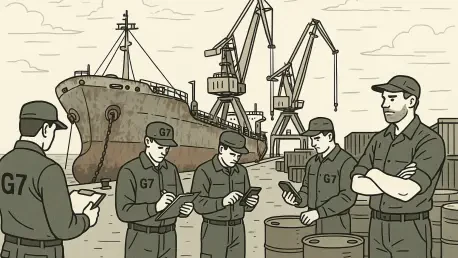
A pivotal trend complicating this sanction is Russia’s adept use of a shadow fleet—aging, non-compliant tankers sourced from obscure markets—to sustain its oil exports. These vessels have become a lifeline, enabling Moscow to bypass Western restrictions with startling effectiveness. Key buyers like China, India, and Turkey, who snap up over 90% of Russia’s seaborne crude, show little sign of curbing purchases, especially if discounted prices offset the risks of dealing with shadowy shipping networks. Intriguingly, scrapping the price cap alongside this ban might even streamline transactions for these nations, reducing the financial hit Russia takes per barrel.
This persistent demand from major markets reveals a deeper market dynamic: the global appetite for cheap oil often trumps geopolitical alignments. As long as discounts hold, Russia’s shadow fleet could keep trade flowing, albeit with higher operational costs and risks like accidents or regulatory scrutiny. For market watchers, this suggests that the ban might push up logistical expenses for Russia without fully halting exports, creating a fragmented but still functional trade network. The G7’s opportunity lies in targeting these shadow operations with tighter oversight, though achieving that without global consensus remains a tall order.
Enforcement Bottlenecks and Market Volatility Risks
Drilling deeper into market implications, enforcement emerges as the linchpin that could make or break this sanction’s impact on oil flows. The ban’s success depends on rigorous vessel inspections and detentions, particularly by coastal states in strategic hubs like the Baltic and Nordic regions. Without ironclad commitment, non-compliant shipping will likely persist, diluting the ban’s effect. A pressing concern for markets is the potential backlash—rising energy costs or retaliatory cuts in Russian supply could exacerbate volatility, especially if Western nations hesitate to absorb the economic pain of stricter enforcement.
Additionally, the enforcement challenge ties directly to price stability. If the ban disrupts even a fraction of Russia’s compliant trade without curbing shadow fleet operations, the resulting supply uncertainty could jolt benchmark prices upward. This scenario poses a dilemma for G7 economies already grappling with inflationary pressures and energy transition goals. Markets might see short-term turbulence as traders adjust to perceived risks, even if actual supply disruptions remain minimal. The takeaway for investors is a need to brace for fluctuating conditions, with an eye on how enforcement rigor unfolds in the coming months.
Reflecting on Market Insights and Strategic Paths Forward
Looking back, this analysis unpacked a bold G7 strategy to hobble Russia’s oil revenue through a maritime services ban, set against a backdrop of complex market dynamics. The exploration revealed a mixed picture: while targeting tanker access aimed to strike at a critical revenue source, Russia’s shadow fleet and robust demand from non-Western buyers diluted the potential impact. Enforcement hurdles stood out as a glaring weak spot, with the risk of price volatility casting a shadow over global energy stability. Geopolitical maneuvers further muddied the waters, as Russia’s alliances with key markets like China and India countered Western pressure.
For energy firms, the path ahead demanded diversification of supply chains to mitigate reliance on Russian crude, alongside hedging strategies to weather price swings. Policymakers, on the other hand, faced the task of forging broader international coalitions to tighten enforcement and investing in alternative energy to lessen market dependence on volatile regions. For consumers and professionals, staying attuned to sanction developments and preparing for potential cost hikes became prudent steps. Ultimately, the saga of this ban underscored a high-stakes economic battle, where strategic foresight and adaptability emerged as vital tools for navigating an uncertain energy landscape.