
Beyond the Battlefield The Energy War Against Ukraine
As the conflict evolves, a grim reality has set in far from the traditional frontlines, where the battle is not for territory but for the very energy that powers a nation’s survival. Russia’s systematic campaign to dismantle Ukraine’s energy infrastructure has emerged as a critical second front, transforming power plants and pipelines into strategic targets. This energy war targets the foundation of modern life, directly impacting national security, the well-being of millions of civilians, and the stability of the entire economy.
The relentless nature of these attacks raises urgent questions about the grid’s capacity to endure. Understanding the strategic objectives behind this assault, from disrupting gas transit to causing widespread blackouts, is essential. The core of the issue lies in whether Ukrainian resilience and frantic repair efforts can outpace the deliberate, calculated destruction, and what the long-term consequences of this brutal energy war will be for the nation’s future.
Anatomy of a Coordinated Assault
The New Frontline Targeting Gas Transit and LNG Lifelines
Recent escalations have seen Russia expand its targets to include Ukraine’s vital gas transit systems, a move that signals a new phase in the energy war. A drone strike in the Odesa region specifically targeted infrastructure connected to the Transbalkan pipeline, a crucial conduit for U.S. liquefied natural gas (LNG) arriving from Greece. This attack is widely interpreted as a direct challenge to Ukraine’s efforts to diversify its energy sources and reduce its historical dependence on Russian supplies.
Interestingly, data from Ukraine’s gas transit operator showed that planned transit volumes remained stable immediately following the attack. This apparent resilience could suggest a degree of system redundancy or that the damage was not critical enough to halt flows. However, it also raises the question of whether this was merely a temporary reprieve, with the strike serving as a strategic warning of the vulnerability of Ukraine’s energy lifelines.
Living in the Dark The Human Cost of a Strained Electrical Grid
While gas infrastructure faces new threats, the electrical grid has borne the brunt of a sustained and punishing assault, leading to cascading failures with a severe human cost. For weeks, the country has endured rolling blackouts and emergency power cuts, a situation officials describe as exceptionally “complicated.” In the capital city of Kyiv, the strain became so acute that at certain points, half of all residents were left simultaneously without electricity, disrupting everything from home life to essential services.
This constant uncertainty imposes a profound psychological and logistical toll on the civilian population. The struggle to perform daily tasks without reliable power, heat, or water has become a grim reality. The worsening situation underscores how the war on the grid is also a war on the morale and endurance of the Ukrainian people, turning basic modern conveniences into unpredictable luxuries.
The Unending Cycle of Damage and Desperate Repairs
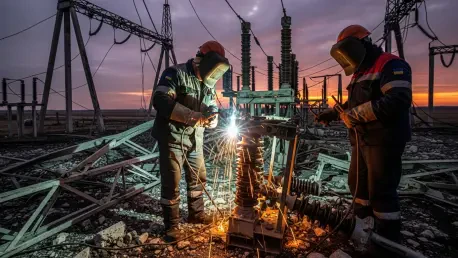
For Ukrainian engineers and utility workers, the conflict has become an overwhelming operational challenge characterized by a demoralizing cycle of destruction and repair. Reports consistently highlight that new Russian strikes often negate the painstaking work completed to fix previous damage, creating a scenario where progress is constantly erased. Crews work under the constant threat of bombardment to restore a system that is being systematically dismantled.
This unending loop of damage raises serious doubts about the long-term viability of simply patching the grid together. Sourcing specialized components for Soviet-era infrastructure is immensely difficult, and the sheer scale of the destruction is testing the limits of the country’s restoration capacity. The critical question is whether a tipping point exists where the pace of attacks definitively outstrips the ability to repair, leading to a systemic and potentially irreversible collapse.
An Economy on Life Support The High Price of Keeping the Lights On
The economic fallout from this energy assault has been staggering, crippling Ukraine’s domestic production and forcing a reliance on costly alternatives. The sustained attacks have deprived the nation of more than half of its domestic gas production capacity, a devastating blow to its energy independence. This loss has transformed Ukraine from a country with significant domestic resources into one forced to import vast quantities of energy to survive.
To compensate for the shortfall and stabilize the grid, the government has been compelled to implement drastic countermeasures. These include nationwide power rationing and authorizing over four billion cubic meters of additional gas imports for a single winter season. While necessary for immediate survival, this reliance on expensive foreign energy places an immense strain on an already war-torn economy, making it an unsustainable long-term strategy.
Forging Resilience Amidst the Rubble
A synthesis of reports confirms that Russia’s attacks represented a strategic effort to induce systemic failure across Ukraine’s energy sector. The campaign tested Ukrainian resilience to its absolute limit, while the economic cost of lost production and emergency imports became monumental. Despite the immense pressure, the grid’s ability to avoid a complete, nationwide collapse pointed to a remarkable, albeit strained, capacity for endurance.
In response, a consensus emerged around critical strategies to mitigate the crisis. These included accelerating the decentralization of power generation to create a less target-rich environment, hardening key substations and other critical infrastructure against attack, and deepening integration with European energy networks to ensure emergency supply. International support also shifted from purely financial aid toward providing specialized equipment, technical expertise, and, most critically, advanced air defense systems to protect what remains of the grid.
The Long Shadow of the Energy War
The concerted assault on Ukraine’s power grid became a defining element of the conflict, with consequences that extended far beyond immediate blackouts. This campaign highlighted the extreme vulnerability of centralized energy systems in modern warfare and forced a radical rethinking of national security priorities. The battle was not just about military gains but about a nation’s fundamental ability to function.
Ultimately, the struggle underscored the immense long-term challenges awaiting Ukraine’s reconstruction. The need to rebuild its energy infrastructure from the ground up, with a focus on security and independence, was paramount. This energy war served as a stark illustration of a new paradigm of conflict, where victory could be determined not only by territory captured but by a nation’s simple, desperate ability to keep its lights on.